
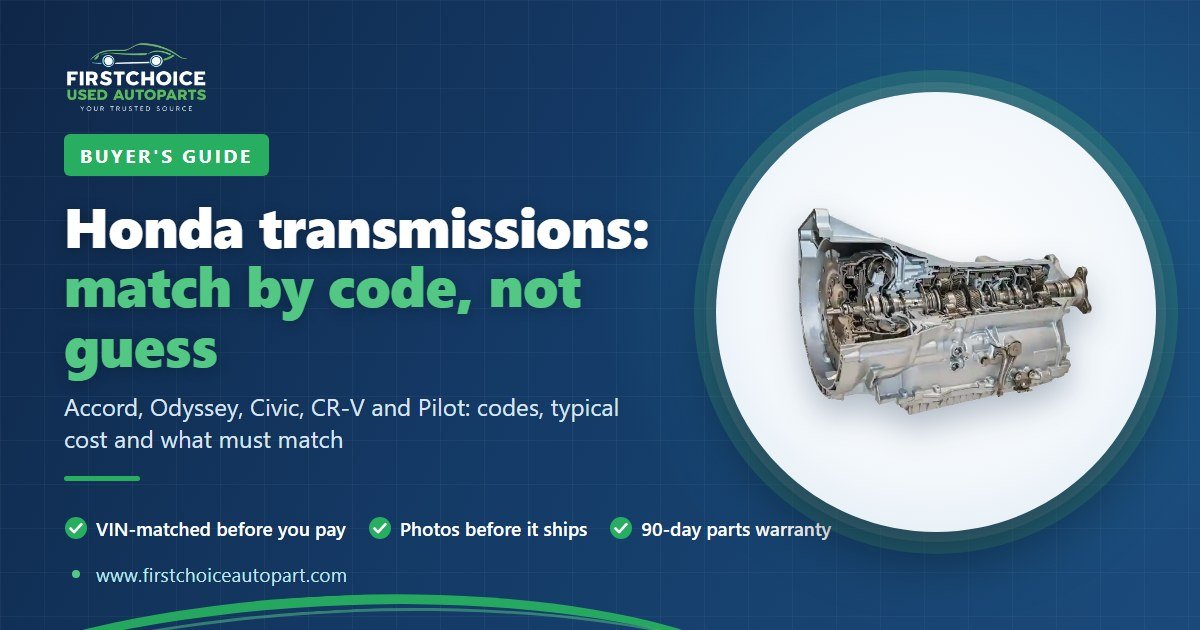
Quick Answer: Match a used Honda transmission by the model code stamped on the case and by VIN, not by model name. Honda used 4 and 5-speed automatics, 6-speeds, CVTs and 9 and 10-speed units under the same nameplates, sometimes by trim within one year. Engine, drive type and generation must match too. A used unit typically runs about $400 to $2,500 before labor.
Your Accord, Odyssey, Civic, CR-V or Pilot slips between gears, flares on a shift or bangs into drive, and the shop says the automatic is worn out. A used Honda transmission is often the sensible repair on a car this age, but ordering one by model and year is how buyers end up with a unit that will not bolt in or will not shift right.
Honda automatics from roughly 1999 to 2004 earned a rough reputation, but the bigger risk today is fitment: Honda’s later 5-speeds, 6-speeds, CVTs and 9 and 10-speed units each fit a narrow range of engines, drive types and years. This guide is for Honda owners and their shops. It shows how to find your code, rule out cheaper fixes, price the job and check the photos before you approve a VIN-matched used transmission.
Key facts
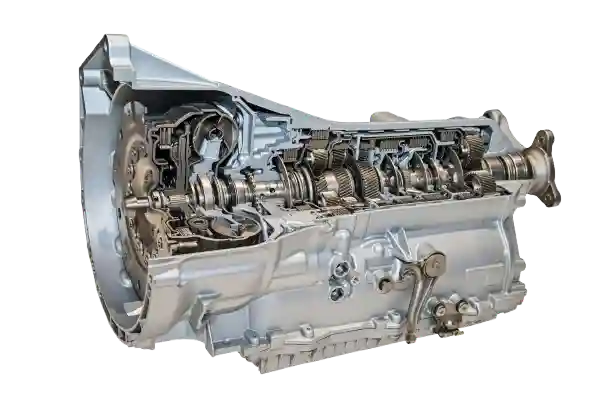
- Honda 4, 5 and 6-speed automatic transmissions use a parallel shaft design with a separate clutch pack for each gear, so a slip in one gear often points to that gear’s clutch.
- Honda stamps a short transmission model code on the case next to the serial number. A used Honda transmission should match that code and the VIN, not just the model and year.
- Honda used different transmissions by trim in some years: 2011 to 2013 Odyssey Touring models had a 6-speed automatic while other Odyssey trims kept a 5-speed.
- A used Honda automatic transmission or CVT typically costs about $400 to $2,500 for the unit, plus roughly 5 to 9 hours of installation labor, depending on type and model.
- FirstChoice matches a used transmission to the VIN before payment, sends photos of the actual unit for approval and covers it with a 90-day parts warranty (labor not covered).
Why Do Honda Transmissions Have a Reputation, and Does Yours Share It?
The reputation belongs mostly to Honda and Acura automatics built around 1999 to 2004, especially V6 units in the Odyssey, Accord and Pilot, plus the 4-speed in the 2001 to 2005 Civic. Many wore out early from clutch wear and heat. Honda responded with a recall on some models and extended warranties on others, all long expired.
Honda builds its 4, 5 and 6-speed automatics differently from most brands. Instead of planetary gear sets, they use parallel shafts with a separate gear pair and clutch pack for each gear (the newer 9 and 10-speeds are planetary). That is why a worn Honda often slips in one gear only, and why debris from that one clutch can spread and hurt the rest.
Here is how the common symptoms usually read:
- Flare or slip on one shift: the engine revs up between gears, often on the 2-3 or 3-4 shift. It usually means the clutch for the next gear is worn or not getting full pressure.
- Harsh or delayed engagement: a bang into drive or reverse, or a pause before the car moves. Wrong fluid, a sticking solenoid or internal wear can cause it.
- Flashing D or D4 light: on many older Hondas the gear indicator flashes when a transmission fault code is stored. Read the code first.
- Shudder at light throttle: a rumble strip feel at steady speed points to the torque converter lockup, or to judder in a CVT.
- CVT whine or hesitation: a whine that rises with speed or a lag from a stop, on Civic, CR-V and 2013 and later 4-cylinder Accord models.
Which Transmission Does Your Honda Have?
Your Honda has the transmission whose model code is stamped on the case and returned by a VIN decode, and that code changes with the engine, drive type, generation and sometimes trim. The table shows the common gas units. Treat the years as approximate and confirm by code.
| Model | Common automatic units (approximate, confirm by code) |
|---|---|
| Accord | 1998-2002: 4-speed; 2003-2012: 5-speed (4-cylinder and V6 units differ); 2013-2017: CVT on the 4-cylinder, 6-speed on the V6; 2018-2022: CVT on the 1.5 turbo, 10-speed on the 2.0 turbo |
| Odyssey | 1999-2001: 4-speed; 2002-2010: 5-speed; 2011-2013: 6-speed on Touring trims, 5-speed on the rest; 2014-2017: 6-speed; 2018-2019: 9-speed on most trims, 10-speed on top trims; 2020 and later: 10-speed |
| Civic | 2001-2005: 4-speed (some HX models had an early CVT); 2006-2013: 5-speed; 2014-2015 sedan and coupe: CVT; 2016 and later: CVT on most automatic models |
| CR-V | 2002-2004: 4-speed; 2005-2014: 5-speed; 2015 and later: CVT |
| Pilot | 2003-2015: 5-speed; 2016-2018: 6-speed on most trims, 9-speed on Touring and Elite; 2019-2022: 9-speed; 2023 and later: 10-speed |
Watch out: Recent hybrid Accord and CR-V models use a hybrid drive unit with electric motors inside, not a regular CVT. It does not swap with the gas model’s transmission, so tell the parts specialist it is a hybrid from the start.
Is It the Transmission, or Something Cheaper to Fix?
It is the transmission when the fluid is right, the codes point inside the unit and the slip or harsh shift stays after the simple fixes. A good shop rules out these first:
- Fluid level and type: Honda units are sensitive to fluid. Most 4, 5 and 6-speed automatics take Honda ATF DW-1 and most newer CVTs take Honda HCF-2. A generic fluid can cause harsh shifts or shudder.
- Codes and live data: a gear ratio code in the P0730 to P0735 range or a torque converter clutch code points inside the unit. On many Honda automatics the shift solenoids and clutch pressure switches bolt to the outside of the case, so a single solenoid or switch code may be a smaller repair.
- Software updates: Honda has released updates for shift quality and low speed judder on some CVT, 9-speed and 10-speed models. Ask a Honda dealer whether an update applies to your VIN.
- Mounts and engine look-alikes: worn engine or transmission mounts make a shift feel like a bang, and an engine misfire can feel like converter shudder. On V6 models with cylinder deactivation, misfire and mount problems are common enough to check first.
If the drain plug magnet and fluid hold heavy clutch material and metal, or the car has lost a gear with correct fluid, the unit is usually done. Have the shop flush the cooler and lines with the swap, because debris left there can damage the replacement. If the engine turns out to be the real failure, look at VIN-matched used engines instead.
What Does a Used Honda Transmission Cost?
A used Honda transmission typically costs about $400 to $2,500 for the unit, and the type is the biggest factor. The 4 and 5-speed automatics came out of a huge number of cars and are plentiful, while the 9 and 10-speed units have fewer donors. These are typical US market ranges, and the exact price depends on your code, drive type and the donor’s mileage.
| Item | Typical range | Notes |
|---|---|---|
| Used 4 or 5-speed automatic | About $400-$1,200 | Older Accord, Civic, CR-V, Odyssey and Pilot; V6 and AWD units cost more |
| Used 6-speed automatic | About $700-$1,600 | Odyssey, V6 Accord and some 2016-2018 Pilots |
| Used CVT | About $700-$1,800 | Civic, CR-V and 4-cylinder Accord; whole unit replacement is the usual repair |
| Used 9 or 10-speed automatic | About $1,000-$2,500 | Newer Pilot, Odyssey and Accord 2.0 turbo; fewer donors |
| Removal and installation labor | Often 5-9 hours | V6 minivans and AWD models often take longer; your shop’s rate applies |
| Fluid, cooler flush, learning procedure | Varies by shop | Ask for these in the same estimate |
| Remanufactured unit | Often $2,500-$5,000 | For comparison only |
FirstChoice quotes used OEM transmissions at up to 70% less than a new dealer part, and the quote is free. On an older Odyssey or Accord, weigh the whole job against the car’s value; our repair or replace cost breakdown walks through the same math for an engine, and it applies to a transmission too.
What Must Match for a Used Honda Transmission to Fit?
A used Honda transmission fits when the model code, the engine, the drive type and the generation all match your car. Sharing a nameplate or a speed count is not enough.
| What must match | Why it matters |
|---|---|
| Transmission model code | The code stamped on the case identifies the exact unit, including gearing and internal parts |
| Engine | A 4-cylinder unit and a V6 unit differ in bellhousing, gearing and calibration, even in the same Accord year |
| Front drive or AWD | AWD CR-V and Pilot models use a transfer assembly at the transmission to drive the rear driveshaft; confirm whether it comes with the unit |
| Generation | Sensors, connectors, mounts and cooler fittings change between generations, for example 2003-2007 vs 2008-2012 Accord |
| Trim, in some years | 2011-2013 and 2018-2019 Odyssey and 2016-2018 Pilot used different transmissions by trim |
| Honda and Acura sharing | Some units are shared with Acura models or across the Pilot, Odyssey and Ridgeline, but only when the code matches |
The VIN is the fastest way to pin these down, as our guide to decoding your VIN for used parts explains. After the swap, your shop clears the old adaptive values and runs Honda’s transmission learning procedure with Honda’s diagnostic software or a capable scan tool.
What Should You Check in the Photos Before You Approve?
Check the code, the mounting points and every connection before you say yes. With FirstChoice, nothing ships until you approve photos of the actual transmission, so review them with your mechanic and look for:
- Code stamp: the model code on the case should match the code your parts specialist quoted.
- Bellhousing and mounting ears: no cracks, broken bolt bosses or chipped mount brackets.
- Axle openings: Honda front drive units are transaxles with the differential inside, so look for damaged axle seal bores or broken axle stubs.
- Solenoids, switches and connectors: unbroken connectors with clean pins and no snapped solenoid or pressure switch housings.
- Cooler fittings: not bent or cracked.
- Transfer assembly on AWD units: whether it is included, and that its output is undamaged.
- Case condition: no impact marks, weld repairs or oily grime hiding a leak.
More checks are in our guide to checking a used transmission before buying.
How Does Buying a Used Transmission From FirstChoice Work?
- Send your year, make, model and VIN, plus the transmission code if you have it.
- A parts specialist matches the transmission to your VIN before you pay and sends a free quote with the price, warranty term and shipping details.
- The supplier confirms the unit is available and in good condition, pulls it and photographs it.
- You approve the photos. Nothing ships until you do.
- Delivery target is within 5 business days of photo approval, and tracking is emailed within 2 days of shipment.
Transmissions ship by free LTL freight to a business address, such as your repair shop, in the 48 contiguous states, and carry a 90-day parts warranty (labor is not covered). FirstChoice does not install or program the unit, so line up your shop first. Start on the used transmissions for sale page, or call 1-888-383-2439 for 10% off phone orders, Monday to Friday, 9 AM to 6 PM EST.
Frequently Asked Questions
Which Honda transmissions have the worst reputation?
The automatics built around 1999 to 2004 in the Odyssey, V6 Accord and early Pilot, plus the 2001 to 2005 Civic 4-speed, drew the most complaints. Later units generally hold up better but still wear from heat and old or wrong fluid. Whatever the year, buy by code.
Can I put a 4-cylinder Accord transmission in a V6 Accord?
No. The 4-cylinder and V6 units have different bellhousings, gearing and calibration, even in the same model year, so the 4-cylinder unit will not bolt to the V6 or shift correctly. Match the engine, the model code and the generation instead.
Does a used Honda transmission need programming?
Usually it needs a learning procedure rather than full programming. Your shop clears the old adaptive values and runs Honda’s transmission learning steps with Honda diagnostic software or a capable scan tool, then road tests the car. On newer 9 and 10-speed models, ask whether a software update applies to your VIN.
Is a used Honda CVT worth buying?
Often, yes, when the car is otherwise solid. Few general shops rebuild Honda CVTs, so replacing the unit is the usual repair, and a used one costs far less than a new or remanufactured unit. Ask about software updates for judder, and fill with Honda HCF-2 or the fluid your manual lists.
What fluid does a Honda transmission use?
Most Honda 4, 5 and 6-speed automatics use Honda ATF DW-1, and most newer Honda CVTs use Honda HCF-2. The 9 and 10-speed units and older CVTs use other Honda fluids, so check the owner’s manual for your model. Wrong fluid can cause harsh shifts or judder, so confirm the spec with your shop.
Related reading:
Used Transmission Buyer’s Guide: Everything You Need to Know
How to Check a Used Transmission Before Buying: 7-Step Verification Guide
Used Toyota Transmission Guide: Camry, Corolla, RAV4, Tacoma
How to Read a Used Auto Parts Quote Before You Pay