
Quick Answer: Warm AC after a front-end hit usually means the condenser is leaking or crushed, because it sits ahead of the radiator and takes the impact first. Look for bent fins, an oily patch or a hiss. Have a shop confirm the leak before anyone recharges, then replace the condenser and the receiver-drier or accumulator, pull a vacuum and recharge. Recharging a leaking system can starve the compressor of oil.
Your car took a hit up front: a low-speed bump, a chunk of road debris or a deer. It still drives fine, but the AC that was cold last week now blows warm, either right away or a little warmer every day. The tempting fix is a recharge can from the parts store, and on a front-end hit that is often the most expensive choice you can make.
The AC condenser sits in front of the radiator and takes the hit first. A pinhole there lets fresh refrigerant, and the compressor oil it carries, leak back out while the compressor keeps working. This guide shows how to read the damage, what else the hit can explain, what the repair typically costs and how to match a used OEM AC condenser so the fix lasts.
Key facts
- On most cars and trucks the AC condenser sits in front of the radiator, so it is often the first AC part damaged by a front-end hit, deer strike or road debris.
- Recharging an AC system with a leaking condenser does not fix it: the refrigerant leaks out again, taking compressor oil with it, and the compressor can run short of lubrication.
- AC service procedures generally call for a new receiver-drier or accumulator when a leaking condenser is replaced, because the desiccant absorbs moisture while the system is open.
- A used AC condenser must match the year, model, engine, refrigerant type, line fittings and whether the receiver-drier is built into the condenser.
Why does a front-end hit make the AC blow warm?
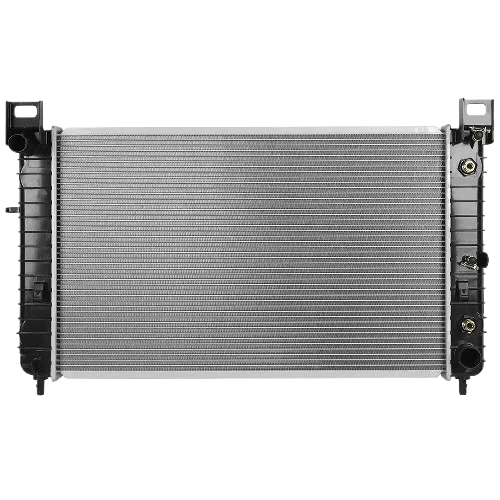
Because the condenser is usually the AC part closest to the bumper. It is a thin aluminum heat exchanger mounted ahead of the radiator, right behind the grille, so a stone or a bent bracket reaches it before the radiator. The refrigerant inside runs at far higher pressure than coolant, so even a small crack or puncture leaks.
Its job is to shed heat: hot, high-pressure refrigerant vapor from the compressor cools in the condenser and leaves as a liquid for the evaporator in the dash. A leak drops the charge, and crushed fins or a damaged fan keep it from shedding heat. Either way the vents blow warmer.
What are the signs of a damaged AC condenser?
The main AC condenser damage symptoms are warm air from the vents, an oily or dirty patch on the condenser face, and a compressor that will not engage or keeps clicking on and off. The size of the leak sets how fast the AC warms up.
- Warm air right after the hit: a puncture or cracked end tank let the charge out. With pressure that low, a pressure switch or sensor usually keeps the compressor from engaging (some clutchless compressors behave differently).
- Cold at first, warmer over days or weeks: a pinhole or a loosened line fitting is leaking slowly.
- Compressor clutch clicking on and off quickly: often a low charge.
- An oily, dirt-caked spot on the condenser face, an end tank or a fitting. Refrigerant leaks out with oil, and the oil traps road dust. If the system has dye, the spot glows under a UV light.
- Crushed or flattened fins over a wide area, or a condenser pushed back against the radiator.
- A hiss from the front of the car right after the hit, which is refrigerant escaping.
Look through the grille with a flashlight. A few bent fins are cosmetic if the tubes and tanks are intact, but an oily spot next to a dent usually marks a leak.
Is it the condenser, or did the hit damage something else?
Often it is the condenser, but the same hit can damage the cooling fan, an AC line, the radiator or front-end wiring, and those can make the AC blow warm too. Match what you notice to the likely cause before you approve parts.
| What you notice | Likely cause | What the shop checks |
|---|---|---|
| Warm right after the hit, compressor does not engage | Condenser or line punctured, charge gone | Gauge pressures, visible hole, oily spray pattern |
| AC slowly gets warmer over days | Pinhole in a tube, cracked tank or loose fitting | UV dye, electronic leak detector, nitrogen pressure test |
| Cold while driving, warm at idle | Fan damaged or unplugged, flattened fins, debris between cores | Fan operation, fin condition, high side pressure at idle |
| Warm AC and the temperature gauge climbing | Fan or radiator damaged too | Coolant level, radiator tanks and core, fan shroud |
| Full charge, no leak, compressor not engaging | Blown fuse, damaged connector or pressure sensor | Fuses, pressure sensor signal, clutch power and ground |
How a shop proves the condenser is leaking
A technician connects gauges first. Little or no static pressure with the engine off means the system is empty or close to it. To find the leak, the shop uses UV dye, an electronic leak detector, or fills the empty system with dry nitrogen and checks each joint with soapy water.
Ask for the leak location in writing, so you know whether you need a condenser alone or a line too. A hard hit can also damage the radiator, fan, latch support and bumper reinforcement; our guide to front-end parts to check after a deer hit covers the full list.
Safety: If the temperature gauge climbs or coolant drips, stop driving and have the radiator and cooling fan checked. A damaged fan can overheat the engine in traffic, not just the AC.
Why is recharging a leaking condenser a costly mistake?
Because the refrigerant leaks out again and takes the compressor’s oil with it. Much of that oil circulates through the system with the refrigerant and escapes at the leak, so each leak-down leaves less oil to lubricate the compressor.
An empty, punctured system also takes in air and moisture, which saturate the desiccant in the receiver-drier or accumulator and can react with the oil to form acids. Many recharge cans add stop-leak sealer, which will not seal a crushed tube and can clog the expansion valve or orifice tube.
The worst case is a healthy compressor that wears out after a few recharges. A failing compressor sheds metal, and modern flat-tube condensers are too fine to flush clean, so the job grows to a condenser, a compressor and a flush. A used OEM AC compressor is a fair fix then, but the bill climbs steeply; our used AC compressor buying guide covers that job.
Federal rules also prohibit knowingly venting refrigerant, and technicians who service car AC for pay must be EPA certified under Section 609 of the Clean Air Act.
The repair that lasts, in order
- Confirm the leak, and check the fan, radiator and AC lines for damage from the same hit.
- Recover any refrigerant left in the system.
- Replace the condenser and the receiver-drier or accumulator, plus the orifice tube if the system has one, with new O-rings.
- Add the oil type and amount the service information calls for.
- Pull a vacuum, confirm it holds, then recharge by weight to the under-hood label spec.
- Check vent temperature, pressures and compressor noise.
How much does AC condenser replacement cost?
A condenser replacement with a new drier and a recharge typically runs about $400 to $1,200 at an independent shop, more with a dealer condenser or on R-1234yf systems. These are typical US market ranges, and the exact price depends on the vehicle.
| Item | Typical cost (approximate) | What drives it |
|---|---|---|
| Used OEM AC condenser | $60-$250 | Vehicle, size, built-in drier |
| New aftermarket condenser | $50-$250 | Brand; fit and finish vary |
| New OEM condenser from the dealer | $200-$700, more on some luxury models | Make and model |
| Receiver-drier, desiccant bag or accumulator | $15-$80 | Separate unit or cartridge in the condenser |
| Labor to replace the condenser | About 1 to 3 hours, more on some models | Whether the bumper cover or support must come off |
| Evacuate and recharge, R-134a | About $150-$300 | Shop rate, charge size |
| Evacuate and recharge, R-1234yf | About $250-$600 or more | Refrigerant cost, charge size |
The under-hood label names your refrigerant. Most newer vehicles use R-1234yf, which costs far more per pound than R-134a. The condenser is the easiest place to save: FirstChoice quotes a used AC condenser at up to 70% less than a new dealer part, and the quote is free. If the compressor is damaged too, compare AC compressor cost: new vs used vs rebuilt.
What must match for a used AC condenser to fit?
Condensers that look alike can differ in fittings, drier and brackets. Send your VIN so a parts specialist can match the exact one.
| What must match | Why it matters |
|---|---|
| Year, model and body | Size and mounting change between generations, sometimes mid-generation |
| Engine and cooling package | Different engines, turbo, diesel and towing packages can use different condensers |
| Refrigerant type | R-134a and R-1234yf systems use different parts, and some models switched within a generation |
| Built-in receiver-drier | Many condensers carry the drier in a side tank; others use a separate drier or an accumulator |
| Line fittings | Inlet and outlet position, fitting style and O-ring sizes must match your lines |
| Brackets and mounts | Pins, rubber isolators and clips that hang it on the radiator or support differ by model |
If the label on the old condenser is still readable, its part number helps confirm the match. Our guide to decoding your VIN for the right used part shows what the VIN tells a specialist. If the radiator leaks too, add a used OEM radiator to the same quote.
What should you check in the photos before you approve a used condenser?
Look for straight fins, undamaged tubes and tanks, clean fittings and no oily spots. Nothing ships until you approve photos of the actual condenser, so ask for the full face, both end tanks and each fitting.
- Fin face: mostly straight, with no large flattened area.
- Tubes and end tanks: no dents, creases or kinks, especially at the corners.
- Oil stains: none. A dark, dirt-caked patch on a used condenser marks a leak.
- Fittings: straight, with clean threads and sealing faces, ideally capped.
- Drier and mounts: drier cap or plug present, brackets and pins unbroken.
- Corrosion: no white, powdery corrosion or crumbling fins, common on salt-belt cars.
- Label: part number readable, shape matching your old condenser.
Ask whether the donor car was hit in front; a condenser from a car damaged at the rear or side carries less risk. Photos cannot prove a condenser is leak-free, so your shop should run a vacuum hold or nitrogen test after install and before the recharge.
How does ordering a used condenser from FirstChoice work?
- Send your year, make, model and VIN, plus the refrigerant type from the under-hood label.
- A parts specialist matches the condenser to your VIN before you pay and sends the price, warranty term and shipping details. The quote is free.
- The supplier confirms the part is available and in good condition, then photographs the actual condenser.
- Nothing ships until you approve the photos.
- Delivery target is within 5 business days of photo approval, by tracked parcel to your card’s billing address.
Phone orders at 1-888-383-2439 get 10% off, Monday to Friday, 9 AM to 6 PM EST. Or buy a used AC condenser through the free quote form, and book the install, vacuum and recharge with your AC shop.
Frequently Asked Questions
Can I drive with a damaged AC condenser?
Usually yes, with the AC off, as long as the radiator, cooling fan and temperature gauge are normal. Once the charge is gone, a pressure switch or sensor normally keeps the compressor off. Repair it soon, before moisture and dirt enter the open system.
Can a leaking AC condenser be repaired instead of replaced?
Rarely. Bent fins can be combed straight, but a hole in a thin flat tube or a cracked tank seldom holds a repair at high-side pressure. Stop-leak sealer is not a fix: it can clog the expansion valve or orifice tube, and some shops charge extra or decline to work on a system that contains sealer.
Should I replace the radiator when I replace the condenser?
Only if it is damaged: look for coolant leaks, cracked plastic tanks or a crushed core. If both were hit, replacing them in one visit saves a second round of labor.
Will insurance pay for an AC condenser after a deer hit or collision?
Usually, if your policy covers the front-end damage; a deer strike typically falls under comprehensive coverage, a collision with another car under collision coverage. Ask the shop to put the condenser, drier and recharge on the estimate. See used OEM parts after an accident for how insurers handle used parts.
What warranty comes with a used AC condenser from FirstChoice?
Used AC condensers carry a 30-day parts warranty, and labor is not covered. They ship by tracked parcel to the billing address on your card. A damaged or incorrect part is replaced, or refunded in full if no replacement is available.
Related reading:
Used AC Compressor: Complete Buying Guide
AC Compressor Cost: New vs Used vs Rebuilt
Hit a Deer? Front End Parts to Check and Replace
How to Check Used Parts Quality Online