
Quick Answer: A seat belt that won’t retract usually has dirty or twisted webbing, a grimy D-ring guide or a worn retractor spring, and cleaning the webbing with mild soap and water often fixes a slow belt. A belt that locked tight and short after a crash usually has a fired pretensioner and must be replaced, never reset. A VIN-matched used OEM belt, installed by a qualified technician, is a common lower cost replacement.
You let go of the seat belt and it hangs slack across your lap, crawls back into the pillar, or will not click into the buckle at all. Or the crash is over, the car is at the shop, and the driver’s belt is now jammed tight and short. Those look like one problem, but guessing wrong costs you either a part you did not need or the safety device you rely on most.
A slow belt can usually be cleaned. A belt that locked tight after a crash cannot, because its pretensioner has fired. This guide is for any driver with a slow, stuck or locked seat belt: how to tell which problem you have, what is safe to fix yourself, what replacement typically costs, and when used OEM seat belts are the right replacement.
Key facts
- A seat belt that retracts slowly usually has dirty, stiff or twisted webbing or a grimy D-ring guide, and cleaning the webbing often fixes it.
- A fired seat belt pretensioner cannot be reset or reused, so a belt or buckle whose pretensioner fired in a crash must be replaced.
- A passenger seat belt that ratchets and will not pull back out is usually in child seat locking mode, which resets when the belt winds all the way in.
- A used OEM seat belt must match the seat position, body style, pretensioner, connector and buckle switch, and should match the webbing color.
Why won’t my seat belt retract?
A seat belt won’t retract when drag on the webbing beats the retractor spring, or when the retractor itself is worn or jammed. The retractor is a spring loaded spool, usually in the B-pillar for front seats and behind the rear seat or parcel shelf for rear seats. Its spring is deliberately light so the belt does not press hard on your chest.
Because the spring is light, small amounts of friction win. Dirt, sunscreen, spilled drinks and skin oil make the webbing sticky and stiff, and the plastic guide loop near your shoulder (the D-ring) collects the same grime. A twisted strap, or webbing pinched by trim after a repair, stops it the same way.
Locking is a separate system. Modern retractors lock when the car tilts or stops hard, and when the webbing is pulled out fast. Most front belts in modern vehicles, and rear belts in many newer ones, also have a pretensioner: a small pyrotechnic charge that pulls the belt tight in the first instant of a crash.
Slow, stuck, locked or won’t latch: which problem do you have?
A slow or twisted belt is usually a cleaning job, while a belt that stays locked tight, will not latch after cleaning, or came with an airbag light needs parts. Two of the most alarming symptoms are normal behavior.
| What the belt does | Likely cause | Usually needs |
|---|---|---|
| Retracts slowly or leaves slack | Dirty, stiff webbing, a grimy D-ring, or webbing pinched in trim | Cleaning; a retractor if still slow |
| Strap twisted, will not wind in flat | Webbing flipped at the D-ring | Folding the strap to untwist it |
| Will not pull out with the car parked on a slope | The tilt lock doing its job | Nothing; pull slowly on level ground |
| Passenger belt clicks and will not pull back out | Child seat locking mode, switched on by pulling the belt all the way out | Nothing; let it wind all the way in |
| Locked tight and short after a crash, airbag light on | Pretensioner fired | Belt assembly or buckle, plus an airbag system scan |
| Will not pull out at any angle, no crash | Jammed lock, or a loose retractor sitting at the wrong angle | Retractor or full belt assembly |
| Tongue will not latch or release | Debris, sticky residue or a broken latch | Cleaning; a buckle if it still fails |
How do you clean a slow seat belt safely?
- Pull the webbing all the way out and hold it with a cloth padded clamp.
- Scrub both sides with warm water and mild soap, using a soft brush. Skip bleach and solvents, which can weaken the fibers.
- Wipe out the D-ring slot and the metal tongue.
- Let the webbing dry fully while extended. Wet webbing wound into the retractor can mildew.
- Remove the clamp and check that the belt winds all the way in and locks on a sharp tug.
Warning: Do not spray WD-40, silicone or grease into the retractor or buckle. Lubricants collect dirt and can interfere with the locking parts. If clean webbing still retracts slowly and is not pinched in the trim, the retractor is likely worn and the belt assembly needs replacing.
For a buckle that will not latch, shine a light into the slot, pick out coins or debris, and blow it clear with compressed air. A buckle that still will not latch, or lets go when you tug the belt, needs replacing.
Is a seat belt safe to use after a crash?
Not if its pretensioner fired: that belt must be replaced. Many automakers also call for replacing, or at least having a technician inspect, any belt worn in a moderate or severe crash, even when it looks fine. Your owner’s manual states the rule for your vehicle. These signs mean the belt is done:
- Tight and short: the belt is snug against the seat or shorter than before, and will not pull out.
- Airbag light on: pretensioners are wired into the airbag system, so a fired one sets a fault.
- Buckle sitting low: on vehicles with a buckle pretensioner, a fired buckle sits lower than before.
- Damaged webbing: cuts, fraying, melted spots or torn stitching.
- Load marks: a bent or gouged tongue or a deformed D-ring.
A fired pretensioner cannot be oiled, cleaned or reset, because its charge is spent. In many vehicles the airbag control module also stores crash data, so your technician scans the system and follows the factory procedure. If the airbags deployed too, read whether used airbags are safe and look at used OEM airbags matched to the VIN the same way.
Seat belt defects are sometimes covered by a safety recall, repaired free at a dealer, so check your VIN with the NHTSA recall lookup first. If the crash is an insurance claim, see how used OEM parts work in insurance claims.
Safety: Seat belts are safety parts. Have a qualified technician disarm the airbag system per the service manual, install the belt, torque the anchor bolts to factory spec and confirm the airbag light goes out.
How much does it cost to fix or replace a seat belt?
Cleaning costs next to nothing, a buckle typically runs tens of dollars to a few hundred, and a full belt assembly with a pretensioner is the expensive part. These are typical US market ranges, not quotes; the exact price depends on your vehicle and seat position.
| Repair | Typical parts cost | Typical shop labor |
|---|---|---|
| Clean webbing, D-ring and buckle | Under $20 | DIY, or 0.3-0.5 hour |
| Buckle, no pretensioner | $25-$100 used OEM, $50-$200 new | 0.5-1 hour |
| Buckle with a pretensioner | $50-$200 used OEM, $150-$400 new | 0.5-1.5 hours |
| Front belt assembly with pretensioner | $50-$250 used OEM, $200-$600 or more new | 1-2 hours |
| Rear belt assembly | $30-$150 used OEM, $100-$350 new | 0.5-2 hours |
| Airbag system scan after a crash | None | 0.5-1 hour, more if a module needs work |
Luxury models cost more, and labor rates vary by region. After a crash, budget for every belt that was worn, not just the one you noticed. FirstChoice quotes used seat belts for sale at up to 70% less than a new dealer part, and the quote is free.
What must match on a used seat belt?
The seat position, body style, pretensioner, connector and buckle switch must match, and the webbing color should match your interior. A parts specialist reads most of these from your VIN, but you must say exactly which seat the belt is for.
| What must match | Why it matters |
|---|---|
| Seat position | Retractors are built for one side and row; driver and passenger parts often differ |
| Year range and body style | Belt length and anchor points can differ between two door, four door, crew cab and extended cab bodies |
| Pretensioner and connector | The wrong pretensioner or plug sets an airbag fault and may not fire |
| Seat type | Seat mounted buckles can differ between bucket and bench seats, and between power and manual seats |
| Buckle switch | In many vehicles the buckle switch reports to the airbag system |
| Webbing color | Belts follow the interior trim color |
Most retractors carry a label with the part number; if you can read yours, send it with the quote request. Our guide on how to decode your VIN to find the right part shows what the specialist works from.
What should you check in the photos before you approve a used seat belt?
Check the photos for signs the belt was never loaded in a crash and has every part you need. With FirstChoice, nothing ships until you approve photos of the actual belt, so ask for each view below.
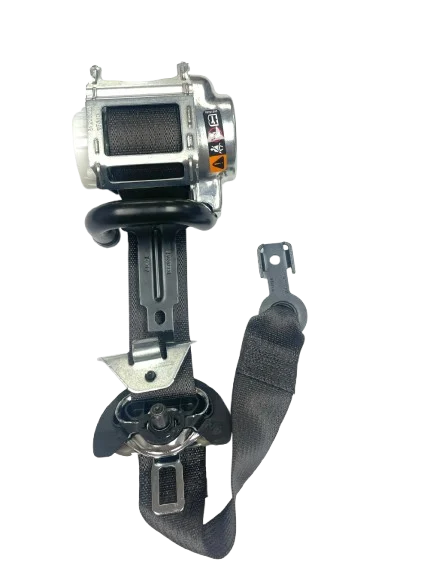
- Label: a readable part number that matches your quote.
- Pretensioner: housing whole, with no bulging, cracks or scorch marks, and the webbing not locked short.
- Webbing: no cuts, fraying, melted spots, water stains, mildew or torn stitching.
- Tongue and D-ring: no bends or gouges that point to crash loads.
- Connector: plug attached with its lock tab intact. A cut pigtail would mean splicing an airbag circuit, which many automakers advise against.
- Hardware: ask whether anchor bolts are included; some factory procedures call for new bolts.
Photos cannot show whether the lock works. Before installation, your technician should pull the webbing fully out and back and check that it locks on a sharp tug and when the retractor is tilted, then confirm the airbag light goes out once the belt is in. See checking quality before buying used parts online for the same habits on any part.
How does ordering a used seat belt from FirstChoice work?
Ordering takes five steps, and nothing ships until you have seen the actual belt.
- Send your year, make, model and VIN, and say which seat the belt is for.
- A parts specialist matches the belt to your VIN before you pay and sends the price, warranty term and shipping details. The quote is free with no obligation.
- The supplier confirms the belt is available and in good condition, pulls it and photographs the actual belt.
- You check the photos. Nothing ships until you approve them.
- Delivery target is within 5 business days of photo approval, by tracked parcel to the billing address on your card.
Phone orders at 1-888-383-2439 get 10% off, Monday to Friday, 9 AM to 6 PM EST. To compare offers, see how to read a used auto parts quote, or buy a used seat belt through the free quote form.
Frequently Asked Questions
Can I spray lubricant into a seat belt retractor?
No. WD-40, silicone and grease collect dirt inside the retractor and can interfere with the locking parts, and the retractor is not designed to be serviced. Clean the webbing and D-ring instead. If a clean belt still retracts slowly, replace the belt assembly.
Can a fired seat belt pretensioner be reset?
Not in the car. The charge in a fired pretensioner is spent, and factory repair procedures call for replacing the belt or buckle that carries it. Some mail-in services advertise rebuilding fired pretensioners, but that is not a factory procedure, so talk to your technician and insurer before you consider one.
Why is my airbag light on after replacing a seat belt?
Usually the replacement has the wrong pretensioner or connector, a plug is not fully seated, or a fault code from the crash is still stored. After a deployment, some vehicles also need the airbag control module reset or replaced. A technician with a scan tool reads the codes to tell which.
Does insurance pay to replace seat belts after a crash?
Seat belts damaged in a covered collision are usually included in the repair estimate, including belts that locked or had a pretensioner fire. Make sure the shop lists every belt that was worn. Some estimates specify used OEM parts, which is why VIN matching and photos matter.
What warranty and delivery come with a used seat belt from FirstChoice?
Used seat belts carry a 30-day parts warranty, and labor is not covered. They ship by tracked parcel to the billing address on your card, with a delivery target within 5 business days of photo approval. A damaged or incorrect part is replaced, or refunded in full if no replacement is available.
Related reading:
Are Used Airbags Safe? The Complete Safety Guide
How to Verify Airbag Compatibility for Your Vehicle
Used OEM Parts After an Accident: Insurance Claims Explained