
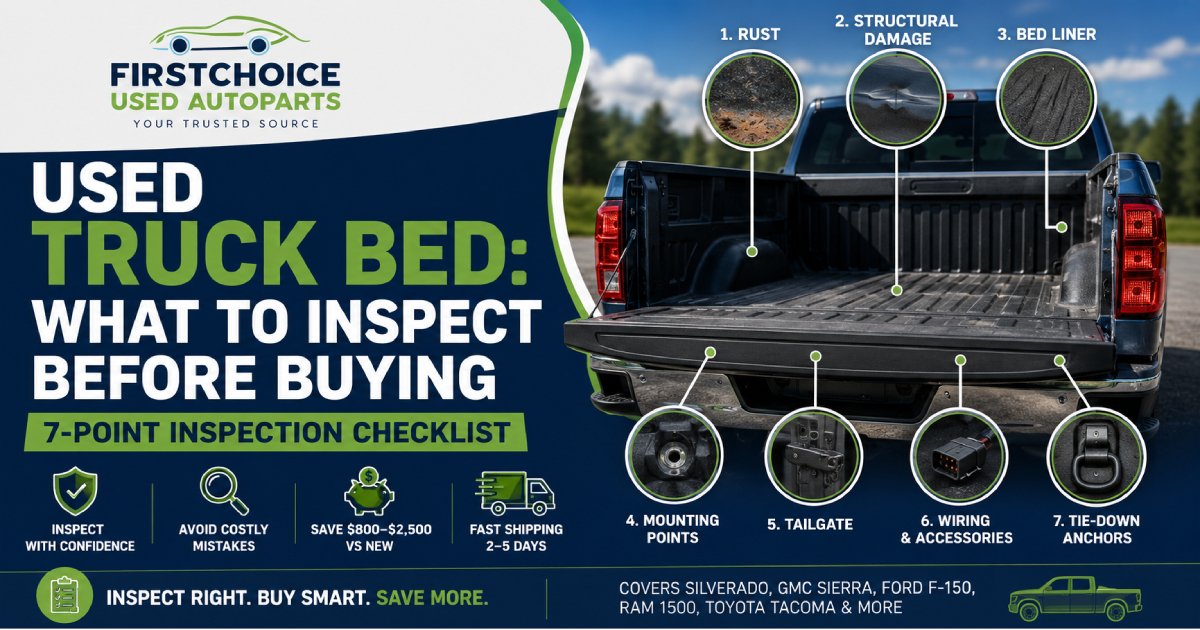
Before buying a used truck bed, verify: (1) the bed length matches your cab configuration, (2) the mounting holes and frame rail width match your truck’s frame, (3) rust is surface-only — not through the floor or front wall, (4) the wheel wells are not collapsed or repaired, (5) the tailgate latch and hinges are included and functional, (6) any bed-mounted wiring harness connections are intact, and (7) the bed liner (if present) isn’t hiding damage underneath. A used truck bed in good condition saves $800–$2,500 over new — but only if you verify it before it ships.
Truck bed replacement is one of the highest-ticket used parts transactions in the market. A new OEM bed runs $1,500–$4,000 before installation. A quality used bed from a matching donor truck runs $400–$1,200 delivered — and saves you the same functional result. The difference between a great buy and an expensive mistake comes down to seven specific things you check before you commit.
From our sales data, Chevy Silverado, Ford F-150, and GMC Sierra are the three most common truck beds we ship. This guide applies to all three — plus Dodge RAM and Toyota Tacoma.
First: Confirm the Right Bed Before Anything Else
Truck beds are not universal — even within the same model year. You must confirm three things before evaluating condition:
| Spec | Why It Matters | How to Confirm |
|---|---|---|
| Bed Length | Short, standard, and long beds have different mounting hole positions — they are not interchangeable | Measure your current bed inside rail-to-rail; check your door jamb sticker or VIN decoder |
| Cab Style | Regular cab, extended cab, and crew cab trucks are often paired with specific bed lengths — a mismatched combo looks wrong and may not comply with state inspection | Count your doors; confirm your current bed length |
| Generation Year Range | Beds are compatible within a generation — crossing generations means different frame rail width, different mounting bolt pattern, different wheel well size | Use VIN decoder or ask supplier to confirm generation match |
| Truck | Short Bed | Standard Bed | Long Bed | Generation Ranges |
|---|---|---|---|---|
| Ford F-150 | 5.5′ (66″) | 6.5′ (78″) | 8′ (97″) | 1997–2003 | 2004–2008 | 2009–2014 | 2015–2020 | 2021+ |
| Chevy Silverado 1500 | 5’8″ (68″) | 6’6″ (78″) | 8’2″ (98″) | 1999–2006 | 2007–2013 | 2014–2018 | 2019+ |
| GMC Sierra 1500 | 5’8″ (68″) | 6’6″ (78″) | 8’2″ (98″) | Same as Silverado — beds are interchangeable within same gen |
| Dodge / RAM 1500 | 5’7″ (67″) | 6’4″ (76″) | 8′ (96″) | 2002–2008 | 2009–2018 | 2019+ |
| Toyota Tacoma | 5′ (60″) | 6′ (73″) | — | 2005–2015 | 2016–2023 | 2024+ |
| Nissan Frontier | 5′ (59.5″) | 6’1″ (73.3″) | — | 2005–2021 | 2022+ |
Silverado and Sierra beds are interchangeable within the same generation. A 2010 Sierra 6.5′ bed fits a 2010 Silverado of the same cab style — same frame rail width, same bolt pattern. This significantly expands your donor pool when sourcing.
The 7-Point Inspection: What to Check on Every Used Truck Bed
Rust — Where It Is Matters More Than Whether It Exists
Surface rust on the exterior is normal and expected on any used truck bed. What you’re looking for is structural rust in specific locations:
- Bed floor: Press on the floor at the front corners and along the center. Any give, crumbling, or holes means the floor is rusted through — a bed with a compromised floor is a structural liability and not worth buying.
- Front wall (cab end): The vertical panel closest to the cab. This area traps moisture and rusts from the inside out. Visible rust blistering on the front wall face indicates active deterioration.
- Wheel well lips: The rolled edges around the wheel openings. These rust from the inside and eventually separate from the bed side. Look for separation or heavy pitting at the seam.
- Mounting pads: The 6–8 pads where the bed bolts to the frame. These need to be solid — if they’re rusted through, the bolts won’t hold torque.
Acceptable: Surface rust on exterior paint, light rust on unpainted floor panels, minor wheel well surface oxidation.
Walk away: Holes in the bed floor, separated wheel well seams, mounting pads that won’t accept a bolt.
Structural Damage — Dents, Creases, and Repaired Areas
Minor cosmetic dents are fine on a used bed — expected, even. What you need to look for is structural damage:
- Creased bed sides: A sharp crease (not a dent — a fold line) indicates the side panel has been bent past its yield point and will not hold its shape long-term
- Front wall impact: If the front wall has been pushed or creased, the frame crossmember behind it may also be damaged — this affects how the bed sits on the frame
- Bondo/filler: Run your hand along the bed sides and tailgate. Filler is significantly heavier than steel and creates a subtle bulge you can feel. Ask directly whether any panels have been body-worked
- Repaired wheel wells: Fiberglass or metal patch repairs on wheel wells indicate collision damage. The repair may hold, but the structural integrity of that section is compromised
Bed Liner — Asset or Hiding Place
A spray-in bed liner (Line-X, Rhino, ArmorThak) is a genuine asset — it protects the floor and looks good. A drop-in plastic liner can be hiding significant floor rust underneath it.
When a bed has a drop-in liner, ask that it be removed before shipping (or inspect photos with it removed). We’ve seen beds where the drop-in liner was installed specifically to conceal a rusted floor. A reputable yard will remove it and photograph the floor underneath upon request.
Spray-in liners that are chipped, peeling, or have bare spots at the edges may indicate moisture intrusion underneath — ask for photos of the floor perimeter where the liner meets the bed sides.
Mounting Points and Frame Rail Width
The bed mounts to the frame via 6 to 8 bolts through rubber isolation pads. Confirm:
- All mounting hole locations are present and the steel around each hole is solid
- The mounting pad rubbers (if still attached) are not crumbled or missing
- The frame rail width of the donor truck matches your truck’s frame — this is typically confirmed by matching the generation year range, but if you’re cross-shopping across makes, measure your frame rail width at the bed mounting points
On Silverado and Sierra cross-swaps: the frame rails are the same within the same generation, so the beds are interchangeable. On F-150 to F-250 cross-swaps: the frame rail width is different — F-250 beds do not fit F-150 frames.
Tailgate — Included, Functional, and Matching
Confirm upfront whether the tailgate is included with the bed. On some yards, the tailgate is removed and sold separately because it commands its own price. A matching tailgate (same color, same generation) is worth significantly more than the bed alone when it comes to resale.
If the tailgate is included:
- Test the latch mechanism — it should open and close smoothly with the cable or handle
- Check the hinge strap condition — worn straps let the tailgate drop too fast and eventually fail
- On F-150 models with the step-assist tailgate (2015+): confirm the step mechanism deploys and retracts
- On GM trucks with the MultiPro tailgate (2019+): confirm all six positions function
Bed-Mounted Wiring and Accessories
Modern truck beds often have wiring for:
- Bed LED lighting (F-150, Silverado, RAM — common on mid and upper trims)
- 120V power outlet in the bed (Ram Multifunction Tailgate, F-150 Pro Power)
- Rear camera mount wiring (some beds have a camera housing integrated in the bed top rail)
- 7-pin trailer connector bracket mount
If your truck has bed lighting or a bed-mounted camera, confirm the donor bed has the wiring harness intact — not cut. A missing harness means a custom wiring job at installation.
Tie-Down Anchors and Stake Pockets
Stake pockets (the rectangular holes along the top rail) and tie-down D-rings are frequently damaged or missing on working trucks. Confirm:
- Stake pocket lips are not bent or folded inward — they need to accept aftermarket accessories
- Factory D-ring tie-downs are present and anchor bolts are not stripped
- If your truck has a factory toolbox mounting system, the mounting rails are intact
“I needed a 6.5′ bed for my 2012 Silverado LTZ. Asked FirstChoice specifically about rust on the front wall and floor, and whether the drop-in liner had been removed for inspection. They had photos of the floor underneath — clean. Shipped in three days. Silverado color match was perfect. $780 delivered vs. $2,200 for a new aftermarket bed.”
What to Ask the Seller Before Confirming Your Order
- “Has the bed floor been inspected for rust-through, and can you send photos?” — Any yard with honest documentation will answer this without hesitation
- “Is the tailgate included, and is it the same color code?” — This is a separate line item at many yards
- “Was a drop-in liner present, and was it removed for a floor inspection?” — Critical if the listing mentions a drop-in liner
- “Are the mounting pads/isolators still attached?” — Missing pads increase installation time and cost
- “What is the donor truck’s generation year?” — Confirm it falls within the compatible range for your truck
Frequently Asked Questions
How much does a used truck bed cost?
Used truck beds typically cost $400–$1,200 depending on make, year, condition, and whether the tailgate is included. Total installed cost including labor (4–6 hours typically) adds $300–$600. Comparable new aftermarket beds run $1,200–$2,500; OEM new beds are $1,800–$4,000 before installation.
Can I put a different year truck bed on my truck?
Within the same generation — yes. Silverado and GMC Sierra 1999–2006 beds are interchangeable, for example, as are F-150 2009–2014 beds across those six years. Crossing generations is generally not compatible due to changes in frame rail width, mounting bolt pattern, and wheel well dimensions. Always confirm the generation range, not just the year.
Does a truck bed come with the tailgate?
Not always — many yards sell the tailgate separately because it commands additional value. Always ask explicitly whether the tailgate is included and confirm it matches the color code of the bed. A mismatched tailgate significantly reduces the cosmetic value of the replacement.
What is the most important thing to check on a used truck bed?
The bed floor for rust-through and the front wall for structural rust. These are the two areas that determine whether a used bed is structurally sound or a liability. Surface rust on the exterior is acceptable and expected. Holes in the floor or a separated front wall seam are not.
Can I install a used truck bed myself?
Yes — truck bed removal and installation is one of the more DIY-accessible body jobs. The bed is held by 6–8 bolts through the frame rails. With two or three people, a jack stand for support, and basic hand tools, the swap takes 3–5 hours. The main challenge is the weight — a full-size truck bed weighs 150–300 lbs. A hoist, engine crane, or additional helpers makes the job significantly safer.
Will a used truck bed rust faster than a new one?
A used truck bed that has been cleaned, any rust-through addressed, and re-coated or spray-lined will not rust faster than new. Surface rust that is treated and sealed is stable. The primary risk is untreated hidden rust that continues spreading after installation — which is why inspecting under drop-in liners and behind the front wall before purchase matters.