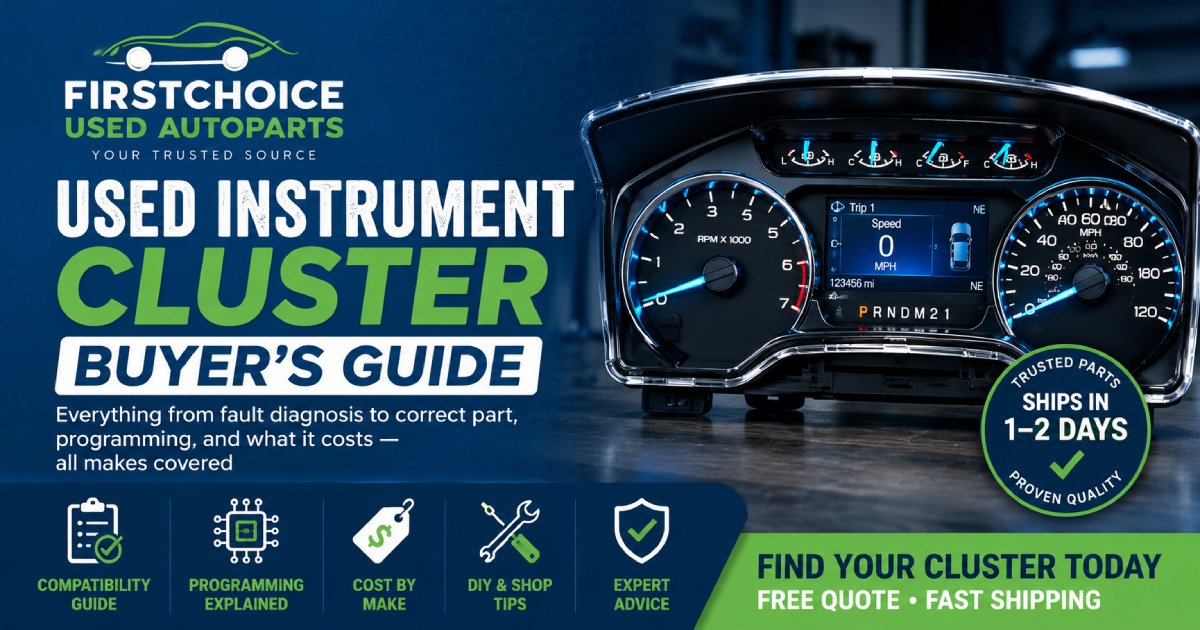
Everything from fault diagnosis to correct part, programming, and what it costs — all makes covered
Instrument cluster failure shows up in a few ways: gauges that stop responding, a completely dark display, a speedometer stuck at one reading, or a cluster that flickers and goes out intermittently. All of these point to the same solution — a used cluster from a matching donor vehicle, installed and programmed by a shop with the right tools.
Your Two Biggest Questions — Answered Up Front
Will a used cluster work in my car?
Yes — if it matches your generation, engine type, and trim level. All gauges will function. The main compatibility traps are: wrong generation (different connector), wrong engine variant (diesel vs. gas), and wrong trim (base cluster won’t show premium DIC features). Full details in our compatibility guide.
What happens to the mileage?
The cluster will initially display the donor vehicle’s mileage. Your vehicle’s actual mileage is stored separately in the ECM and is unaffected by the cluster swap. On Ford, GM, and Dodge/Chrysler/Jeep vehicles, programming corrects the display to show your actual miles. Toyota, Honda, and Nissan through 2015 are plug-and-play but mileage correction isn’t typically available — keep your repair invoice for disclosure when selling. Full explanation in our compatibility guide.
Cluster Guides — By Topic
Will a Used Instrument Cluster Work in My Car?
Covers every compatibility factor: generation year ranges, engine type, trim level differences, 4WD vs. 2WD, and the mileage display question answered clearly. Includes a plug-and-play vs. programming table by make and year, and a mismatch symptom guide.
Read: Instrument Cluster Compatibility Guide →How to Program a Used Instrument Cluster
Exactly which tool is needed by make, what the programming process does, which vehicles are truly plug-and-play, how mileage correction works (and when it’s legal), and what to tell your shop before installation. Covers Ford, GM, Dodge/Chrysler/Jeep, Toyota, Honda, and Nissan.
Read: Instrument Cluster Programming Guide →Used Instrument Cluster Cost by Make
| Vehicle | Used Cluster Cost | Programming Cost | Installed Total | Plug & Play? |
|---|---|---|---|---|
| Ford F-150 / F-250 (2009–2014) | $150–$320 | $80–$140 | $330–$600 | No |
| Ford F-150 / F-250 (2015+) | $180–$380 | $100–$180 | $380–$700 | No |
| Chevy/GMC Silverado/Sierra (1999–2006) | $120–$240 | $0 | $180–$430 | Yes |
| Chevy/GMC Silverado/Sierra (2007–2013) | $140–$280 | $80–$150 | $320–$570 | No |
| Chevy/GMC Silverado/Sierra (2014+) | $160–$340 | $100–$180 | $360–$660 | No |
| Dodge RAM 1500/2500 (2002–2008) | $120–$240 | $0 | $180–$420 | Yes (most) |
| Dodge RAM 1500/2500 (2009–2018) | $150–$320 | $80–$150 | $330–$610 | No |
| Jeep Grand Cherokee/Wrangler (2011+) | $150–$300 | $80–$150 | $330–$590 | No |
| Cadillac DTS/STS/Escalade | $160–$340 | $100–$160 | $360–$650 | No |
| Toyota Tacoma/Tundra (2005–2015) | $130–$280 | $0 | $190–$460 | Yes |
| Honda Accord/CR-V (2003–2015) | $120–$260 | $0 | $180–$440 | Yes |
| Nissan Frontier/Titan/Pathfinder | $120–$260 | $0 | $180–$440 | Yes |
Top Makes We Ship — What to Know for Each
Ford — #1 Volume Make for Instrument Clusters
F-150 and F-250 Super Duty clusters account for our largest volume. The 2009–2014 F-150 generation is the highest-demand unit — three trim-level variants (base, mid, premium) exist within that generation. All require IPC programming via Ford IDS or Forscan. Independent Ford shops with IDS are widely available; Forscan makes the 2009–2014 generation one of the most DIY-accessible programming jobs in the market.
The 2004–2008 F-150 (11th generation) is largely plug-and-play with matching part numbers — one of the simplest cluster swaps in the truck segment.
Chevrolet / GMC — #2 Volume Make
Silverado and Sierra clusters split into two distinct eras: the stepper motor era (1999–2006) — analog gauges, plug-and-play, very affordable at $120–$240 — and the digital integration era (2007+) requiring SPS programming via Tech 2 or MDI. The 1999–2006 cluster is one of the most cost-effective repairs in the truck market. The 2007–2013 generation frequently develops gauge failure (all needles drop, DIC goes dark) — our highest-volume GM cluster repair.
Dodge — #3 Volume Make
RAM 1500 and 2500 clusters from 2009+ all require wiTECH programming. Pre-2009 RAMs are plug-and-play. The post-2009 generation with Uconnect requires trim-level matching — the Uconnect display cluster and the base cluster are different assemblies with different part numbers. Programming via wiTECH 2.0 is straightforward for shops with the subscription.
Cadillac — High-Ticket Clusters with DIC
Cadillac DTS, STS, and Escalade clusters all require SPS programming and are among our higher-margin units at $160–$340 for the used cluster. The DIC (Driver Information Center) in Cadillac clusters is tightly integrated — trim matching is important. All require dealer or SPS-equipped independent shop for programming.
Toyota and Honda — The Easy Ones
Toyota trucks (2005–2015) and Honda cars/crossovers (2003–2015) are the simplest cluster replacements in our operation. Match the part number, install, clear codes. No programming required. If the mileage display matters, document the repair — mileage correction tooling isn’t standard for these platforms.
“I called three different suppliers. FirstChoice was the only one who asked me specifically which trim my 2012 F-150 was before quoting. Turns out the XLT and FX4 clusters in that year are different part numbers even though they look identical. They shipped me the exact right unit. Shop programmed it with Forscan in 30 minutes. $290 total — dealer wanted $1,050.”
How to Buy a Used Instrument Cluster — Step by Step
# WordPress HTML + CSS“`htmlFrequently Asked Questions
How much does a used instrument cluster cost?
Used instrument clusters typically cost $120–$380 for the unit depending on make, year, and trim level. Total installed cost including labor and programming (where required) is generally $280–$650. Dealer replacement with a new unit runs $700–$1,800 installed.
How do I know my instrument cluster has failed?
Common signs: all gauges stop moving or show incorrect readings simultaneously, the display goes completely dark, backlighting fails while gauges still work, speedometer stays pegged or bounces erratically, or a specific IPC fault code (typically a U-code or instrument cluster module fault) is stored. A single gauge failing (fuel gauge only, or temp gauge only) sometimes points to a sensor rather than the cluster itself.
Can I drive with a bad instrument cluster?
Technically yes — the engine and transmission operate independently of the cluster. However, you lose all real-time feedback on speed, fuel level, engine temperature, and oil pressure. Driving without these gauges working creates real risk of running out of fuel or missing an overheating engine. Repair should not be deferred long-term.
What is the difference between a speedometer and an instrument cluster?
The instrument cluster is the entire dashboard panel that includes the speedometer, tachometer, fuel gauge, temperature gauge, DIC display, and warning indicator lights. The speedometer is just the speed gauge within that cluster. When any of these components fail, the entire cluster is replaced as a single unit — individual gauge replacement is not practical on modern clusters.
Do all used instrument clusters need to be programmed?
No. Toyota trucks (2005–2015), Honda cars/crossovers (2003–2015), and Nissan trucks are plug-and-play — no programming required. Chevy/GMC 1999–2006 and Dodge RAM 2002–2008 are also largely plug-and-play. Most Ford (2009+), GM (2007+), and Dodge (2009+) vehicles require VIN programming via brand-specific scan tools.