
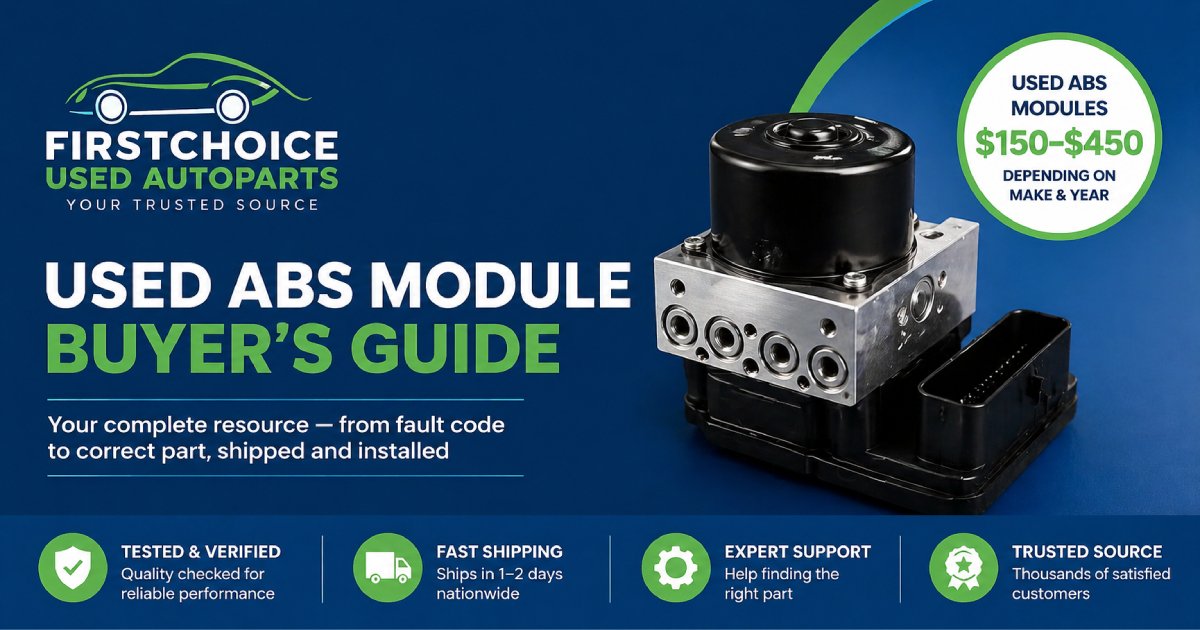
Your complete resource — from fault code to correct part, shipped and installed
A used ABS module (HECU assembly) costs $150–$450 depending on vehicle make and year.
ABS module is our #1 volume part — we ship more of these than any other component. The most common mistake buyers make: ordering without knowing whether their vehicle needs the full HECU assembly or just the electronic module (EBCM/CAB), and whether programming is required after installation. This guide covers both.
ABS modules are the most-ordered used part in our operation — ahead of transmissions, speedometers, and steering columns. Ford, Dodge, and Chevy truck owners are the most frequent buyers, followed by Jeep, Toyota, and Honda. The repair is straightforward when you have the right part and know the programming requirements going in.
Give us your year, make, model, and fault code — we’ll confirm the right part before it ships.
Check Availability — Get a Free QuoteStart Here: What Does Your Fault Code Say?
The ABS warning light is not a diagnosis. Before ordering any ABS part, pull the specific fault code with a scanner that reads ABS/chassis codes — basic engine code readers won’t show ABS codes. AutoZone and O’Reilly scan for free.
| Fault Code | What It Means | Part Needed |
|---|---|---|
| C0035, C0040, C0045, C0050 | Wheel speed sensor failure | Wheel speed sensor — NOT the ABS module |
| C0110 | ABS pump motor failure | HECU (full assembly) |
| C0265, C0267 | EBCM relay / power circuit | EBCM or HECU depending on make |
| C1214 (GM) | System relay coil circuit open | EBCM (GM 1999–2013 — separate module) |
| U0121 | Lost communication with ABS module | EBCM / wiring harness |
| C0161 | ABS/TCS brake switch circuit | EBCM or switch — diagnose further |
| C0245, C0246 | Wheel speed sensor frequency error | Tone ring / reluctor — NOT the module |
Wheel speed sensor codes (C0035–C0051) are the most common misdiagnosis. These do not mean your ABS module is bad. They mean a sensor at one of your wheels is failing or sending incorrect data. Replacing the ABS module for a wheel speed sensor code wastes money and doesn’t fix the light.
ABS Module Guides — By Topic
ABS Module vs. ABS Control Module: What’s the Difference?
Not all ABS modules are the same component. On some vehicles (older GM trucks, most Dodge/Jeep products) the electronic module and the hydraulic pump are separate parts. On others (most Ford, Toyota, Honda, and newer GM) they’re combined into one HECU assembly. Ordering the wrong configuration wastes $200–$400 and delays your repair.
Read: ABS Module vs. ABS Control Module →ABS Module Programming After Replacement: What You Need to Know
Some ABS modules are plug-and-play. Others require dealer-level programming to configure the module to your VIN. Skipping this step leaves the ABS light on and disables your anti-lock braking and traction control systems. This guide covers which vehicles require programming, which tools are needed, and what it costs.
Read: ABS Module Programming Guide →Used ABS Module: Complete Buyer’s Guide
Our original guide covering what to look for in a used ABS module, how to verify compatibility, mileage considerations, and what questions to ask your supplier before ordering.
Read: Used ABS Module Buyer’s Guide →Used ABS Module Cost by Make
| Vehicle | Assembly Type | Used Unit Cost | Installed Total (Est.) | Programming? |
|---|---|---|---|---|
| Ford F-150, F-250 (2004–2020) | HECU | $180–$380 | $380–$750 | Yes |
| Chevy/GMC Silverado (1999–2013) | Separate EBCM | $120–$250 | $300–$600 | Yes — SPS |
| Chevy/GMC Silverado (2014+) | HECU | $180–$380 | $380–$750 | Yes |
| Dodge RAM 1500/2500 (2002–2012) | Separate CAB | $120–$240 | $300–$580 | Yes — wiTECH |
| Dodge RAM 1500/2500 (2013+) | HECU | $200–$420 | $400–$800 | Yes |
| Jeep Grand Cherokee, Wrangler | Separate CAB | $120–$280 | $300–$640 | Yes |
| Toyota Tacoma, Tundra (2003–2015) | HECU | $160–$340 | $300–$600 | No — plug and play |
| Honda Accord, CR-V (2003–2015) | HECU | $140–$300 | $280–$560 | No — plug and play |
| Nissan Frontier, Titan | HECU | $160–$320 | $300–$580 | No — plug and play |
| Cadillac DTS, STS, Escalade | Separate EBCM | $140–$300 | $320–$650 | Yes — SPS |
Top Makes We Ship ABS Modules For
Based on our actual sales data, here are the most common makes and what to know about each:
Ford — Our #1 ABS Module Make
Ford F-150, F-250, and Explorer account for our highest ABS module volume. All use an integrated HECU design — you need the full assembly, not just the electronic module. Programming is required using Ford IDS or Forscan. Most independent Ford shops have this capability. Cost savings vs. dealer: typically $600–$1,200.
Dodge — #2 in Volume
RAM 1500 and 2500 are the most common. Pre-2013 models use a separate CAB (Controller Antilock Brake) — the electronic module only. This is a significant advantage: you pay less ($120–$240 vs. $200–$420 for the full HECU) and replacement is simpler. Post-2013 RAMs use an integrated HECU. All Dodge ABS modules require wiTECH programming.
Chevy/GMC — #3 in Volume
Silverado and Sierra 1999–2013 use a separate EBCM — one of the most frequently replaced ABS components in the country, and one of the most affordable used parts at $120–$250. The C1214 code (system relay coil circuit) is the most common failure code on this generation. SPS programming via Tech 2 is required.
Jeep — Strong Recurring Volume
Grand Cherokee and Wrangler use a separate CAB in most model years — same as the RAM 1500 advantage above. Jeep owners benefit from lower replacement cost since only the electronic module is needed in most cases. wiTECH programming required.
“I went to three different parts websites before calling FirstChoice. Nobody else could tell me whether I needed the whole assembly or just the module for my 2008 RAM 2500. FirstChoice told me immediately — I needed the CAB module only, not the full HCU, because 2008 RAMs use the separate design. Saved me $180 right there.”
— Curtis J., Birmingham, AL
How to Buy a Used ABS Module the Right Way
Frequently Asked Questions
How much does a used ABS module cost?
A used ABS module (HECU assembly) typically costs $150–$450 depending on vehicle make and year. Separate EBCM or CAB modules (older GM trucks, Dodge/Jeep pre-2013) run $120–$280. Total installed cost including labor and programming is typically $350–$800, compared to $900–$2,200 at a dealer for a new unit.
How do I know if my ABS module is bad?
The ABS warning light alone is not enough — you need a specific fault code in the C0100–C0299 or U0121 range that points to the module itself (not a wheel speed sensor). Common module-specific codes: C0110 (pump motor failure), C0265 (EBCM relay), C1214 on GM trucks (system relay), U0121 (lost communication). Wheel speed sensor codes (C0035–C0051) do not mean the module is bad.
Can a used ABS module be programmed to any vehicle?
Yes — used ABS modules from a different vehicle can be programmed to your VIN on vehicles that require programming. The module stores the donor vehicle’s configuration until overwritten by the programming process. On plug-and-play vehicles (most Toyota, Honda, Nissan), the module simply adapts without programming. In both cases, a used module functions fully after correct installation.
What is the difference between an ABS module and an ABS pump?
The ABS pump (hydraulic modulator) is the mechanical component that physically pulses brake pressure. The ABS module (EBCM/CAB) is the computer that commands it. On most modern vehicles they are combined into one HECU assembly and replaced together. On older GM trucks and most Dodge/Jeep products, they are separate components — allowing you to replace only the failed component rather than the full assembly.
How long does a used ABS module last?
A used ABS module from a verified low-mileage source typically lasts the remaining life of the vehicle with normal use. Electronic modules have no moving parts — they fail from corrosion, power surges, or internal component failure, not mechanical wear. A module that was functioning correctly in a 90,000-mile donor vehicle has no inherent reason to fail prematurely in your vehicle.