
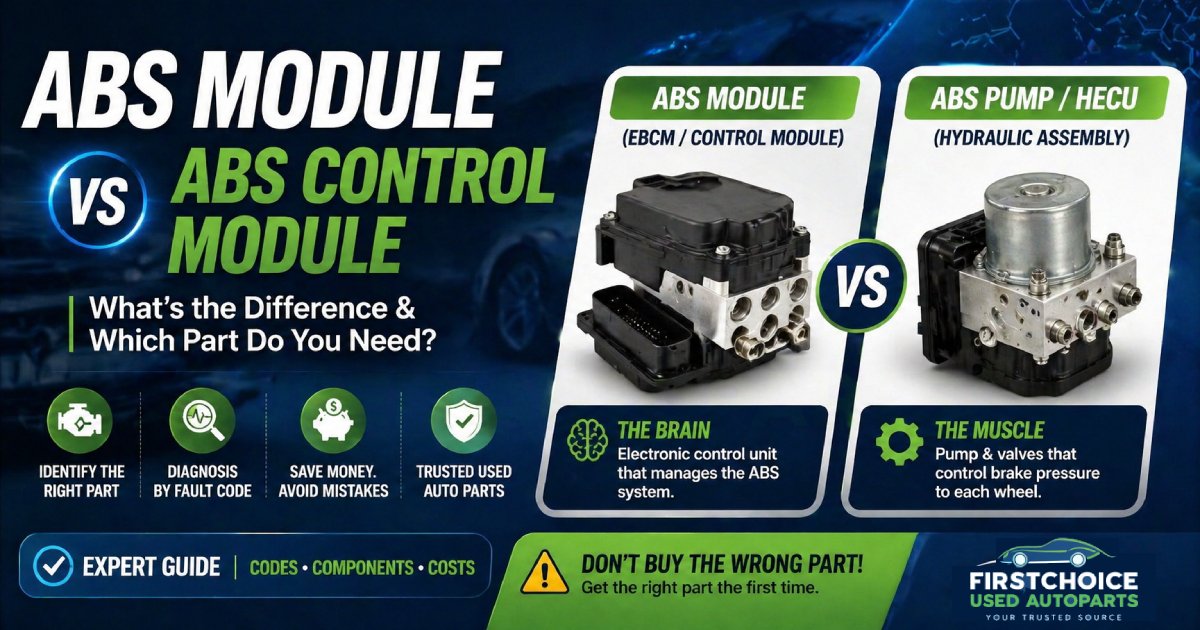
“ABS module” and “ABS control module” often refer to the same electronic component — the EBCM (Electronic Brake Control Module), which is the computer that controls your anti-lock braking system. However, on many vehicles the EBCM is physically attached to the ABS pump/modulator as a combined unit called an HECU (Hydraulic Electronic Control Unit). Whether you need the computer only, the pump only, or the entire combined assembly depends on which component failed — and that’s determined by the fault code, not just the ABS warning light.
This is one of the most common sources of confusion in ABS repairs — and it costs people money. A customer orders an “ABS module” meaning the whole assembly, but the seller ships the electronic control module only. Or a shop diagnoses “ABS control module failure” when the actual problem is the hydraulic pump motor. Getting the right part starts with understanding what each term means.
Not sure which ABS part your vehicle needs? Give us your year, make, model, and fault code.
Get a Free Quote — We’ll Confirm the Right PartThe Three ABS Components You Need to Know
1. EBCM — Electronic Brake Control Module (the “brain”)
This is the computer. It receives wheel speed sensor data, detects impending wheel lockup, and sends commands to the hydraulic modulator to pulse brake pressure. It contains the ABS software and calibration data specific to your vehicle’s VIN and configuration.
What it looks like: A plastic or aluminum box, often bolted directly to the ABS hydraulic modulator. On many vehicles it cannot be separated from the modulator without special tools.
When it fails: Fault codes like C0265 (EBCM relay circuit), U codes (communication failure), or ABS light on with no wheel speed sensor codes typically point here.
2. ABS Hydraulic Modulator / Pump Assembly (the “body”)
This is the mechanical component — a block containing solenoid valves for each brake circuit and an electric pump motor. When the EBCM commands ABS intervention, the modulator pulses brake pressure to each wheel independently.
What it looks like: A metal block with multiple brake lines connecting to it, usually mounted in the engine bay near the brake master cylinder.
When it fails: Fault codes for individual solenoid circuits (C0110, C0161, C0265 pump motor), physical brake fluid leaks from the modulator body, or a pump motor that runs constantly/won’t shut off.
3. HECU — Hydraulic Electronic Control Unit (combined assembly)
On most vehicles manufactured since the mid-2000s, the EBCM and the hydraulic modulator are sold and replaced as a single combined unit — this is the HECU. When most people say “ABS module,” they mean the entire HECU assembly.
What it looks like: The same metal block as the modulator, but with the electronic control module integrated into one side — usually connected by a wiring harness plug.
When it fails: Either component within the HECU can cause the failure. Replacing the entire HECU is the most common repair approach because separating the two components requires specialized equipment and is rarely cost-effective.
The terminology varies by make and year:
Ford calls it the ABS Control Module (and it’s usually the HECU).
GM calls it the EBCM (Electronic Brake Control Module) — sometimes separate, sometimes integrated.
Dodge/Chrysler uses CAB (Controller Antilock Brake) for the module and HCU for the hydraulic unit.
The part your mechanic orders uses whichever term the OEM uses — but they’re all referring to the same functional components.
Which Component Does Your Vehicle Need? — By Make
| Make / Vehicle | Configuration | What “ABS Module” Typically Means | Separable? |
|---|---|---|---|
| Ford F-150, F-250, Explorer (2004–2020) | HECU (combined) | Entire assembly — module + pump | No — replace as unit |
| Chevy/GMC Silverado, Sierra (1999–2013) | Separate EBCM + BPMV | EBCM only (electronic module) OR BPMV (pump/valve body) | Yes — diagnose first |
| Chevy/GMC Silverado, Sierra (2014+) | HECU (combined) | Entire assembly | No — replace as unit |
| Dodge RAM 1500/2500 (2002–2012) | Separate CAB + HCU | CAB (controller antilock brake) — module only | Yes — common to replace CAB only |
| Dodge RAM 1500/2500 (2013+) | HECU (combined) | Entire assembly | No — replace as unit |
| Jeep Grand Cherokee, Wrangler | Separate CAB + HCU (most years) | CAB (module) is most common failure; HCU if pump codes | Yes |
| Toyota Tacoma, 4Runner, Tundra | HECU (combined) | Entire assembly | No — replace as unit |
| Honda Accord, CR-V, Pilot | HECU (combined) | Entire assembly — VSA modulator-control unit | No — replace as unit |
| Nissan Frontier, Pathfinder, Titan | HECU (combined) | Entire assembly | No — replace as unit |
| Cadillac (most models) | Separate EBCM + BPMV | EBCM (module) is most common failure — especially on STS, DTS | Yes |
How to Identify Which Part Failed on Your Vehicle
The ABS warning light alone does not tell you which component failed. You need the specific fault code — not just a generic “ABS fault.” Any OBD-II scanner that reads ABS/chassis codes (not just engine codes) will pull this. Auto parts stores like AutoZone and O’Reilly will scan for free.
| Fault Code Range | What It Points To | Likely Part Needed |
|---|---|---|
| C0035–C0051 (Wheel Speed Sensor codes) | Wheel speed sensor or tone ring | Sensor — NOT the ABS module |
| C0110 (Pump Motor Circuit) | Pump motor failure in HECU | HECU (full assembly) |
| C0161 / C0265 (EBCM relay, power circuit) | Electronic module failure | EBCM or HECU depending on make |
| C0245 / C0246 (Wheel Speed Sensor Frequency) | Tone ring damage or reluctor wheel | Tone ring — NOT the module |
| U0121 (Lost Comm with ABS Module) | Module communication failure | EBCM or wiring harness |
| C1214 (GM — ABS solenoid relay) | EBCM or relay circuit | EBCM on GM vehicles (1999–2013) |
Don’t replace the ABS module if your codes are C0035–C0051 or C0245.
These are wheel speed sensor codes — the sensor or tone ring is the problem, not the module. Replacing the ABS module for a wheel speed sensor fault wastes $200–$600 and doesn’t fix the ABS light.
Why the Right Diagnosis Saves You Money
On older GM trucks (1999–2013 Silverado/Sierra), the EBCM and the BPMV (brake pressure modulator valve) are separate. The EBCM alone — the electronic module — can be replaced for $100–$250 used. If you instead buy the entire HECU/BPMV assembly because you saw “ABS module” online without diagnosing, you’ve spent $400–$700 unnecessarily.
On the flip side, on a 2014+ Silverado or any Ford F-150, the two components are fully integrated. Ordering just the “EBCM” won’t get you a functional replacement — you need the complete HECU assembly.
This is why the fault code matters more than the part name.
“I was quoted $680 for a full ABS assembly for my 2007 Silverado. I called FirstChoice, gave them my code (C1214), and they told me the 2007 uses a separate EBCM — I only needed the module, not the whole pump. Paid $185 shipped. Shop programmed it and my ABS light cleared immediately.”
— Ron T., Memphis, TN
Used ABS Module: What to Verify Before Buying
- Confirm combined vs. separate: Know whether you need the HECU (full assembly) or EBCM/CAB (module only) before ordering
- Match by VIN: ABS modules are often VIN-specific — especially on vehicles requiring programming. Give the seller your full 17-character VIN
- Ask if programming is required: Some units are plug-and-play; others require dealer-level programming (see our ABS Programming Guide)
- Confirm it was pulled from a running vehicle: A used ABS module from a vehicle with active ABS fault codes is not a clean unit
- Verify the part number or application matches your specific trim: Some vehicles have different ABS configurations for 2WD vs. 4WD or different brake package trims
Tell us your year, make, model, and the specific ABS fault code — we’ll confirm exactly which part you need.
Find Your ABS Part — Free QuoteFrequently Asked Questions
Are ABS module and ABS control module the same thing?
Usually yes — both terms typically refer to the EBCM (Electronic Brake Control Module), the computer that controls the anti-lock brake system. However, on some vehicles (especially older GM trucks and many Dodge/Jeep products), the EBCM is physically separate from the hydraulic pump/modulator. On most modern vehicles, they are combined into a single HECU assembly. Knowing which configuration your vehicle has is essential before ordering a replacement.
What is an HECU?
HECU stands for Hydraulic Electronic Control Unit. It is a combined assembly that integrates both the ABS hydraulic modulator (which contains the pump motor and solenoid valves) and the electronic control module (the computer). Most vehicles manufactured since 2010 use an HECU design, meaning both components must be replaced together as a single unit.
Do I need to replace the whole ABS module or just the pump?
It depends on your specific fault code. If the code points to a pump motor failure (like C0110), you need the hydraulic assembly or full HECU. If the code points to an electronic/relay failure (like C0265 or U0121), the electronic module is the problem. On vehicles where the two are combined (HECU), you replace the entire assembly regardless of which component internally failed.
How much does a used ABS module cost?
Used ABS modules (EBCM only) typically cost $80–$250. Used HECU assemblies (combined module + pump) typically cost $150–$450 depending on vehicle make and year. Total installed cost including labor is generally $300–$900, versus $700–$1,800 at a dealer.
Can I replace the ABS module myself?
The physical replacement is straightforward on most vehicles — unbolt the old unit, bolt in the new one, reconnect the brake lines and harness. However, many modern ABS modules require programming after installation. If your vehicle requires programming, the physical swap is only half the job — the module must also be calibrated to your VIN before the ABS system will function correctly.
Why does my ABS light stay on after replacing the module?
Most likely causes: (1) the replacement module requires programming and hasn’t been configured to your VIN, (2) there is a secondary fault (wheel speed sensor, wiring) that was present before the module replacement, or (3) the replacement unit itself has a fault. Clear the codes after installation and scan again — if new codes appear, diagnose those specifically.