
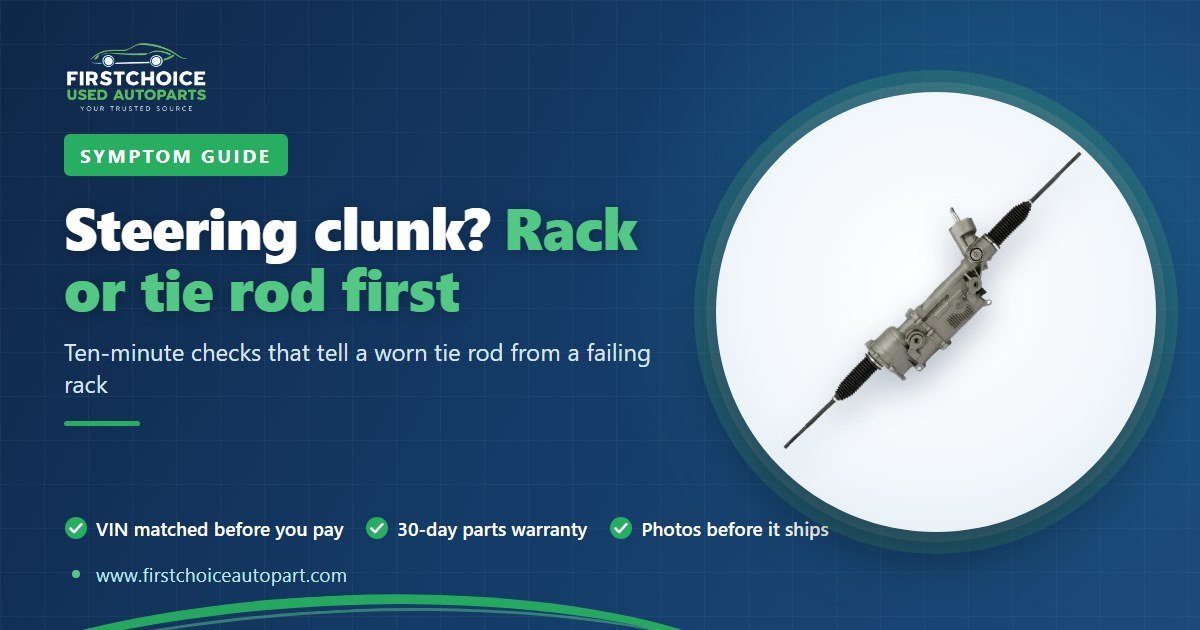
Quick Answer: A clunk over bumps or a car that wanders with play in the wheel is often a worn tie rod, a far cheaper fix than a rack. The rack itself is the likely cause when power steering fluid collects in the rack boots, the rack has play inside its housing, or steering is heavy in one direction. A dry park test and a wheel shake check usually settle it in about ten minutes.
Your steering clunks over bumps, or the car drifts and you keep correcting to hold your lane, and someone has said the words rack and pinion. A shop rack job with a new rack can run over $1,000, while a tie rod end replacement with an alignment usually costs a few hundred dollars. The mix-up goes both ways: sound racks get replaced for a worn tie rod end, and new tie rods get fitted to a rack that is leaking inside its boots.
This guide is for drivers with loose, clunking or wandering steering who want to know what is worn before they approve the bill. It covers which symptoms point where, the checks a mechanic uses, typical costs, and how to match a used OEM rack and pinion if the rack really is the problem.
Key facts
- A clunk or wander in rack and pinion steering is often traced to a worn tie rod or another front end joint, not a failed rack.
- Power steering fluid inside the rack’s bellows boots means the rack’s internal seals are leaking. New tie rods will not fix that leak.
- In a dry park test, the worn steering joint is the one where motion goes in on one side and comes out late on the other.
- On a raised front wheel, play at 3 and 9 o’clock usually means tie rods or rack; play at 12 and 6 usually means a ball joint or wheel bearing.
- Replacing a tie rod or a steering rack changes toe, so the front end needs a wheel alignment right after the job.
How do the rack and the tie rods fit together?
The rack turns steering wheel rotation into side to side motion, and the tie rods carry that motion to each front wheel. Every worn joint along the way adds a little play, so the job is finding which joint has it.
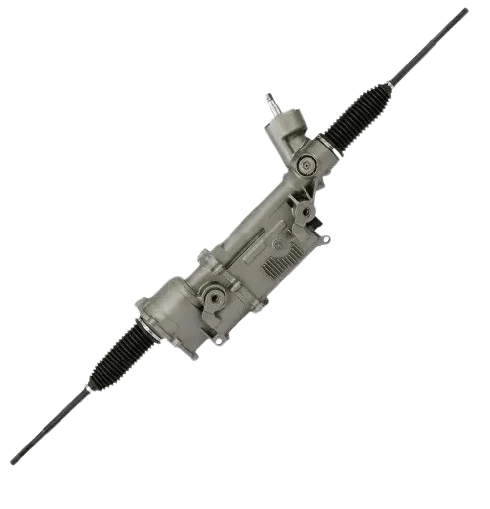
- Rack and pinion: a pinion gear on the input shaft drives a toothed bar inside a housing bolted to the subframe or body. A spring loaded yoke holds the rack against the pinion, and a hydraulic pump or an electric motor adds assist.
- Inner tie rods: a ball socket threaded onto each end of the rack, hidden inside the rubber bellows boot. Because it sits inside the boot, a worn inner tie rod is often blamed on the rack.
- Outer tie rod ends: a ball stud bolted into the steering arm on the knuckle and threaded onto the inner tie rod. Turning the inner rod in those threads sets toe.
Above the rack sit the intermediate shaft and the steering column, which can clunk too. Our post on steering column vs steering shaft explains those two.
Which symptoms point to a tie rod, and which to the rack?
Clunks over bumps, play in the wheel and feathered tire wear usually point to a tie rod. Fluid in the boots, heavy steering in one direction, binding or an electric steering warning point to the rack. Treat the table as a starting point, not a verdict.
| Symptom | Most likely cause | Also check |
|---|---|---|
| Clunk over bumps, felt in the wheel | Worn outer or inner tie rod | Rack yoke wear, rack mount bushings, sway bar links |
| Wander, constant small corrections | Worn tie rods or toe out of spec | Rack play, control arm bushings, tires |
| Feathered or saw tooth tire wear | Toe out of spec from a worn or bent tie rod | Bent steering arm on the knuckle |
| Fluid inside the rack boots | Leaking internal rack seals | Nothing cheaper fixes this |
| Wet where the input shaft enters the rack | Pinion or valve body seal | Hose fittings and pump nearby |
| Heavy steering in one direction only | Internal rack seal or valve fault (hydraulic) | Fluid level, a seized joint, a torque sensor fault on electric racks |
| Clunk or notchy feel turning while parked | Intermediate shaft joint | Strut mounts, rack mount bushings |
| Steering warning light, assist cuts out | Electric assist motor, sensor or module | Battery, charging, wiring |
Wander alone should never justify a rack. After a hard hit to one wheel, a bent steering arm can mimic a bent tie rod; see how to tell if a steering knuckle is bent.
How does a mechanic tell the rack from a tie rod in ten minutes?
A mechanic rocks the steering with the car on its wheels, shakes each raised wheel, and watches which joint moves loosely.
- Dry park test: wheels on the ground, a helper rocks the steering wheel an inch or two each way. Hold each joint in turn, from the intermediate shaft to the outer tie rod end. A good joint moves as one piece; a worn one moves on one side first.
- Wheel shake at 3 and 9: front raised, push and pull the tire at 3 and 9 o’clock. Hold the outer tie rod end while you shake. If the play stops at your hand, the end is fine and the looseness is further in.
- Boot squeeze: grip the inner tie rod through the boot while the wheel is shaken. A knock you feel there is a worn inner tie rod. On a hydraulic rack, a boot that feels full of liquid means the rack seals are leaking.
- Rack movement: during the dry park test, watch the housing. If the housing shifts at its mounts, the bushings or bolts are the problem. If the input shaft turns before the rack moves, the rack is worn.
- Leak trace: clean the rack and lines, run the engine, turn the wheel lock to lock a few times without holding it at full lock, and look again. Fluid at a hose fitting is a line repair; fluid at the boots or input shaft seal is the rack.
Play at 12 and 6 o’clock usually points to a ball joint or wheel bearing instead, though a badly worn bearing can show play both ways. Ask the shop to show you the loose joint before you approve parts.
What else in the front end makes the same clunk?
- Sway bar links: clunk over small bumps, unchanged when you rock the steering.
- Ball joints: knock over bumps and under braking, with play at 12 and 6 o’clock.
- Strut mounts: pop or creak when turning slowly.
- Intermediate shaft: clunk or a notchy feel while turning in a parking lot. On some models it comes with the used steering column, on others as a separate shaft.
How much does a tie rod job cost compared with a rack?
A tie rod repair typically costs a few hundred dollars with the alignment, while a shop rack job with a new dealer rack can pass $1,000. The ranges below are approximate US market figures; rack labor runs longer on vehicles where the subframe must be lowered, and the exact price depends on the vehicle and the shop.
| Repair | Parts (approximate) | Labor (approximate) |
|---|---|---|
| Outer tie rod end, one side | $15-$80 | 0.5-1 hour |
| Inner tie rod, one side | $20-$100 | 1-1.5 hours |
| Rack mount bushings | $15-$60 | Varies widely by vehicle |
| Used OEM rack, hydraulic | $130-$320 | 2-6 hours |
| Used OEM rack, electric | $200-$450 | 2-6 hours |
| New dealer rack | $380-$1,200, more for some electric racks | 2-6 hours |
| Front wheel alignment | $80-$200 at a shop | Needed after any of the above |
Guessing wrong costs real money: a sound rack replaced for a worn tie rod, or tie rods fitted to a leaking rack, then labor and an alignment paid twice. When the rack is confirmed, FirstChoice quotes a used rack and pinion for sale at up to 70% less than a new dealer part, and the quote is free.
When is replacing the rack the right call?
Replace the rack when the fault is inside it. Replace the tie rods, bushings or bolts when the play is there instead.
- Rack is the fix: fluid in the boots, a leaking input shaft seal, play between rack and housing, tight or notchy spots through the turn, a rack bent in a collision, or an electric assist fault traced to the rack.
- Rack is not the fix: play at a tie rod, a leaking hose or pump, worn rack mount bushings that can be replaced on their own, loose mounting bolts, or wander caused by toe or tires.
- Hydraulic racks: heavy steering on cold mornings that eases after a few minutes of driving often points to internal seal or valve wear inside the rack.
Steering is a safety system. Have a qualified technician install a rack or tie rods, torque fasteners to spec, fit new locking nuts or cotter pins where the maker calls for them, and align the car. Do not reuse a rack or tie rod that was bent in a crash.
What must match for a used rack and pinion to fit?
Racks that look alike can differ in assist type, drivetrain, ratio and electronics, so send your VIN and a part number from the old rack’s label if you can read it. The short version is below; our used rack and pinion buyer’s guide covers each point in depth.
| What must match | Why it matters |
|---|---|
| Assist type | Hydraulic and electric racks do not interchange. A power steering reservoir under the hood usually means hydraulic assist. |
| Drivetrain and trim | 2WD and 4WD or AWD versions, and some trims with a quicker or variable ratio, use different racks |
| Part number and connector | On an electric rack with its own motor, the part number and connector should match the old rack |
Some electric racks need a calibration with a scan tool after the install, and many cars with stability control need a steering angle sensor reset after the alignment. Your mechanic does those steps. Our guide on decoding your VIN for the right part shows what the VIN tells a parts specialist.
What should you check in the photos before you approve a used rack?
Look for dry, intact boots, an undamaged housing and a readable label. Nothing ships until you approve photos of the actual rack, so ask for both ends and the input shaft.
- Label: a readable part number, with ports or a connector where your old rack has them.
- Boots: no splits and no oily stains. A swollen, oily boot is the leak you are trying to escape.
- Housing: no cracks, broken mount ears or impact marks. Ask whether the donor had front end damage.
- Input shaft and tie rods: clean splines, no heavy rust at the seal, and straight inner tie rods if included.
Photos cannot show internal wear, so have your mechanic repeat the dry park test after the install.
How does buying a used rack and pinion from FirstChoice work?
- Send your year, make, model and VIN, plus hydraulic or electric and any part number from the old rack.
- A parts specialist matches the rack to your VIN before you pay and sends the price, warranty term and shipping details. The quote is free.
- The supplier confirms the rack is available and in good condition, then photographs the actual part.
- Nothing ships until you approve the photos.
- Delivery target is within 5 business days of photo approval, by tracked parcel to your card’s billing address.
Phone orders at 1-888-383-2439 get 10% off, Monday to Friday, 9 AM to 6 PM EST. Or buy a used rack and pinion through the free quote form.
Frequently Asked Questions
Can a bad tie rod make the steering wheel shake?
Yes. A badly worn tie rod end can let the wheel shimmy, often over rough pavement. A steady vibration that rises with speed is more often wheel balance, a bent wheel or a tire problem.
Is it safe to drive with a worn tie rod end?
Only gently, and only to a shop. A tie rod end links the steering to the wheel, and one that separates leaves that wheel unsteered. If the play is large or the wheel feels loose, have the car towed instead.
Should I replace the tie rods when I replace the rack?
Often the outer ends, if they are worn or original on a high mileage car, since they are already disconnected. Used racks often come with the inner tie rods still attached, but not always. Ask what the quote includes, and align the car after either job.
Can an alignment alone fix steering wander?
Only when nothing is worn. If toe has drifted on a tight front end, an alignment can cure the wander. If a tie rod, ball joint or the rack has play, the settings will not hold, so a good shop checks the joints first.
What warranty comes with a used rack and pinion from FirstChoice?
Used rack and pinion units carry a 30-day parts warranty, and labor is not covered. They ship by tracked parcel. A damaged or incorrect part is replaced, or refunded in full if no replacement is available.
Related reading:
Used Rack and Pinion Buyer’s Guide
Steering Column vs Steering Shaft
How to Tell If a Steering Knuckle Is Bent
How to Decode Your VIN for the Right Part