
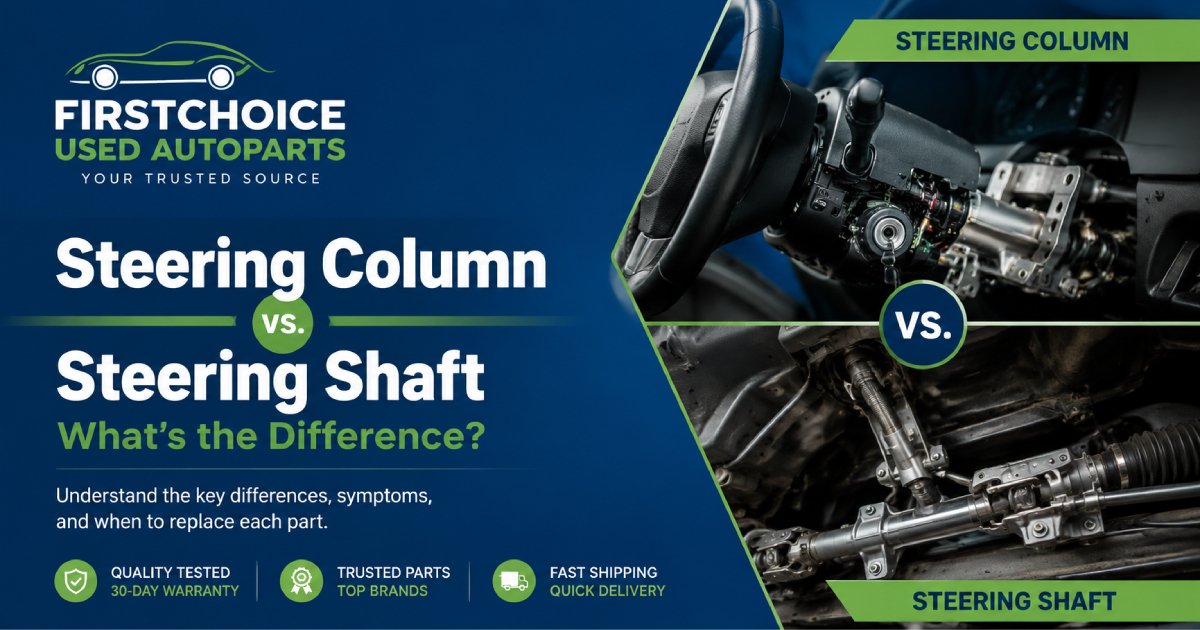
The steering column is the full assembly inside your cabin — it holds the steering wheel, controls the tilt/telescoping mechanism, houses the ignition, and carries all the electrical switches for turn signals, cruise, and horn. The steering shaft (also called the intermediate shaft) is the mechanical link between the bottom of that column and your steering rack or gear box. They are completely separate parts, fail for different reasons, and require different repairs.
Confusing the two leads to misdiagnosis — you replace an expensive column when the actual problem is a $60 shaft U-joint, or vice versa. This guide breaks down exactly what each part does, what symptoms point to each, and how to make sure you’re ordering the right one.
Need a used steering column? FirstChoice carries Ford, Chevy, Jeep, and Dodge — verified function, 30-day warranty.
Check Availability →What Is a Steering Column?
The steering column is the assembly that runs from the steering wheel down into the firewall of the vehicle. It’s a multi-component assembly that does far more than just connect the wheel to the car.
What’s inside a steering column:
- Column tube and housing — the main structural jacket that everything mounts to
- Tilt/telescoping mechanism — allows you to adjust steering wheel position
- Ignition lock cylinder — where you insert and turn the key
- Turn signal switch and cancelling cam — controls turn signals and self-cancels after turns
- Multi-function switch — controls wipers, cruise control, headlight stalk
- Clock spring (spiral cable) — maintains electrical continuity for airbag, horn, and steering wheel buttons while the wheel rotates
- Wiring harness connectors — 3 to 6 plugs connecting all electrical functions to the vehicle’s BCM
The column is entirely inside the cabin. It mounts to the firewall with a bracket and connects at the bottom to the steering shaft via a U-joint coupling.
What Is a Steering Shaft?
The steering shaft (also called the intermediate shaft, rag joint shaft, or u-joint shaft) is the mechanical link between the bottom of the steering column and the input shaft of the steering rack (rack-and-pinion) or steering gear box (recirculating ball).
What’s inside a steering shaft assembly:
- Upper U-joint — connects to the column output shaft
- Shaft body — typically a steel tube or solid shaft
- Lower U-joint — connects to the rack or gear box
- Slip joint — on some designs, allows the shaft to compress in a collision (safety feature) or accommodate suspension travel
The shaft passes through the firewall and is entirely mechanical — no electrical components. On most trucks and SUVs it’s visible by looking up under the dash or by tracing the steering column down to where it exits the firewall.
Steering Column
- Inside the cabin
- Contains electrical switches, ignition, clock spring
- Tilt/telescoping mechanism lives here
- Mounts to firewall bracket and dash
- Cost: $150–$380 used
- May require programming (Ford PATS, Dodge SKREEM)
Steering Shaft
- Passes through the firewall
- Purely mechanical — no electrical parts
- Contains U-joints and sometimes a slip joint
- Connects column to rack or gear box
- Cost: $40–$120 used/aftermarket
- No programming required — direct swap
Symptoms: Column Problem or Shaft Problem?
This is where most DIYers get confused. The symptoms overlap in one area — steering feel — but each has distinct indicators once you know what to look for.
| Symptom | Column | Shaft |
|---|---|---|
| Clunking/popping when turning at low speed | ✓ Primary shaft symptom | |
| Grinding/binding feeling during parking turns | ✓ Worn U-joint | |
| Dead spot in steering feel (loose then tight) | ✓ Failed slip joint | |
| Steering wheel wobble at highway speed | ✓ Column bearing worn | ✓ Bent shaft or worn U-joint |
| Airbag warning light (B-codes) | ✓ Clock spring failure | |
| Horn not working | ✓ Clock spring failure | |
| Turn signals don’t self-cancel | ✓ Cancelling cam worn | |
| Tilt won’t lock / column droops | ✓ Tilt mechanism worn | |
| Key sticks or won’t turn | ✓ Ignition cylinder | |
| Cruise control or audio buttons dead | ✓ Multi-function switch | |
| Clunk only felt through the wheel, not heard | ✓ Column U-joint at base | ✓ Shaft U-joint |
Quick diagnostic test for the shaft: Park the vehicle. With the engine off, rock the steering wheel back and forth with small inputs. If you hear or feel a distinct clunk or knock that repeats rhythmically, the steering shaft U-joint is the likely culprit — not the column.
The Clunk-on-Turn: The Most Misdiagnosed Steering Symptom
The most common call we get is: “I have a clunk or knock when I turn the steering wheel at low speed.” This symptom gets misattributed to tie rods, ball joints, and steering columns — but in the majority of cases, it’s the intermediate shaft U-joint.
Why? The intermediate shaft U-joint sits right at the firewall. It’s exposed to heat, road spray, and moisture. On high-mileage trucks (120,000+ miles), the U-joint grease dries out and the joint develops play. The clunk is the shaft binding and releasing as it passes through its arc of travel during turning.
How to confirm it’s the shaft:
- Have a helper rock the steering wheel while you watch the intermediate shaft at the firewall from under the dash
- Look for any movement or play in the shaft before the rack input shaft moves — any perceptible delay = worn U-joint
- Alternatively, have someone watch the U-joint from the engine bay while you rock the wheel — slop in the joint will be visible
Cost to fix: A used or aftermarket intermediate shaft for most trucks (F-150, Silverado, RAM) costs $45–$100. It’s a 45-minute job requiring only basic hand tools. This is the first repair to attempt when you hear the low-speed clunk — not a full column replacement.
When You Actually Need to Replace the Column
The full column needs replacement when:
- The tilt mechanism is broken and the column droops or won’t hold position
- The ignition cylinder is seized or the ignition switch has failed
- The clock spring is broken and can’t be replaced separately (some vehicles the clock spring is integrated)
- The column was in a collision and the collapsible section has compressed (safety columns are one-use)
- Multiple electrical failures exist simultaneously (turn signal, wipers, horn, cruise all failing = likely internal column wiring damage)
Collision rule: If the vehicle has been in a front-end collision hard enough to deploy the airbags, the steering column’s collapsible section has likely compressed. A compressed column cannot be reset — it must be replaced. Never reinstall a collision-damaged column.
When You Need Just the Shaft
Replace only the intermediate shaft when:
- You hear a clunk/knock on turns at low speed (parking lot speed)
- You feel a grinding or binding sensation that gets worse during full-lock turns
- You can see or feel play in the shaft U-joints with the engine off
- All electrical column functions (signals, horn, cruise) work normally
- Tilt and telescoping work correctly
Parts at a Glance: Column vs. Shaft
| Steering Column | Steering Shaft | |
|---|---|---|
| Location | Inside cabin, under dash | Passes through firewall |
| Electrical? | Yes — multi-function switches, ignition, clock spring | No — purely mechanical |
| Programming? | May be required (Ford, Dodge, Jeep) | Never required |
| Typical used cost | $150–$380 | $40–$120 |
| Install difficulty | Moderate — dash disassembly required | Easy — 2 bolts each end |
| Primary failure mode | Tilt wear, ignition wear, clock spring, electrical | U-joint wear, slip joint corrosion |
| Key symptom | Electrical failures, drooping wheel, key problems | Low-speed clunk, binding on turns |
“I was about to order a full steering column for my 2008 Silverado because of a bad clunk on turns. Thankfully I read this — it was the intermediate shaft U-joint. $58 part, 40 minutes, clunk completely gone. Full column would have been $220 and way more work.”
Confirmed it’s the column? FirstChoice has Ford, Chevy, Jeep, and Dodge steering columns in stock — tested, 30-day warranty.
Get a Free Quote →Frequently Asked Questions
What is the difference between a steering column and a steering shaft?
The steering column is the full assembly inside your cabin — housing the ignition, turn signal switch, clock spring, and tilt mechanism. The steering shaft (intermediate shaft) is the mechanical link between the base of the column and the steering rack, containing U-joints. They are separate parts with different failure modes.
What symptoms point to a bad steering column vs. a bad steering shaft?
Column problems: tilt won’t lock, ignition key issues, airbag warning light, dead horn, signals that don’t cancel. Shaft problems: low-speed clunk on turns, grinding during parking maneuvers, a dead spot in steering feel. If your electrical functions are fine and you only have the clunk, start with the shaft.
Can I replace the steering shaft without replacing the column?
Yes — the intermediate shaft is a completely independent component. It costs $40–$120 and requires no programming. It’s the right first repair when you have the low-speed clunk symptom.
What causes a steering column to go bad?
Worn tilt mechanism, failed ignition lock cylinder, broken clock spring, damaged turn signal cancelling cam, and corroded wiring connectors. High-mileage vehicles (150,000+ miles) and humid climates accelerate these failures.
What causes a steering shaft to go bad?
Worn U-joints from dry grease, water intrusion, and corrosion. Off-road use and wet climates accelerate shaft wear. The clunk-on-turn at low speed is the clearest symptom.
How much does a used steering column cost vs. a steering shaft?
Used steering columns: $150–$380. Steering shafts (used or aftermarket): $40–$120. Always diagnose which part has actually failed before ordering — the shaft is the cheaper and easier repair if it’s the culprit.