
Quick Answer: A steering knuckle is likely bent when, after a pothole or curb hit, camber or toe on one wheel will not set to spec, the steering wheel stays off center, or one tire wears fast on an edge. A shop confirms it by measuring steering axis inclination, the included angle and toe-out on turns and comparing both sides. The casting rarely wears out, so a VIN-matched used OEM knuckle is a sound fix.
You hit a pothole or clipped a curb, the car now pulls or the steering wheel sits crooked, and the alignment shop says it will not hold. The next quote on the counter may be new struts and control arms. Before you approve it, check the one part that can bend a degree and still look perfect: the steering knuckle.
This guide is for drivers who keep paying for alignments that do not fix the car. It covers the symptoms, how a shop proves a bent knuckle, what else bends in the same hit, typical costs, and how to match a used OEM steering knuckle if yours is bent.
Key facts
- A bent steering knuckle usually shows as camber or toe that will not set to spec on one wheel, or a steering wheel left off center after alignment.
- An alignment that will not set points to a bent part. An alignment that drifts out after a few weeks usually points to worn or loose parts.
- Alignment shops check for a bent steering knuckle by comparing steering axis inclination (SAI), the included angle and toe-out on turns between the left and right wheels.
- A steering knuckle has no moving parts, so a straight, uncracked used OEM knuckle from an undamaged donor corner works like the original.
- A used steering knuckle must match the side, front or rear position, drivetrain, brake package, hub bearing style and wheel speed sensor mount.
What does a steering knuckle do, and why does a bent one hide so well?
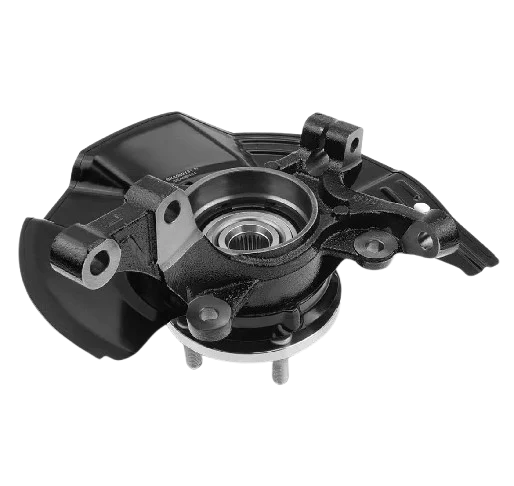
The steering knuckle is the cast or forged part that holds the wheel hub and turns with the steering. It connects to the strut or upper ball joint, the lower ball joint and the tie rod end, and it carries the brake caliper and usually the wheel speed sensor.
Each of those points sets a wheel angle, so a knuckle bent by a degree or so changes camber or toe. That is too small to see, and a casting has no rubber or fluid to show damage. A bent knuckle looks fine until it is measured.
Knuckles are strong, so the tire, wheel, tie rod or control arm often gives way first. A hard, square hit, such as sliding sideways into a curb, can still drive the load into the knuckle. On front-wheel drive cars the CV axle runs through it too; see axle shafts vs CV axles.
What are the symptoms of a bent steering knuckle?
The main bent steering knuckle symptoms are an alignment that cannot be set to spec on one wheel, a steering wheel that stays off center, and one tire wearing fast on an edge. You feel or measure them more than you hear them.
- Camber or toe will not come into spec on one wheel, or the technician runs out of adjustment on that side only.
- Steering wheel off center, or a pull that started right after the hit and an alignment did not cure.
- One tire wearing on its inner or outer edge within a few thousand miles of a fresh alignment.
- Unequal turning: the car turns tighter one way, or a tire rubs at full lock on one side only. That can point at a bent tie rod or steering arm, and the steering arm is part of the knuckle on most cars.
- A wheel that leans at the top compared with the other side. Only a large bend shows this, and that knuckle may also be cracked.
A bent knuckle is usually quiet. A hum that rises with speed points at a damaged hub bearing, a clunk at a ball joint, tie rod end or sway bar link, and a new ABS light at a wheel speed sensor or wire hit at the knuckle.
Will not hold or will not set: what is the alignment shop telling you?
Those phrases point at different parts. An alignment that will not set cannot be brought into spec on the rack, which suggests something is bent. One that will not hold was set correctly but drifts out again, which usually means something is loose or worn.
| What the shop says | What it usually means | Parts to check |
|---|---|---|
| Cannot get camber or toe into spec on one wheel | Something on that corner is bent | Knuckle, strut, lower control arm, tie rod |
| Angles in spec, steering wheel off center | Toe set with the wheel off center, rear toe pushing the car sideways, or a bent steering arm | Tie rod adjustment, rear toe, steering arm |
| Set fine, then out again within weeks | Worn parts or slipping adjusters | Ball joints, bushings, tie rod ends, camber bolts |
| Both sides off after a harder crash | Mounting points have moved | Subframe, strut towers, control arms |
Ask for the before and after printout. It shows which wheel and which angle is off, and that is the evidence you need before you approve parts.
How a shop proves the knuckle is bent, not the strut or control arm
The shop reads angles a basic alignment does not adjust: steering axis inclination (SAI), the included angle (SAI plus camber) and toe-out on turns, compared left to right. Not every report shows them, so ask.
- SAI normal, included angle off: the mounting points are usually fine, and a part on the wheel side is bent. That usually means the knuckle, or the strut on a strut suspension.
- SAI off, included angle normal: the knuckle is probably fine, and a control arm, subframe or strut tower has likely bent or moved.
- Toe-out on turns uneven side to side: usually a bent steering arm, which is cast into the knuckle on most cars.
On a MacPherson strut car the strut and knuckle bolt together, so the shop may check the strut for straightness or swap in a known good part. If the strut is the bent piece, a used OEM strut matched to your suspension package fixes that corner.
Tie rods bend easily in the same hit. If the steering also clunks or wanders, read rack and pinion vs tie rod symptoms.
Safety: Do not drive on a knuckle with a visible crack, a wheel that leans or steering that binds. Have a qualified technician inspect the corner.
How much does it cost to replace a bent steering knuckle?
With a used OEM part, replacing one knuckle and aligning the car typically costs several hundred dollars in total, more on trucks or rusted parts. These are typical US market prices per knuckle, before labor; the exact price depends on the vehicle.
| Knuckle | New OEM from dealer (typical) | New aftermarket (typical) | Used OEM (typical) |
|---|---|---|---|
| Front, car or small SUV | $150-$450 | $50-$180 | $40-$175 |
| Front, midsize SUV or pickup | $250-$700 | $90-$300 | $75-$275 |
| Front, with hub and bearing installed | Usually sold separately | $120-$350 | $75-$300 |
| Rear, independent rear suspension | $150-$500 | $60-$220 | $40-$200 |
Labor typically runs about 1.5 to 3 hours per side, more when ball joints or the hub are rusted in. Add a full alignment, typically about $100 to $200. Many shops also fit a new hub bearing, since the old one took the same hit.
Two struts and two control arms usually cost far more than one knuckle, and they will not fix a bent one. FirstChoice quotes a used steering knuckle at up to 70% less than a new dealer part, and the quote is free.
Can a bent knuckle be straightened, and is a used one safe?
Replace a bent knuckle; do not straighten it. Heating or bending a steering casting can leave hidden cracks, and vehicle makers generally call for replacing bent steering and suspension parts. Camber correction bolts can pull the reading back into spec on some strut cars, but they work around the bend and cannot fix a bent steering arm.
A used OEM knuckle is a sound choice because the knuckle has no moving parts. The bearing, ball joints and tie rod end wear; the casting does not. The rule: never reuse a knuckle from the damaged corner of a crashed donor. Have a qualified technician install it, use new single-use nuts and cotter pins where the service manual calls for them, torque the fasteners to spec and align the car.
What must match for a used steering knuckle to fit?
Knuckles that look alike can differ in ways that only show at install, so send your VIN and the corner.
| What must match | Why it matters |
|---|---|
| Side | Left and right knuckles are mirror images |
| Front or rear | Independent rear suspension has its own rear knuckles |
| Drivetrain | A knuckle on a driven wheel has a bore for the CV axle, so 2WD and 4WD trucks, or FWD and AWD rear knuckles, often differ |
| Brake package | Larger heavy duty, towing or sport brakes can use different caliper mounts |
| Hub bearing style | Bolt-on hub units and press-in bearings need different knuckles |
| Ball joint, strut and tie rod mounts | Pressed or bolted ball joints, strut clamps and taper sizes vary by model and year |
| Wheel speed sensor mount | The ABS sensor hole or bracket must fit your sensor |
The number cast into a knuckle is often a casting number, not the service part number, so treat it as a clue. Our guide to decoding your VIN for the right part shows what the VIN tells a parts specialist.
What should you check in the photos before you approve a used knuckle?
Look for cracks, impact marks, repair marks and damaged threads. The supplier photographs the actual knuckle and nothing ships until you approve those photos, so ask for both faces and every mounting point.
- Casting number and side: readable, and the shape matches your old knuckle from the same angle.
- Cracks: none at the ball joint taper, strut clamp, steering arm or caliper ears. Aluminum knuckles can crack as well as bend, so look closely.
- Impact marks: no fresh gouges or flattened edges. Ask which corner of the donor was damaged.
- Heat or weld marks: blued metal, grinding or weld beads mean someone tried a repair. Pass on it.
- Threads and bores: clean caliper bolt threads, an intact sensor hole and a bearing bore without deep pitting.
Photos cannot show a small bend, so the final proof is the alignment: with a straight knuckle, that corner sets into spec and its SAI and included angle match the other side. For more, see how to check used parts quality online.
How does buying a used steering knuckle from FirstChoice work?
- Send your year, make, model, VIN and the corner, and say whether you want it bare or with the hub.
- A parts specialist matches the knuckle to your VIN before you pay and sends the price, warranty term and shipping details. The quote is free.
- The supplier confirms the part is available and in good condition, then photographs the actual knuckle.
- Nothing ships until you approve the photos.
- Delivery target is within 5 business days of photo approval, by tracked parcel to your card’s billing address.
Phone orders at 1-888-383-2439 get 10% off, Monday to Friday, 9 AM to 6 PM EST. Or buy a used steering knuckle through the free quote form, and book the install and alignment with your shop.
Frequently Asked Questions
Can a bent steering knuckle cause a vibration?
Usually not. A bent knuckle mostly causes a pull, an off center steering wheel and uneven tire wear. Vibration after a pothole more often comes from a bent wheel, a damaged tire or a hub bearing. A tire with a sidewall bulge must be replaced.
Is it safe to drive with a bent steering knuckle?
Only gently, and only to a shop. The knuckle holds the wheel, the brake caliper and the steering link, and the hit that bent it can also crack it. Do not drive if the wheel leans, the steering binds or you see a crack.
Do I need to replace both steering knuckles?
No. Knuckles rarely wear out, so only the bent one needs replacing. A hard hit can damage both sides, so ask the shop to compare SAI and included angle on both wheels, and check the bearing and ball joint while it is apart.
Do I need an alignment after replacing a steering knuckle?
Yes. Swapping the knuckle disturbs the tie rod and strut or ball joint mounts, so toe and camber change. Book a full alignment the same day. If that corner still will not set to spec, something else there is bent.
What warranty comes with a used steering knuckle from FirstChoice?
Used steering knuckles carry a 30-day parts warranty, and labor is not covered. They ship by tracked parcel. A damaged or incorrect part is replaced, or refunded in full if no replacement is available.
Related reading:
Steering Clunk or Wander: Rack and Pinion or Tie Rod?
Used Axle Shaft vs CV Axle
Used Rack and Pinion Buyer’s Guide
How to Decode Your VIN for the Right Part