
Quick Answer: Replace first whatever sat under the water line and cannot be dried reliably: airbags, the airbag control module, seat belt buckles and retractors, and any submerged control module such as the ECM. Change milky oil or fluids before running the engine and pull the wet carpet padding. Dry, service and watch mechanical parts. Water at the dashboard, or salt water over the seats, usually means walking away.
Your car sat in floodwater during the storm, the insurer did not total it, and it may even start and drive as if nothing happened. That calm is the trap. Water left in connectors and wiring keeps corroding metal for weeks, and the first warning light often comes after you have settled with the adjuster.
This guide is for owners deciding what to fix on a flooded car worth keeping. It covers reading the water line, what to do before you turn the key, which flood damaged car parts to replace first, typical used OEM costs and when to walk away.
Key facts
- Flood damage to car electronics often shows up weeks later, because water trapped in connectors and wiring keeps corroding the metal after the car seems dry.
- The water line sets the flood repair scope: water over the floor reaches modules, wiring and seat belt parts, and water at the dashboard usually means a total loss.
- A flooded engine should not be cranked until the air intake and oil are checked, because water in a cylinder can bend a connecting rod.
- A used OEM engine computer (ECM or PCM) typically costs about $100 to $400, against about $500 to $2,000 new from a dealer, before programming.
Why does a flooded car run fine, then fail weeks later?
Because flood damage is mostly corrosion, and corrosion takes time. Water trapped in connectors and circuit boards stays long after the carpet looks dry, and its dirt and any salt keep eating at copper pins and solder joints. Stranded wire can also wick moisture along under the insulation, away from the spot that got wet.
- Warning lights that come and go, especially airbag (SRS), ABS or check engine.
- Windows, locks, seats or mirrors that act on their own or quit.
- A battery that drains while parked because a corroded circuit keeps drawing current.
- Network codes (U codes), stalls or a no start as modules lose contact.
- A musty smell or fogged glass from wet carpet padding.
None of these show on the day the water goes down, so how the car drives today proves little.
How high did the water get, and what does that mean for repairs?
The water line is the best single predictor of the bill. Look for silt or debris lines on door panels, seat bases and under the dash, and mud in the spare tire well and seat rails.
| Water reached | What usually got wet | Typical outcome |
|---|---|---|
| Below the door sills | Brakes, wheel bearings, low engine bay connectors, axle and transmission vents | Usually repairable: dry, change contaminated fluids, watch |
| Over the floor, below the seats | Carpet and padding, floor wiring, modules under seats or console, belt buckles, seat motors | Repairable on many cars; submerged modules and safety parts get replaced |
| Seat cushions to lower dash | Seat foam, seat side airbags, belt retractors, footwell fuse boxes | Costs climb fast; get a written estimate first |
| At or above the dashboard | Instrument cluster, radio, climate controls, body module, most wiring | Usually a total loss |
| Into the air intake | Engine cylinders | Do not crank; the engine may need replacing |
Salt or brackish storm surge water corrodes far faster than rainwater, and days in the water do more harm than hours. Either pushes a row toward the worse outcome.
Safety: A hybrid or electric car whose high voltage battery sat in salt water can catch fire days or weeks later. Do not charge it, park it outside away from buildings and have a technician check it.
What should you do before you start a car that sat in floodwater?
Do not start it until you know whether water reached the air intake and the oil. Cranking with water in a cylinder can bend a connecting rod, turning a drying job into an engine job.
- Photograph everything: the water line inside and out, carpet, engine bay and odometer. Your insurer and shop will want them.
- Disconnect the battery. Wet circuits with power on them corrode faster, and some modules stay powered with the key off.
- Check the air filter. If it is wet, the spark plugs come out (glow plugs or injectors on a diesel) and the engine is turned by hand to push water out.
- Pull the dipsticks. Milky oil or foamy transmission fluid means water got in. Change it before running, and again after a short run.
- Check the axles and transfer case. They breathe through vents, so a hot axle in cold water can draw water in. A shop checks the fluid at the fill plug.
- Dry the cabin. Pull the carpet and padding and run fans or a dehumidifier. EPA mold guidance for homes says to dry wet materials within 24 to 48 hours.
Which flood damaged car parts should you replace first?
Replace safety parts and submerged electronics first, then fluids and the interior, and watch the rest. A practical rule: if an electronic part sat under water, replace it; if a mechanical part got wet, dry it, service it and watch it.
First: airbag and seat belt parts that sat in water
On many cars the airbag control module (SRS module) sits low, under the center console or a seat, where water collects. Many vehicle makers’ repair procedures call for replacing submerged SRS parts, such as the module, crash sensors and belt pretensioners, because corrosion can keep them from working in a crash.
Seat side airbags soak with the seat foam. On most newer cars the front belt buckles hold a switch the airbag system reads, and retractors near the floor can fill with silt so the belt will not retract or lock. Replace mud soaked belts with used OEM seat belts of the same part number, and submerged airbags with undeployed used OEM airbags from a car that was not flooded. A qualified technician should install them and clear the SRS codes; see whether used airbags are safe.
Second: the engine computer and modules below the water line
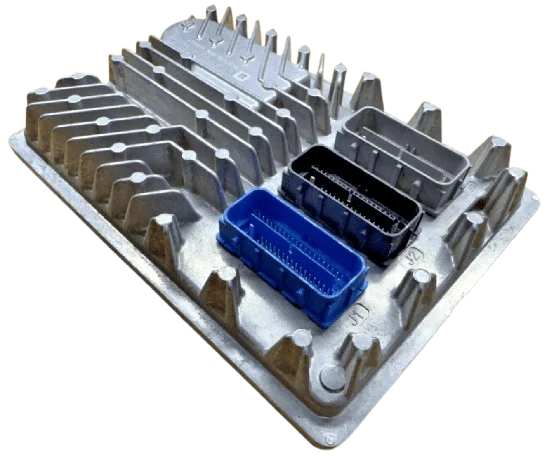
An engine computer (ECM or PCM) that sat in water should be replaced, not dried. Water leaves residue under chips and on solder joints, and the module may run for weeks before it drops out. It sits behind a kick panel or under the dash on many cars, and in the engine bay on others.
Engine bay computers are built to resist splash and spray, not to sit under water, so unplug the connector and look. Green or white crust on the pins or a tide mark on the case means replacing the module, and often the connector. A used OEM ECM matched to your VIN costs a fraction of a new one, but most cars from about the mid 2000s on need it programmed to the VIN and immobilizer by a dealer or a shop with factory level software.
Give the transmission and body control modules, footwell fuse boxes and fuel pump connector the same test.
Third: fluids, filters and the interior
- Oil, filters and any milky fluid: engine air, cabin air, transmission, axles and transfer case.
- Carpet padding, and usually the carpet. Padding holds water like a sponge and grows mold.
- Seat foam that soaked through, treating any seat airbag as a safety part.
Starters, alternators, wheel bearings, brakes and the blower motor can often be saved after a short fresh water flood. Dry and service them, then watch for noise, slow cranking or a weak charge over the next few months.
What does flood repair cost, and when should you walk away?
The bill depends mostly on how many modules and safety parts sat under water. Below are typical US market ranges for the parts that usually decide the total; the exact price depends on your vehicle.
| Part | Used OEM (typical) | New from dealer (typical) | Extra work to plan for |
|---|---|---|---|
| Engine computer (ECM or PCM) | $100-$400 | $500-$2,000 | VIN programming, typically about $100 to $250 |
| Airbag, per position | $80-$300 | $400-$1,200 | SRS code clearing with a capable scan tool |
| Airbag control (SRS) module | $100-$300 | Varies widely by vehicle | Programming on some newer vehicles |
| Instrument cluster (water at the dash) | $120-$380 | $600-$1,400 | Mileage setup and programming on many models |
FirstChoice quotes a used engine computer (ECM) and other used OEM electronics at up to 70% less than a new dealer part, and the quote is free. If insurance is paying, see used OEM parts in insurance claims.
Signs it is time to walk away
- Water reached the dashboard, or salt water soaked the seat cushions.
- The engine took water, was cranked and now knocks or fails a compression test. Weigh replacing the engine against buying another car.
- Several modules are failing, or new U codes keep appearing weeks later.
- The estimate nears the car’s market value before hidden corrosion is counted.
- A hybrid or electric car’s high voltage battery or its wiring sat in water.
What must match for a used ECM or safety part to fit?
A replacement must match your original by part number and VIN, not just year, make and model. Two cars of one model can need different computers, airbags and belts.
| What must match | Why it matters | Where to find it |
|---|---|---|
| Hardware part number | Connectors and internal circuits must be the same | Label on your old module |
| Software or calibration ID | A shop can often reflash a different calibration, not different hardware | Module label or scan tool |
| Engine, transmission, emissions | Fuel, spark and shift settings are specific; federal and California calibrations differ | VIN decode and the underhood emissions label |
| Airbag and belt part numbers | Connectors, inflators and pretensioners vary by trim, seat and side | Label on the part, plus your VIN |
Read the label on the flooded module before anyone throws it out. Our guide to decoding your VIN for the right part shows what the VIN tells a parts specialist.
What should you check in the photos before you approve a part?
Look for any sign the replacement was ever wet. The supplier photographs the actual part and nothing ships until you approve those photos, so ask for the label and connector ends close up.
- Label: readable, with the part number on your quote.
- Connector pins: bright and straight, with no green or white crust.
- Case and seals: no tide marks, dried mud, cracks or pry marks.
- Airbags: cover, connector and label undamaged.
- Seat belts: clean webbing, no mud in the buckle. Ask whether the pretensioner has fired; a belt with a fired pretensioner must not be reused.
Photos cannot prove a module works, so your shop should scan it after install. For more, see how to check used part quality online.
How does ordering a used ECM from FirstChoice work?
- Send your year, make, model and VIN, plus the old module’s part number if readable.
- A parts specialist matches the part to your VIN before you pay and sends the price, warranty term and shipping details. The quote is free.
- The supplier confirms the part is in good condition, pulls it and photographs the actual part.
- Nothing ships until you approve the photos.
- Delivery target is within 5 business days of approval, by tracked parcel to your card’s billing address.
Phone orders at 1-888-383-2439 get 10% off, Monday to Friday, 9 AM to 6 PM EST. Or buy a used ECM through the quote form and book programming with your shop.
Frequently Asked Questions
Is a flood damaged car worth fixing?
Often, if the water stayed below the seat cushions, it was fresh water and the car was dried within a day or two. Then the job is submerged safety parts and modules, fluids and padding. Water at the dashboard or salt water over the seats usually costs more than the car is worth.
How long after a flood do electrical problems show up?
Often within a few weeks, sometimes months. Water trapped in connectors keeps corroding pins and solder joints after the car seems dry, so faults start as warning lights that come and go. Have a shop scan the car again a few weeks after the flood.
Can you dry out a wet ECM and reuse it?
Not reliably. Drying removes the water but not the residue and corrosion left on the circuit board and pins, so a dried module can fail weeks later. Replace a submerged engine computer with a part number matched unit, programmed to your VIN where required.
Does car insurance cover flood damage?
In the US, flood damage to a car is usually covered by comprehensive coverage if you carry it, not by liability or collision alone. If damage shows up after the first estimate, report it; insurers often handle it as a supplement to the claim, so keep dated photos and the shop’s findings.
What warranty comes with a used ECM from FirstChoice?
A used ECM carries a 30-day parts warranty, and labor is not covered. It ships by tracked parcel. A damaged or incorrect part is replaced, or refunded in full if no replacement is available. Programming and installation are done by your mechanic.
Related reading:
Used OEM Parts After an Accident: Insurance Claims Explained
Are Used Airbags Safe? The Complete Safety Guide
Will a Used Instrument Cluster Work in My Car?
Seat Belt Won’t Retract or Latch? Fix, Replace or Buy Used