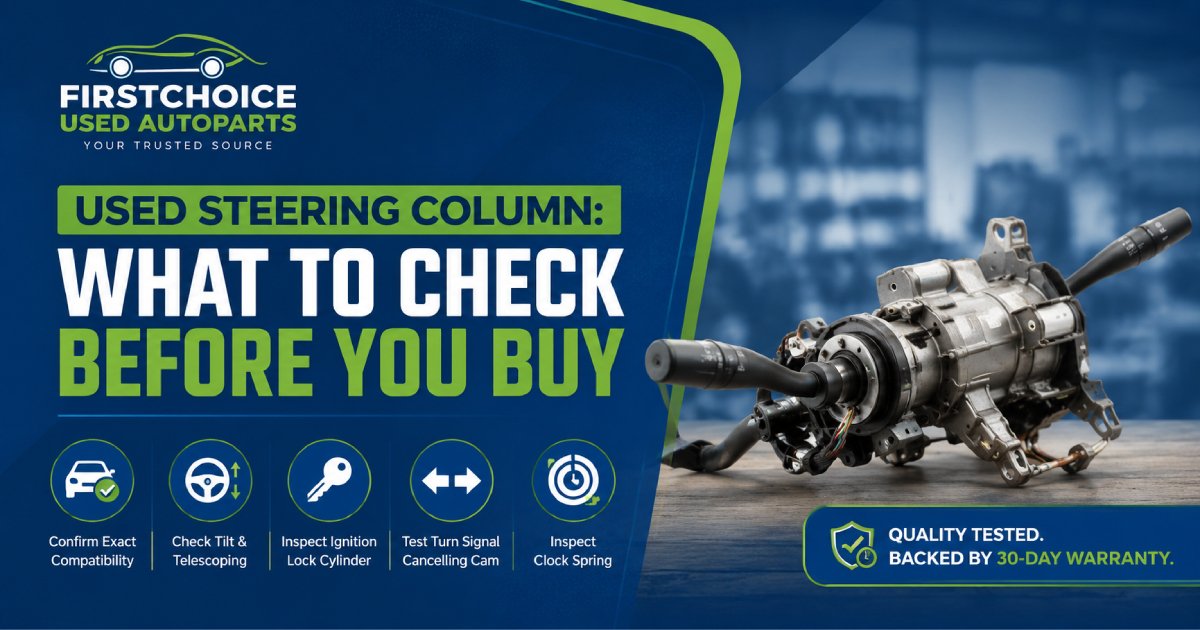
Before buying a used steering column, confirm exact year/make/model/trim compatibility, verify tilt and telescoping functions work, check the ignition cylinder condition, and confirm whether the column requires anti-theft programming for your vehicle. Skipping any of these steps is the fastest way to end up with a column that fits physically but won’t start your car — or one that disables your airbag.
Steering columns are more complex than they look. Beyond the shaft and mounting bracket, a modern column contains the turn signal cancelling cam, clock spring (airbag/horn continuity), column-mounted controls for wipers and cruise, and often the ignition lock cylinder with its transponder ring. Each of these must match your vehicle’s year, trim, and electronic configuration.
Need a used steering column? FirstChoice carries Ford, Chevy, Jeep, and Dodge columns — 30-day warranty.
Check Availability →Step 1: Confirm Exact Vehicle Compatibility — Not Just Year and Make
The biggest mistake buyers make is ordering a steering column by year and make alone. Steering columns vary by trim level, cab style, drivetrain, and — critically — whether the vehicle has column-mounted controls (cruise, audio, wiper stalk) or a simpler base configuration.
| Vehicle | Generation Range | Key Variation |
|---|---|---|
| Ford F-150 | 2004–2008 (10th gen) | Different connector from 2009–2014 |
| Ford F-150 | 2009–2014 (12th gen) | 3 trim configurations (base, XLT, Lariat+) |
| Ford F-150 | 2015–2020 (13th gen) | Aluminum body gen; column redesigned |
| Chevy Silverado | 2003–2007 (GMT800) | Column shift vs. floor shift variants |
| Chevy Silverado | 2007–2013 (GMT900) | Multiple trim electrical packages |
| Chevy Silverado | 2014–2018 (K2XX) | New multi-function switch design |
| Jeep Grand Cherokee | WJ 1999–2004 | Does not interchange with WK 2005–2010 |
| Jeep Grand Cherokee | WK 2005–2010 | Column-shift WK has separate column variant |
| Jeep Wrangler | TJ 1997–2006 | Manual vs. automatic shifter position differs |
| Dodge RAM | 2002–2008 (2nd gen) | Column shift available; different wiring |
| Dodge RAM | 2009–2018 (4th gen) | Electronic steering (EPAS) vs. hydraulic |
4WD vs. 2WD matters: Some column-mounted 4WD selector switches are integrated into the column wiring harness. A column from a 2WD truck will be missing these connectors and will not plug into a 4WD truck’s dash harness correctly.
Step 2: Check Tilt and Telescoping Function
Tilt steering is standard on nearly all post-1990 trucks. Telescoping (adjustable column length) is a premium feature found on XLT, LTZ, Laramie, and higher trims. If your vehicle has telescoping and you order a tilt-only column, the column will physically mount but the telescoping mechanism and its motor will be absent.
What to ask your seller: “Does this column have both tilt and telescoping?” and “Does the telescoping motor turn smoothly in both directions when tested?”
Test the tilt lever or button yourself before accepting delivery. A column where the tilt mechanism is frozen or broken is a safety hazard — the column can drift out of position while driving.
Step 3: Inspect the Ignition Lock Cylinder
This is the single most important item on this list for Ford and Chrysler vehicles. Here’s why:
Ford’s PATS (Passive Anti-Theft System) uses a transponder ring mounted around the ignition cylinder. When you insert a key, the ring reads the key’s chip and communicates with the PCM. If the transponder ring in your replacement column is already programmed to a different VIN, your car will crank but not start — and you’ll get a PATS fault code.
The fix: Transfer your original ignition cylinder from your old column to the new one. This is a 10–15 minute job with the correct pin tool. Your key will continue to work, and PATS programming is not required.
Alternatively, the replacement column can be programmed to your PCM — but this requires a Ford IDS or compatible scan tool and a dealer-level procedure.
| Make | Anti-Theft System | Risk Level | Recommended Approach |
|---|---|---|---|
| Ford (2001–2014) | PATS | High | Swap original ignition cylinder |
| Chrysler/Dodge (2004–2012) | SKREEM | High | Swap original cylinder or wiTECH program |
| GM (2003–2013) | VATS/PASS-Key III | Medium | Swap cylinder; GM key resistance chip must match |
| Jeep (2005–2014) | SKREEM | High | Swap original cylinder recommended |
| Toyota/Honda pre-2015 | Transponder in key only | Low | Plug-and-play — no cylinder swap required |
Step 4: Test the Turn Signal Cancelling Cam
The cancelling cam is a plastic notched ring on the steering column shaft that resets your turn signal lever after you complete a turn. Worn or broken cancelling cams result in turn signals that stay on after turning — a minor but constant annoyance and a safety issue.
Ask the seller to show the turn signal lever self-cancelling when the column is rotated. If the cam is broken or missing, the cost to replace it is $15–35 in parts — not a deal-breaker, but it’s worth negotiating the price down.
Step 5: Inspect the Clock Spring (Spiral Cable)
The clock spring lives between the steering column and steering wheel. It’s a coiled ribbon of wire that allows the wheel to rotate freely while keeping the horn, airbag, cruise control, and audio buttons connected. A damaged clock spring causes:
- Airbag warning light (B1317, B1318, or similar)
- Horn failure
- Dead cruise control or steering wheel audio buttons
The clock spring is typically a separate part from the column itself — but if a used column was removed carelessly (column rotated without the wheel attached), the clock spring can snap internally. You won’t always see visible damage. Ask the seller: “Was the steering wheel attached when the column was removed?”
Pro tip: If you’re ordering a column with the clock spring included, confirm the clock spring part number matches your vehicle’s airbag generation. Pre-2010 and post-2010 Ford F-150 clock springs have different connector configurations.
Step 6: Check the Wiring Harness Connectors
Modern steering columns have multiple wiring connectors — typically 3 to 6 plugs for turn signals, cruise control, ignition, airbag, and column controls. Bent or broken connector pins are common in pulled columns because the harness is often disconnected under the dash in tight spaces.
What to look for:
- Pins should be straight and fully seated in each connector housing
- Connector locking tabs should be intact — broken tabs mean connectors won’t seat securely
- No visible wire splices or tape repairs in the harness
- Ignition switch connector (the large one at the top of the column) should be fully intact
Step 7: Check the Column Shaft for Straightness
A bent column shaft is a red flag indicating the vehicle may have been in a front-end collision. The column shaft should rotate smoothly with no wobble or grinding. Check by placing the column on a flat surface and rotating the shaft slowly — any wobble or rough spots indicate damage.
Collision-damaged columns can also cause:
- Steering wheel shimmy at highway speeds
- Clunking or grinding noise when turning
- U-joint wear at the column-to-rack connection point
Step 8: Confirm Warranty Terms
A used steering column with no warranty is not worth the discount. At minimum, you need a 30-day warranty that covers the column function — tilt, telescoping, ignition operation, and electrical. If the seller can’t offer any warranty, walk away.
Ask specifically: “Does the warranty cover the ignition switch and turn signal functions, or just the column structure?” Some sellers warranty the physical column but exclude electrical components.
“I ordered a used steering column for my 2011 F-150 XLT from FirstChoice. They confirmed the tilt/telescoping functions and told me upfront to swap my original ignition cylinder to avoid any PATS issue. Took me about 20 minutes with a YouTube video. Column works perfectly, saved $680 over dealer price.”
FirstChoice carries Ford, Chevy, Jeep, and Dodge steering columns — verified tilt/telescoping function, 30-day warranty.
Find Your Steering Column →5 Questions to Ask Before You Confirm the Order
- Does the column have tilt only, or tilt and telescoping? (Confirm this matches your vehicle’s original configuration.)
- Is the ignition cylinder included? (If yes, you’ll likely need to swap your original or program the new one. If no, you keep your original — simpler.)
- Was the steering wheel on the vehicle when the column was removed? (If not, the clock spring may be damaged.)
- Does the column have column-mounted cruise and audio controls? (Must match your trim level’s wiring harness.)
- What’s the mileage and what does the warranty cover? (Lower mileage = less wear on the tilt mechanism; warranty scope matters.)
Used Steering Column Cost by Make
| Make / Model | Typical Used Price | Programming Required? |
|---|---|---|
| Ford F-150 (2004–2014) | $180–$320 | Yes (PATS) — swap ignition cylinder |
| Ford F-250/F-350 | $200–$375 | Yes (PATS) |
| Chevy Silverado (2003–2018) | $150–$280 | Usually not required |
| GMC Sierra | $150–$280 | Usually not required |
| Jeep Grand Cherokee (WK) | $175–$380 | Yes (SKREEM) |
| Jeep Wrangler (TJ/JK) | $140–$260 | Usually not required |
| Dodge RAM (2002–2018) | $160–$340 | Yes (SKREEM) for 2006+ |
| Toyota Tacoma / Tundra | $130–$240 | No — plug-and-play |
Frequently Asked Questions
What should I check when buying a used steering column?
Confirm exact compatibility (year/make/model/trim/drivetrain), verify tilt and telescoping function, check the ignition cylinder for PATS/SKREEM anti-theft issues, inspect the clock spring, check wiring connector pins, confirm the shaft is straight, and verify warranty terms before ordering.
Do used steering columns need to be programmed?
Ford (PATS) and Chrysler/Jeep/Dodge (SKREEM) columns may require programming if the ignition cylinder is included. The easiest solution is to swap your original ignition cylinder into the replacement column — this eliminates the programming requirement and lets you keep your existing key.
Can a used steering column cause a no-start condition?
Yes — if the column’s PATS transponder ring is already paired to a different VIN, your car will crank but not start. Always swap your original ignition cylinder or have the column programmed by a shop with the correct scan tool.
Are steering columns interchangeable between model years?
Only within specific generation ranges. Even within the same generation, trim level differences (base vs. XLT vs. Lariat) can create wiring and connector mismatches. Confirm the exact year range and trim before ordering.
What is the clock spring in a steering column?
The clock spring is a coiled ribbon cable that connects the rotating steering wheel to fixed wiring — horn, airbag, cruise, and audio controls. A broken clock spring causes an airbag warning light, dead horn, and non-functional steering wheel buttons.
How much does a used steering column cost?
Used steering columns range from $130–$380 depending on make, model, and options. Ford and Chevy columns are the most common at $150–$320. Jeep and Dodge columns with column-mounted controls or column shifters run $175–$380.
Should I replace the ignition cylinder when replacing the steering column?
No — transfer your original ignition cylinder into the new column. This avoids PATS/SKREEM programming requirements and lets you keep your current keys. It’s a 10–15 minute job with a pin removal tool.