
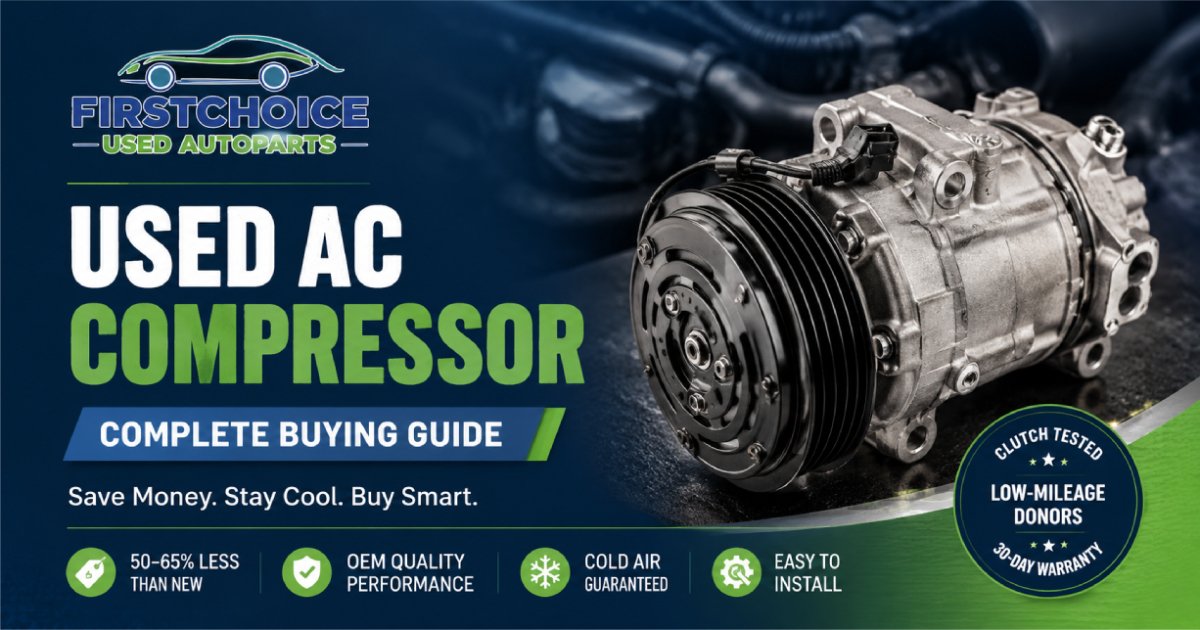
A used AC compressor that hasn’t seized internally costs 50–65% less than new OEM and cools just as well. The catch: you must know how the old compressor failed before ordering a replacement, and the system must be flushed regardless of which type of replacement you use. A compressor that died from internal seizure sent metal debris through your condenser, lines, and evaporator — skip the flush and the replacement unit fails in weeks for the same reason.
This guide covers what to check before ordering, how to identify a compressor that’s safe to use used, oil requirements, and the full 5-step installation process for a successful repair.
Need a used AC compressor? FirstChoice carries Sanden, Denso, Delphi, and Seltec units — clutch tested, low-mileage donors, 30-day warranty.
Check Availability →Step 1: Know How Your Compressor Failed
Before ordering any replacement — used or new — determine the failure mode of the original compressor. The answer determines whether you can safely use a used compressor and what additional parts you must replace.
| Failure Mode | Debris in System? | Safe to Use Used? | Required Additional Parts |
|---|---|---|---|
| Clutch coil burned out | No | Yes — compressor body is fine | New clutch coil only; full flush not required |
| Clutch bearing seized/noisy | No | Yes | New clutch bearing; flush not required |
| Compressor seized internally | Yes — metal debris throughout | Only after full system flush | Flush system, replace orifice tube, replace receiver-drier/accumulator |
| Refrigerant leak at compressor seal | No | Yes | New shaft seal or full compressor; flush not required |
| Compressor noisy but not seized | Partial — early wear debris | With flush recommended | Flush system, replace receiver-drier/accumulator |
| Unknown failure / old system | Unknown | With flush required | Full flush, orifice tube, receiver-drier |
Seized compressor rule: If your original compressor seized (locked up, belt stopped turning, loud metal grinding before failure), do not install any replacement without a complete system flush. Metal particles from a seized compressor collect in the condenser’s fine channels and the orifice tube. Flushing, orifice tube replacement, and receiver-drier replacement are mandatory — not optional.
Step 2: Verify Exact Compatibility
AC compressors are specific to vehicle year, make, model, and engine. Even within the same model, different engine options (V6 vs. V8, different displacement) may use different compressor mounting brackets and belt configurations. Always specify your engine when ordering.
| Vehicle | Common Compressor Brand | Refrigerant |
|---|---|---|
| Toyota Tacoma / Tundra / Camry | Sanden or Denso | R-134a (pre-2017), R-1234yf (2017+) |
| Honda Accord / Civic / CR-V | Sanden or Denso | R-134a (pre-2017), R-1234yf (2018+) |
| Ford F-150 / Explorer | Seltec / Panasonic | R-134a (pre-2021), R-1234yf (2021+) |
| Chevy Silverado / GMC Sierra | Delphi / Harrison | R-134a (pre-2019), R-1234yf (2019+) |
| Dodge RAM / Charger | Sanden / Denso | R-134a (pre-2020), R-1234yf (2020+) |
| Nissan Altima / Frontier / Titan | Calsonic Kansei | R-134a (pre-2018), R-1234yf (2018+) |
R-134a vs. R-1234yf: These two refrigerant systems use different compressor oil types and have different service port configurations. A compressor from an R-134a vehicle cannot be directly swapped into an R-1234yf system without converting the oil. Check your underhood AC label for refrigerant type before ordering.
Step 3: Check the Clutch Before Accepting the Used Unit
The AC compressor clutch is the electromagnetic assembly that engages the compressor when cooling is requested. It’s the most common failure point on used compressors — and it’s also the easiest to test before installation.
How to test the clutch on a used compressor off the vehicle:
- Apply 12V power to the clutch coil connector (two wires — one ground, one 12V positive)
- The clutch plate should pull in and engage the compressor pulley with an audible click
- Turn the clutch plate by hand — the compressor shaft should turn smoothly with no grinding or rough spots
- Release power — the clutch plate should spring free immediately
A clutch that doesn’t engage, makes grinding noise when turning the shaft, or doesn’t release cleanly has a problem. Clutch coil replacement is $20–$45 and straightforward. Bearing noise when turning the shaft = bearing replacement ($15–$30). Neither prevents you from using the used compressor body — just address the clutch component before installation.
The Compressor Oil Requirement — Non-Negotiable
AC compressor oil circulates with the refrigerant throughout the entire system. The replacement compressor must receive the correct oil type and quantity before installation — and the system’s oil level must be correct after adding refrigerant.
| Refrigerant | Oil Type | Common Viscosity | Notes |
|---|---|---|---|
| R-134a | PAG (Polyalkylene Glycol) | PAG 46 (most common) | PAG 100 for Sanden; PAG 150 for some GM — check underhood label |
| R-1234yf | POE (Polyolester) or PAG-YF | POE 46 or PAG-YF 46 | Check OEM spec — do not use standard PAG in R-1234yf system |
Most used compressors are shipped with residual oil inside. Before installing, drain the old oil from the used compressor and refill with the correct amount and type of fresh oil. Check your vehicle’s service specification for the correct oil quantity for the compressor (typically 2–4 oz for the compressor alone; the balance goes into the system during recharge).
Used vs. Rebuilt vs. New: Which to Choose
| Used OEM | Rebuilt / Reman | New OEM | |
|---|---|---|---|
| Cost | $80–$220 | $180–$400 | $300–$900 |
| Warranty | 30–90 days | 1–2 years typically | 2–5 years |
| Risk | Low if clutch tested and system flushed | Low — rebuilt internals | Lowest |
| Best for | Vehicle 8+ years old; clutch failure (not seizure) | Post-seizure replacement; want longer warranty | Newer vehicle; insurer paying; R-1234yf system |
5-Step Ordering and Installation Process
- Identify failure mode. Did the compressor seize (belt stopped, loud grinding)? If yes, plan for a full system flush. If it was a clutch-only failure, flush is recommended but not always mandatory.
- Confirm your vehicle’s refrigerant type. Check the underhood label — R-134a or R-1234yf. Also note the correct PAG oil viscosity listed on the label.
- Order the used compressor with engine specification. Provide year/make/model/engine size. Request clutch function confirmation from the supplier.
- Order the companion parts. Orifice tube ($8–$15), receiver-drier or accumulator ($25–$60), and PAG or POE oil. Have these ready before installation day.
- Install and recharge. Flush system if seizure failure, install all parts, pull vacuum for 30–45 minutes, recharge with the correct refrigerant amount. Check underhood label for refrigerant capacity in ounces.
“My 2009 Silverado’s AC compressor seized and the belt snapped. Shop quoted $980 for a new compressor plus flush and recharge. Called FirstChoice — used Delphi compressor from a 68,000-mile donor was $155. Did the flush myself with AC flush solvent, replaced the orifice tube ($9), and had a shop recharge it for $85. Total: $249 vs. $980. Cold air immediately.”
Know your vehicle’s compressor type? FirstChoice carries Sanden, Denso, Delphi, and Seltec units — clutch tested, low-mileage donors, 30-day warranty.
Find Your AC Compressor →Frequently Asked Questions
Is it worth buying a used AC compressor?
Yes — 50–65% less than new OEM, same performance when properly installed. The clutch must be tested before installation and the system must be flushed if the original compressor seized internally. These are manageable requirements for a significant cost saving.
What causes AC compressor failure?
Low refrigerant causing oil starvation (most common), clutch coil or bearing failure, internal piston failure from liquid refrigerant ingestion, and seal leaks. Clutch failures are repairable; internal seizure requires a full system flush before any replacement.
Do I need to flush the AC system when replacing the compressor?
Always flush after a seized compressor — metal debris from seizure contaminates the entire system. For clutch-only failures, flush is recommended as good practice. Also replace the orifice tube and receiver-drier/accumulator regardless of failure mode.
How much does a used AC compressor cost?
$80–$220 depending on make and brand. Sanden/Denso (Toyota/Honda): $80–$180. Delphi (GM trucks): $100–$200. Seltec/Panasonic (Ford): $100–$200. New OEM: $300–$900. Rebuilt: $180–$400.
What oil goes in a replacement AC compressor?
R-134a systems: PAG oil — PAG 46 for most applications, PAG 100 for Sanden units, PAG 150 for some GM. R-1234yf systems: POE or PAG-YF oil. Check the underhood AC label for the specific viscosity required for your vehicle.