
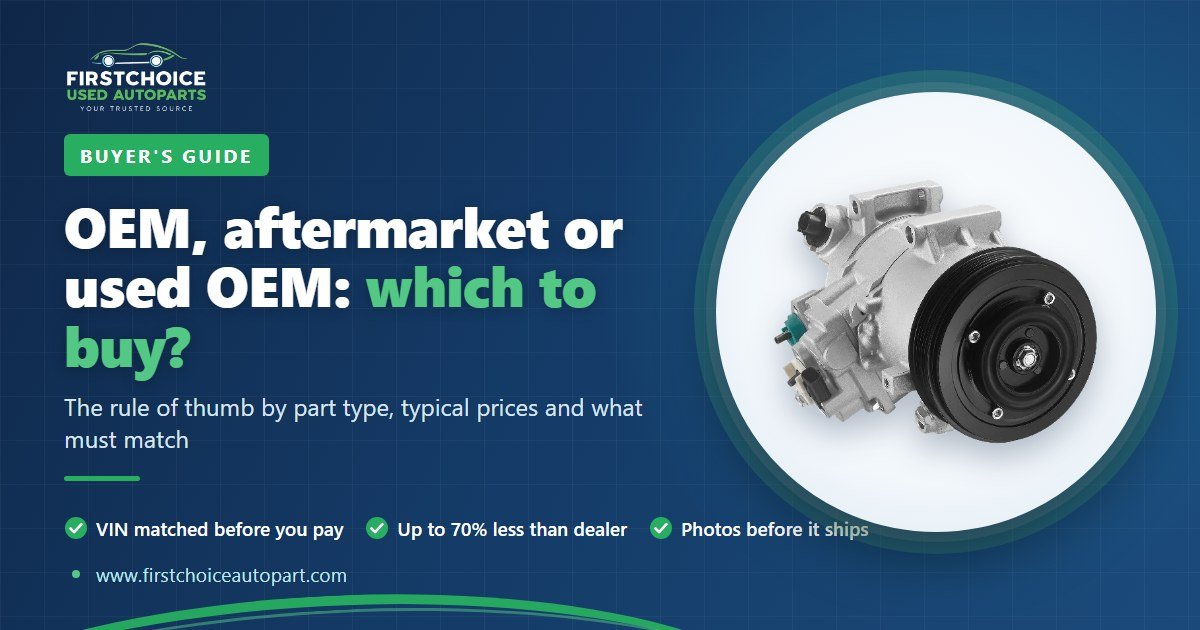
Quick Answer: It depends on the part. Buy wear items such as brake pads, filters and belts new. Keep airbags, seat belts and electronics OEM, new or used. For parts with high labor or factory features, such as an AC compressor or an LED headlight, a VIN matched used OEM part gives factory fit, often near the aftermarket price, with a shorter warranty than new.
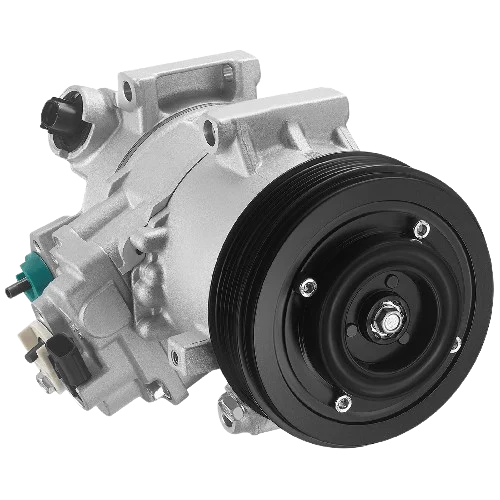
Your AC is blowing warm, and the repair estimate came with a choice: a new aftermarket compressor online for about $200, a dealer compressor for around $650, or a used OEM compressor pulled from another vehicle. The labor is the same for all three, so the part you pick decides whether you pay that labor once or twice.
Aftermarket is cheapest on the shelf, new OEM is safest on paper, and used OEM sits between them: factory design and fit, often near the aftermarket price, with a shorter warranty. Which one wins depends on the part. Here is the rule of thumb by part type, typical prices for the same repair three ways, and what to check before you approve a used OEM AC compressor.
Key facts
- OEM parts are made by or for the carmaker to the original design. Aftermarket parts are made by other companies to fit, and quality varies by brand.
- Installation labor usually costs the same for an aftermarket, new OEM or used OEM part, so a cheap part that fails early means paying that labor twice.
- Wear items such as brake pads, rotors, filters and belts are best bought new, because a used wear item has already spent much of its life.
- Replacement airbags should be OEM parts with the correct part number, never aftermarket or unknown source units. A deployed airbag or fired belt pretensioner is never reused.
- A used OEM AC compressor typically costs about $80 to $250, against roughly $350 to $800 for a new dealer compressor, depending on the vehicle.
- FirstChoice matches each used OEM part to the VIN before payment and ships nothing until the buyer approves photos of the actual part.
What is the difference between OEM, aftermarket and used OEM parts?
OEM parts are built by or for the carmaker to the original design, aftermarket parts are built by other companies to fit, and used OEM parts are original factory parts taken from another vehicle. Listing labels blur those lines, so here is what they usually mean.
- New OEM (genuine): sold by the dealer in the carmaker’s box, under the carmaker’s part number.
- OE supplier (OES): the company that built the part for the carmaker, selling it under its own brand. Compressor makers such as Denso and Sanden show up at parts stores this way, often for less than the dealer box.
- Aftermarket: made by another company to replace the original. Quality runs from as good as factory at strong brands to thin, loose fitting copies. “OEM equivalent” on a listing is a claim, not a certification.
- Remanufactured: a used core rebuilt with new wear parts, sold under the rebuilder’s warranty.
- Used OEM: the original factory part, removed from a donor vehicle. It carries the carmaker’s part number, so a part matched by VIN and part number fits like the original.
Which should you buy? The rule of thumb by part type
Buy wear items new, keep safety restraints and electronics OEM, and weigh used OEM against aftermarket where fit, features or labor cost matter. A brake pad, an airbag and a compressor carry very different risks.
| Part type | Examples | Usually the smart buy | Why |
|---|---|---|---|
| Wear items | Brake pads, rotors, filters, belts, spark plugs, batteries | New, from a known brand or OEM | Made to wear out, so a used one has spent its life |
| Airbags and seat belts | Airbag modules, belt retractors, buckles | OEM only: new, or used with a matching part number | Counterfeit airbags have been sold online; a deployed airbag or fired pretensioner is never reused |
| Electronics | ECM, ABS module, instrument cluster | Used or new OEM, same part number | New aftermarket units are rare, and most modules need programming or coding to the car |
| Major assemblies | Engines, transmissions, axle assemblies | Used OEM or remanufactured | New aftermarket units are rare; used OEM costs far less than new |
| Lighting and mirrors | LED or HID headlights, power mirrors | Used OEM; aftermarket for basic halogen or manual parts | Factory fit, seal and features; cheap lamps can fog up or aim poorly |
| Mechanical parts with high labor | AC compressor, alternator, starter | Low mileage used OEM, or a quality new or reman unit | An early failure means paying the labor again |
| Heat exchangers | Radiators, AC condensers | Used OEM or a quality aftermarket brand; match any towing or heavy duty core | No moving parts, but some aftermarket cores are thinner than the factory part |
Headlights show the limits of cheap aftermarket fastest. On an LED or HID car, a used OEM headlight keeps the factory beam, connector and features for much less than dealer price. For engines, the real contest is used OEM against remanufactured, covered in our guide to used vs rebuilt vs remanufactured engines.
Safety: Have airbags, seat belts, steering and brake parts installed by a qualified technician, and read whether used airbags are safe before you buy one.
How much do OEM, aftermarket and used OEM cost for the same repair?
For most parts, used OEM costs close to aftermarket and far less than the dealer part, while labor stays the same. These are typical US market prices for the part alone; the exact price depends on your vehicle.
| Part | New dealer OEM (typical) | New aftermarket (typical) | Used OEM (typical) | Labor (typical) |
|---|---|---|---|---|
| AC compressor, car or light truck | $350-$800 | $150-$450 | $80-$250 | 1.5-4 hours, plus recharge |
| Halogen headlight, each | $150-$500 | $50-$200 | $75-$250 | 0.5-3 hours |
| LED headlight, each | $500-$2,000 | $200-$700 where made | $250-$900 | 0.5-3 hours |
| Radiator, compact or midsize car | $250-$700 | $80-$250 | $75-$250 | 1-2.5 hours |
| Power heated side mirror | $200-$450 | $40-$120 | $50-$175 | 0.5-1.5 hours |
The labor rule: when the job is costly, buy the part least likely to fail
On an AC compressor job, labor, the refrigerant recharge and a new receiver drier or accumulator typically add roughly $300 to $800 whichever compressor goes in, with R-1234yf systems at the high end, as our AC compressor cost breakdown shows. If a $180 compressor fails in month four, you pay most of that again.
So when the labor costs more than the price gap between your options, buy the option least likely to send the car back. On a mirror that bolts on in half an hour, the cheapest part that fits is often fine. On a compressor, known factory fit is usually worth more than the last $50 of savings. FirstChoice quotes a used AC compressor for sale at up to 70% less than a new dealer part, and the quote is free.
When does a cheap aftermarket part end up costing more?
A cheap aftermarket part costs more when it fails early, fits poorly or drops a feature your car had. Good aftermarket parts exist, so judge the part, not the label. Watch for these signs:
- One part listed for a long run of years and models: a part built to cover many variants may need adapters, sit slightly off or skip a feature.
- Electronic features: an aftermarket headlight may lack auto leveling or adaptive beams, an aftermarket mirror may lack the blind spot light, and either can set a warning message.
- A price far below other brands: on compressors and headlights, the cheapest listings are where you are most likely to find thin castings, weak seals and poor beam patterns.
Aftermarket is a fair pick for a wear item or a simple bolt on part from a known brand, on an older car you plan to run cheaply, or when labor is short. Used OEM has trade offs too: unknown service history, miles on the part and a shorter warranty than most new parts. That is why the match and the photos matter.
What must match for a used OEM part to fit?
The VIN and the OEM part number must match, plus any option that changes the part. Good aftermarket listings cross reference the same OEM number, so find it first whichever way you buy. The details that trip buyers up differ by part:
| Part | What must match | Easy to miss |
|---|---|---|
| AC compressor | Engine, OEM part number, refrigerant type (R-134a or R-1234yf), pulley, connector, mounting and ports | Clutchless compressors, and hybrid electric compressors with orange high voltage cables, do not swap with belt driven clutch units |
| Headlight | Side, lighting type (halogen, HID or LED), part number, connector | Auto leveling, adaptive beams and the housing finish of your trim level |
| Radiator | Engine, transmission cooler lines, part number | Towing or heavy duty cooling packages can use a thicker core |
| Side mirror | Side, power, heat, turn signal, fold, connector | Blind spot light, puddle lamp, camera and memory settings |
The VIN settles most of this, and a parts specialist decodes it for you. A used OEM radiator or headlight is matched the same way as a compressor. For compressor detail such as clutch types, oil and failure causes, see our used AC compressor buying guide, and when a quote arrives, read how to read a used auto parts quote before you pay.
What should you check in the photos before you approve a used OEM part?
Check that the part number matches your quote, nothing is cracked, and there is no sign of the failure you are fixing. With FirstChoice, the supplier photographs the actual part, and nothing ships until you approve the photos. Look for:
- Label: readable, with the same part number as your quote.
- Mounting ears and tabs: no cracks or broken tabs on a compressor body, headlight housing or radiator tank.
- Connectors: whole plugs and locks, with no cut wires.
- Signs of the old failure: on a compressor, a wet oily film at the shaft seal or a clutch face scorched or blue from heat; on a headlight, water or fog inside the lens; on a radiator, crusty coolant trails at the tank seams.
- Openings: compressor ports and radiator necks capped or covered, with clean sealing faces.
Photos cannot show the inside. If the old compressor shed metal, the system needs cleaning, a new drier or accumulator, a new orifice tube or expansion valve, and on many cars a new condenser, whichever compressor you buy.
Tip: A used compressor holds oil from the donor system, and a new one may arrive with a shipping charge of oil. Either way, have your mechanic drain it and add the oil type and amount your system calls for.
How does buying a used OEM part from FirstChoice work?
- Send your year, make, model and VIN, plus the old part number if you have it.
- A parts specialist matches the part to your VIN before you pay and sends the price, warranty and shipping details. The quote is free.
- The supplier confirms stock and condition, pulls the part and photographs it.
- Nothing ships until you approve the photos.
- Delivery target is within 5 business days of photo approval, by tracked parcel for a compressor.
Phone orders at 1-888-383-2439 get 10% off, Monday to Friday, 9 AM to 6 PM EST. When used OEM wins your comparison, buy a used AC compressor through the free quote form.
Frequently Asked Questions
Are aftermarket parts as good as OEM parts?
Some are and some are not. Strong aftermarket brands make parts that match or come close to OEM, and some come from the same suppliers that build the factory part. At the cheap end, fit and materials vary. For wear items a known brand is usually fine; for electronics, airbags and factory features, stay with OEM, new or used.
Will aftermarket or used parts void my car’s warranty?
Not by themselves. Under the federal Magnuson-Moss Warranty Act, a carmaker generally cannot void your warranty just because you used aftermarket or recycled parts, though it can deny a claim if it shows the part caused the damage. The FTC explains these rules.
Will my insurance pay for OEM parts after an accident?
It depends on your policy and your state. Many policies let the insurer write the estimate with aftermarket or used OEM parts, and some insurers sell an OEM parts endorsement. Ask before the repair starts, and see our guide to used OEM parts in insurance claims.
Do used OEM parts need programming or setup?
It depends on the part. A compressor, radiator or mirror needs correct installation, and an AC system must be evacuated with a vacuum pump, recharged to the specified refrigerant weight and leak checked. Control modules, clusters and some adaptive headlights need programming, coding or aiming. FirstChoice does not program or install parts; your mechanic does.
What warranty comes with a used OEM AC compressor from FirstChoice?
A used AC compressor carries a 30 day parts warranty, and labor is not covered. It ships by tracked parcel to the billing address on your card. A damaged or incorrect part is replaced, or refunded in full if no replacement is available.
Related reading:
AC Compressor Replacement Cost: New vs Used vs Rebuilt
Used vs Rebuilt vs Remanufactured Engine
Used AC Compressor: Complete Buying Guide
Used OEM Parts After an Accident: Insurance Claims Explained