
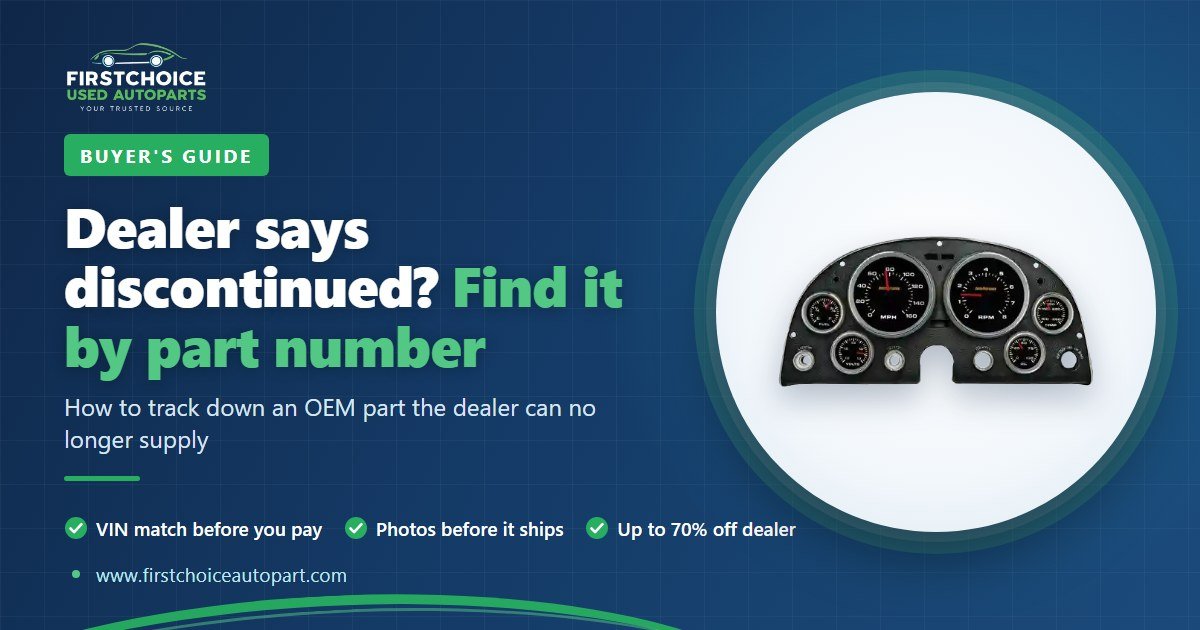
Quick Answer: A discontinued OEM part is one the automaker no longer supplies new, but the same part often still exists. Get the part number from the old part or the dealer, ask for any superseded number, then search used OEM stock by that number and its interchange, which can include other years and sister models. Before you buy, match the VIN, options and connectors, and check photos of the actual part.
The parts counter ran your VIN and gave you the answer you did not want: the part is no longer available. Your car is 15 years old and still runs well, and now a dead instrument cluster, a snapped door handle or a dark climate control panel has you wondering if it is time to give up on it.
Here is what the dealer did not say: no longer available only means the automaker stopped supplying that part number new. The same part often still sits in vehicles at recycling yards, on a dealer shelf in another state, or in a sister model sold under another brand. This guide shows how to find it by part number, what it typically costs, and what to check before you pay.
It is written for owners of cars and trucks roughly 10 to 25 years old and the shops that keep them running.
Key facts
- A part marked NLA (no longer available) by a dealer is no longer supplied new by the automaker; used, leftover new and repaired OEM units often still exist.
- A superseded part number is the newer number an automaker assigns to replace an older one; the dealer catalog shows whether it fits a given VIN.
- The number on the old part’s label, checked against the VIN, is the most reliable search key for a discontinued OEM part, because other years and sister models often share it.
- Many US auto recyclers use an interchange system that groups interchangeable OEM part numbers, so a matching donor can be another model year or a sister model.
- A used OEM instrument cluster typically costs about $120 to $380 and a used climate control panel about $40 to $300, depending on the vehicle and options.
What does no longer available from the dealer really mean?
It means the automaker’s parts network no longer supplies that part number new, so the dealer cannot order one. It does not mean the part has vanished. Dealer systems often mark these parts NLA and, when the automaker has released a replacement, show a superseded number in its place.
- NLA or discontinued: no new supply from the automaker. Look at leftover new stock, used OEM, repair or an aftermarket copy.
- Superseded: a newer number replaced the old one. If the catalog says it fits your VIN, order it.
- Back ordered: the part exists but supply is delayed; ask for a date.
- Leftover dealer stock: another dealer may still have one. Many dealer systems can search other dealers, so ask.
Automakers usually supply service parts for years after a model ends, then drop the slow sellers, and no general federal rule sets how long they must keep them. Parts made in many versions for a few model years, such as clusters, climate control panels and painted trim, are often among the first to go.
Tip: Ask the parts counter to print the part number, its status and any superseded number. Every search below starts there.
How do you find the right part number for a discontinued part?
Read it off the old part first, then confirm it against your VIN. The number on the original part is the most reliable search key, because other years and sister models often share it.
- The label on the old part. Clusters usually carry a sticker or printed number on the back of the housing, climate control panels on the back or side. A number molded into the plastic of a door handle is often a mold or supplier number, not the service part number.
- The dealer printout. The service part number the dealer found from your VIN, plus any superseded numbers.
- Your VIN. It identifies the model year, body and usually the engine, and dealer and recycler systems use it to look up the build details that decide which version you need. Our guide on how to decode your VIN to find the right used part shows what each section means.
- Option codes. Some makes print factory option codes on a sticker, for example the RPO code label that many GM vehicles carry, often in the glove box. These codes separate one version of a part from another.
Electronic parts often carry two numbers, the supplier’s hardware number and the automaker’s service number. Send a photo of the whole label with your quote request; one wrong digit means the wrong part.
Why the interchange number widens your search
Most US recyclers group parts by interchange, and the Hollander interchange is the most widely used system. One interchange number links OEM part numbers that can replace each other, so a part from another model year can be a confirmed match if the automaker carried it over. It is also how a part the two models shared turns up in a GMC twin of a Chevrolet, or a Mercury version of a Ford.
Where can you still find discontinued OEM parts?
Check the dealer network first, then online OEM parts stores, used OEM recyclers, repair services and aftermarket copies. Each trades cost, speed and risk differently.
| Source | What you get | Best for | Watch out for |
|---|---|---|---|
| Other dealers | Leftover new OEM stock | Parts discontinued recently | Few units left; returns on electrical parts are often limited |
| Online OEM parts stores | Leftover new stock listed by part number | Comparing prices on the exact number | Listings can outlive the stock; confirm before you pay |
| Used OEM from recyclers | The original part, pulled from a donor vehicle | Clusters, modules and interior trim with no aftermarket version | Donor age and condition; options and connectors must match |
| Repair or rebuild service | Your own part, repaired | Clusters and modules with a known, fixable fault | Downtime while the part ships both ways; not every fault is fixable |
| Aftermarket copies | A new non OEM part | Common mechanical parts and some door handles | Fit, finish and features vary; rarely made for electronics |
For many electronic and interior parts on a car this age, used OEM is the realistic answer, because no one makes the part new anymore. Pulling it yourself or ordering it matched? Read junkyard vs online used auto parts. For parts where a new copy does exist, OEM vs aftermarket vs used OEM parts explains when each one makes sense.
What does a discontinued OEM part typically cost?
Used OEM is usually the lowest cost route for a part that is no longer made. A used OEM instrument cluster typically costs about $120 to $380, a climate control panel about $40 to $300 and an exterior door handle about $25 to $200, depending on the vehicle and options.
| Route | Typical part cost | The hidden cost |
|---|---|---|
| Leftover new OEM | Often the last list price; sellers of scarce parts may ask more | Few units and limited returns |
| Used OEM instrument cluster | About $120-$380 | Mileage setting and any programming by your shop |
| Used OEM climate control panel | About $40-$150 manual; about $75-$300 automatic | Setup or an actuator relearn on some vehicles |
| Used OEM exterior door handle | About $25-$200, by finish, keyhole and keyless features | Paint to match on body color handles |
| Repair of your own part | Varies by model and fault | Downtime while the part is away |
| Aftermarket copy | Often the lowest price where one exists | Fit, finish and missing features |
Add labor: a used cluster installed and programmed at a shop typically comes to about $280 to $650 in total. FirstChoice quotes a used OEM instrument cluster at up to 70% less than a new dealer part, and the quote is free.
What must match before a used part from another car will fit yours?
The part number or a confirmed interchange, plus the options the part connects to. Automakers often changed parts partway through a model run, so match the version your car was built with.
| Part | What must match | The older car catch |
|---|---|---|
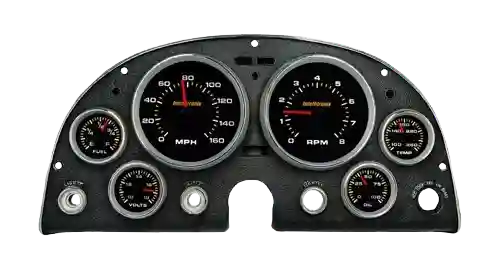
| Instrument cluster | Part number, gas or diesel, automatic or manual, tachometer and info display, mph as the main scale | Many clusters store the mileage; on some makes the cluster is part of the anti-theft system |
| Exterior door handle | Door position, keyhole or no keyhole, finish (painted, textured black, chrome), keyless entry sensor | Paint code and sun fade; brittle internal levers and rod clips |
| Climate control panel | Manual or automatic, single or dual zone, buttons such as rear defrost and heated seats, connectors | Older manual panels may work blend doors by cable, so cable ends must match |
- Programming: many older clusters plug in and work, while others need the mileage set or must be paired to the keys. Read will a used instrument cluster work in my car before you order.
- Mileage law: if the odometer in a replacement cluster cannot be set to your true mileage, federal odometer law requires it to be set to zero, with a written notice on the left door frame giving the prior mileage and the date of the change. See NHTSA on odometer fraud.
- Door handles: used OEM door handles must match the door, the lock and the finish; a body color handle from a different paint code will need paint.
- Control panels: a used OEM climate control module must match button for button, or heated seats and other functions may not work.
What should you check in the photos before you approve a used part?
Check the label, the plastic and the connectors, because age shows there first. With FirstChoice, the supplier photographs the actual part and nothing ships until you approve the photos, so this is your moment to catch a problem.
- Label: readable and matching your number or the confirmed interchange.
- Lens and face on a cluster: no cracks, heavy haze or deep scratches; needles straight and seated.
- Mounting tabs, levers and clips: none cracked or missing. Plastic on a 15 year old part gets brittle.
- Connectors: straight pins, no green corrosion, latches intact.
- Finish and buttons: handle color close to yours, no peeling chrome; no cracked buttons or worn off labels.
- Water signs: white residue or rusty screws can mean a flood donor.
Ask for the front, the back and a close shot of the label. Our guide on how to check quality before buying used auto parts online covers more general checks.
How does ordering a discontinued part from FirstChoice work?
- Send your year, make, model, VIN and the part number from the old part or dealer printout.
- A parts specialist matches the part to your VIN before you pay and sends the price, warranty term and shipping details. The quote is free with no obligation.
- The supplier confirms the part is available and in good condition, pulls it and photographs the actual part.
- Nothing ships until you approve the photos.
- Delivery target is within 5 business days of photo approval, by tracked parcel for small parts, with tracking emailed within 2 days of shipment.
Phone orders at 1-888-383-2439 get 10% off, Monday to Friday, 9 AM to 6 PM EST. Before you pay, it helps to know how to read a used auto parts quote. When you are ready, buy a used instrument cluster through the free quote form. Your mechanic handles installation, mileage setting and any programming.
Frequently Asked Questions
Can the dealer find a discontinued part at another dealer?
Often, yes, if the part was discontinued recently. Many dealer parts systems can search stock at other dealers, so ask the counter to check. Once leftover new units are gone, used OEM and repair are the usual routes.
Is a superseded part number the same as the original part?
It is meant to replace it. A superseded number is the automaker’s newer part for the same vehicles, and it may be a redesign rather than an exact copy. Order it only if the dealer catalog shows it fits your VIN, and read any notes about extra parts or wiring changes.
Will a used part from a different model year fit my car?
It can, when the part number or the interchange confirms it. Automakers often carried parts over for several years and shared them with sister models. A different part number is a different part until a parts specialist confirms otherwise, so match by number and VIN, not by year.
Should I buy a spare if my part is discontinued?
For a car you plan to keep, a second used unit of a scarce part can be cheap insurance. A used part warranty is short, so a spare that sits on the shelf can outlast it. Have your mechanic check the spare soon after it arrives, then store it dry.
What warranty comes with a used instrument cluster from FirstChoice?
Used instrument clusters, door handles and climate control modules carry a 30 day parts warranty; labor is not covered. They ship by tracked parcel to the billing address on your card. A damaged or incorrect part is replaced, or refunded in full if no replacement is available.
Related reading:
Will a Used Instrument Cluster Work in My Car?
How to Program a Used Instrument Cluster After Installation
How to Decode Your VIN to Find the Right Used Auto Part
OEM vs Aftermarket vs Used OEM Parts: Which to Buy