
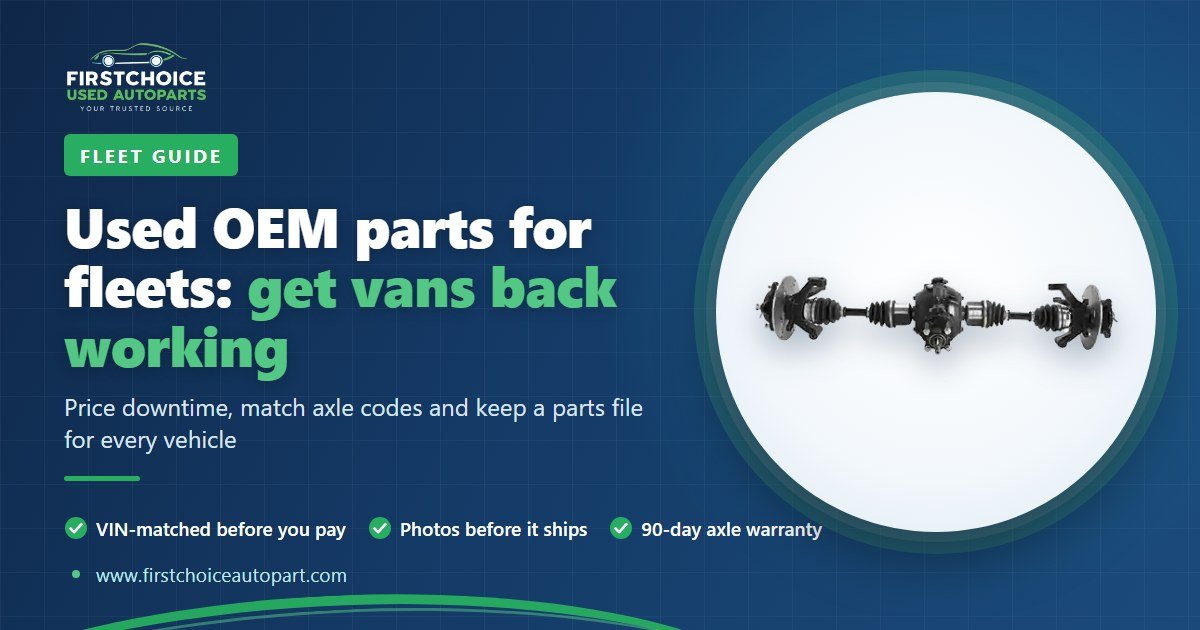
Quick Answer: Fleets cut downtime with used OEM drivetrain parts by keeping each vehicle’s VIN, engine code, transmission code and axle code on file, ordering a complete assembly matched to that VIN instead of waiting on a new part or a gear rebuild, and approving photos of the actual part before it ships. The decision rule is simple: compare the price difference with what each parked day costs you.
One of your cargo vans is sitting in the yard with a rear end that howls under load or a transmission that will not shift, and its jobs are being pushed onto other trucks. The dealer can order a new part, but the van earns nothing while it waits, and a week or two parked can cost more than the part itself.
This guide is for fleet managers and small business owners running work trucks and cargo vans such as the Ford Transit, E-Series, Chevy Express, F-250 and Ram 2500. It shows how to price downtime, when a used OEM rear axle assembly or another matched drivetrain part is the smart call, what must match, and the parts file that lets you send a complete quote request the day a vehicle breaks down.
Key facts
- For a fleet vehicle, the true repair cost is the part, the labor and every day of lost revenue or rental while the vehicle waits.
- A used rear axle assembly must match the gear ratio, the differential type (open, limited slip or locking), single or dual rear wheels and the brake and ABS setup.
- Two fleet vans of the same model and year can have different axle ratios, so each vehicle needs its own axle code on file.
- A used OEM rear axle assembly for a work van or 3/4 ton pickup typically costs about $500 to $2,000, depending on axle size, ratio and locker.
- FirstChoice gives a 90-day parts-only warranty on used axle assemblies, engines and transmissions and ships them by free LTL freight to a commercial address in the 48 contiguous states.
How Much Does a Parked Work Van Really Cost You Per Day?
A parked work vehicle costs you the gross profit it would have earned that day, plus rental, overtime and lost jobs. Many owners know the part quote to the dollar but have never written down that daily number.
- Lost billable work: the jobs the vehicle and crew would have done, minus what other trucks absorbed.
- Rental cost: a rented van has none of your shelving, ladder rack or stock, so the crew also loses time.
- Lost customers: a missed service window on a commercial account can cost more than one day’s revenue.
A simple example: if a service van brings in $700 of gross profit a day, ten working days waiting on a part costs about $7,000. Use your own numbers: if the used route returns the van a few days sooner, those days can be worth more than the part discount.
Which Fleet Repairs Make Sense With Used OEM Parts?
Used OEM parts make the most sense for heavy drivetrain parts, such as axle assemblies, engines and transmissions, where new is expensive or slow and the factory part bolts in as designed. Wear and service items should still be bought new.
| Part | Used OEM fits when | Choose another fix when |
|---|---|---|
| Rear axle assembly | Gears, carrier or housing are damaged and you want a bolt in fix | Only a seal, bearing or brake part is bad (repair it) |
| Engine | The engine is done but the body, frame and transmission are sound | The whole vehicle is near the end of its service life (retire it) |
| Automatic transmission | Internal failure is confirmed | The fault is a solenoid, sensor, wiring or fluid issue that can be repaired |
| Brakes, belts, filters, seals, fluids | Rarely | Almost always: buy these wear and safety items new |
Confirm the failure first: A worn wheel bearing or U-joint can sound like a bad differential. Have your technician check for metal in the gear oil and play at the pinion, and see the warning signs of a failing rear axle assembly.
Should You Rebuild the Rear End or Swap the Whole Axle?
When the vehicle needs to be back fast, swapping a complete axle assembly is usually quicker and more predictable than rebuilding the gears. A ring and pinion job needs pinion depth, backlash and bearing preload set correctly, and many general shops send it out to a specialist.
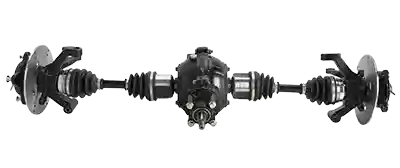
A complete used rear axle arrives with the ring and pinion already set up in its housing. The swap is mostly disconnecting and reconnecting: driveshaft, brake lines, parking brake cables, ABS wiring, shocks, and either the U-bolts on leaf springs or the control arms and track bar on coil springs. On many vans and pickups that often takes about 3 to 6 labor hours, more with heavy rust or dual rear wheels.
A rebuild can still win when the housing is rare or you want a different ratio. For ratio and limited slip detail, see the used rear axle assembly buyer’s guide.
What Does a Used Drivetrain Part Cost for a Work Truck or Van?
Before labor, a used OEM rear axle assembly for a work van or 3/4 ton pickup typically costs about $500 to $2,000, a used gas engine about $1,200 to $3,500 and a used automatic transmission about $850 to $2,400. Heavy duty and late model units usually sit toward the top of each range or above it, and the exact price depends on the vehicle and its codes.
| Part | Typical used OEM range | Typical labor | Price goes up with |
|---|---|---|---|
| Rear axle assembly | About $500-$2,000 | About 3-6 hours | Dual rear wheels, full floating axles, lockers |
| Gas engine, van or pickup | About $1,200-$3,500 | About 8-15 hours, more on E-Series and Express vans (engine under an interior cover) | Low mileage, late model, V8 or V10 |
| Automatic transmission | About $850-$2,400 | About 4-10 hours | Newer 8 and 10 speed and heavy duty units |
FirstChoice quotes up to 70% less than a new dealer part, and the quote is free. Weigh part plus labor against your daily downtime number, using a quote on a used rear end assembly matched to your axle code. For the engine side, see used OEM engines matched by VIN and engine code; for a failed automatic, VIN-matched used transmissions. Diesel engines typically cost more; see the used diesel truck engine guide.
What Must Match on a Used Axle for a Van or 3/4 Ton Truck?
The gear ratio, differential type, axle model, wheel setup and brake hardware must match the vehicle, not just the year and model. Fleet vehicles are often ordered with different options in the same model year, so two identical looking vans can need different axles.
| Item to match | Why it matters | Where to confirm it |
|---|---|---|
| Gear ratio | Can affect speedometer, shift points and fuel use; on 4WD and AWD front and rear must match | Ford door label, GM RPO code, Ram sales code or axle tag |
| Differential type | Open, limited slip or locking; an electronic locker also needs its wiring and dash switch | Axle code, build sheet, cover tag |
| Single or dual rear wheels | Dual wheel housings and shafts are wider and do not swap with single wheel axles | The vehicle itself and the quote |
| Semi or full floating | Most 3/4 and 1 ton pickups and some heavier vans use full floating axles, which do not swap with semi floating ones | Axle model on the tag or hub design |
| Brakes and ABS | Drum or disc, parking brake design and wheel speed sensor location | Photos of the brakes and sensor |
| Mounting and driveline | Spring pads or control arm brackets and the pinion yoke or flange must line up | Photos compared with the old axle |
Not sure how to read an axle code? The differential gear ratio guide shows how to read the ratio from the door label, RPO codes and the axle tag.
What Should Every Fleet Vehicle’s Parts File Include?
Every fleet vehicle’s parts file should hold the VIN, the engine, transmission and axle codes, and photos of the labels that prove them. With it, you can send everything a parts specialist needs to match a replacement in one message, without anyone crawling under the van.
- VIN and unit number: the VIN decodes the model and engine, but not the axle ratio. See this VIN decoding guide for used parts.
- Door jamb label photo: it shows the GVWR, and on most Ford trucks and many Ford vans it also lists axle and transmission codes.
- RPO list or build sheet: many GM vans and trucks carry RPO codes on a service parts label, often in the glove box on older models, and a dealer can print the list from the VIN; Ram build data lists axle and transmission sales codes.
- Axle tag photo: ratio and axle model, taken while the tag is readable.
- Engine and transmission codes: from the VIN, the labels or the tags on each unit.
- Upfit notes: shelving, racks, a liftgate or service body, and any tire size change.
- Part history: what was replaced, when, at what mileage, from whom, and the warranty end date.
Ten minutes per vehicle now saves a day of digging later. Keep the file where whoever orders parts can reach it.
What Should You Check in the Photos Before You Approve the Part?
Check that the photos show the axle tag or part number, a straight housing, and the brake, ABS and mounting hardware your vehicle needs. At FirstChoice the supplier photographs the actual part and nothing ships until you approve, so this is where you catch a mismatch.
- Axle tag or code: legible and matching the ratio and axle model in your file.
- Housing: no bends, cracks or crash damage; tube welds at the carrier intact.
- Cover and pinion seal: a light film of old gear oil is normal; a wet, caked area means a seal to replace at install.
- Wheel ends: same lug count, hub style and single or dual wheel setup as your vehicle.
- Brakes and ABS: drum or disc as on your vehicle, sensor mount in the same place.
- Yoke or flange and spring pads: compare with a photo of your old axle.
- Engine or transmission: tag visible, no broken connectors or mounting ears.
How Does Ordering a Fleet Part From FirstChoice Work?
You send the vehicle details, a parts specialist matches the part to the VIN, and nothing ships until you approve photos of the actual part.
- Send the year, make, model and VIN, plus the axle, engine or transmission code from your file.
- A parts specialist matches the part to that VIN before you pay and sends a free quote with the price, warranty term and shipping details.
- The supplier confirms the part is available and in good condition, pulls it and photographs it.
- You approve the photos. Nothing ships before that.
- Delivery is targeted within 5 business days of approval, by free LTL freight to a commercial address such as your shop or yard in the 48 contiguous states. Tracking is emailed within 2 days of shipment.
Axle assemblies, engines and transmissions carry a 90-day warranty on the part only, never labor; your technician or shop does the install. Have whoever signs for the pallet read the freight receiving checklist. Phone orders at 1-888-383-2439 get 10% off, Monday to Friday, 9 AM to 6 PM EST.
Frequently Asked Questions
Are used OEM parts reliable enough for a work fleet?
Used OEM drivetrain parts are built to the same factory design as the original, so a matched axle, engine or transmission from a sound donor can serve a work truck well. Reliability depends on matching the codes, approving photos of the actual part, fixing what killed the original and renewing seals and fluids at install.
Can one van in the fleet run a different axle ratio than the others?
A different ratio can work on a two wheel drive van, but the speedometer, shift points or both can be off, and some vehicles set fault codes, until a technician updates the axle ratio setting in the computer, where the vehicle allows it. Fuel use changes too. On 4WD and AWD vehicles the front and rear ratios must match. Matching the original ratio is the simplest choice.
Does the warranty cover labor if a used axle fails?
No. FirstChoice warranties cover the part only, never labor. Used axle assemblies, engines and transmissions carry a 90-day parts warranty, and a damaged or incorrect part is replaced, or refunded in full if no replacement is available. Budget install labor as your cost and log each warranty end date.
Can the part ship to our fleet yard instead of a repair shop?
Yes, if the yard is a commercial or business address. Axle assemblies, engines and transmissions ship by free LTL freight to a commercial address in the 48 contiguous states. Plan for a forklift or pallet jack and someone who checks the pallet before signing.
When is a high mileage work van worth repairing at all?
Repair makes sense when the frame, body and the rest of the drivetrain are sound and the repair costs less than a replacement vehicle plus its upfitting. Shelving and rack costs often tip the math toward repair. See replace the engine or buy another vehicle for the cost breakdown.
Related reading:
Used OEM Parts for Repair Shops: Source Without Comebacks
How to Read a Used Auto Parts Quote Before You Pay
Top 5 Used Rear Axle Suppliers in the USA