A used cylinder head is one of the smartest used-parts purchases an engine builder or shop owner can make — but only when the head has been properly inspected and the four compatibility factors have been verified. The cost difference is meaningful: a verified used 5.4L 3V Triton head runs $200–$400 from FirstChoice while a remanufactured unit goes for $550–$900 and a new OEM unit is north of $1,200. The catch is that nobody wants to install a cracked head, a head with sunken valve seats, or a head with a warped deck surface. That is what the inspection process is designed to catch — and what separates a real used-parts supplier from a scrap yard with a website.
This guide walks through the buyer-side fundamentals: why used heads are a viable choice for most US engines, what each engine family typically costs, the four compatibility checkpoints, the full inspection process every FirstChoice head goes through before shipment, and the ordering steps that get you a head that fits the first time. In 2025, FirstChoice shipped over 3,400 drivetrain parts with a 98.2% first-fit rate — cylinder heads are a core part of that volume, and the inspection rigor is the reason for the fit-rate.
Need a used cylinder head with MagnaFlux crack test, pressure test, and donor photos? FirstChoice ships Coyote, Triton, HEMI, Vortec, Duramax, Cummins, and Pentastar heads.
Check Cylinder Head Availability →Why Used Cylinder Heads Are a Common Repair Choice in the US
Cylinder head failures in the US fleet are usually traced to one of three causes: an overheating event that warps the aluminum deck surface, a spark plug ejection that destroys the threads and combustion chamber (a known 5.4L 3V Triton issue), or a coolant intrusion that cracks the head between the valve seats and the water jacket. None of these failure modes are wear-based — they are events. That distinction matters because a head from a donor vehicle that did not experience that event has nothing wrong with it. The casting is the same age as the rest of the engine, but the failure isn’t time-based.
Buyers come to used heads for three reasons. First, cost — a reman head runs roughly 2x to 3x what a verified used head costs, and a new OEM head can be 4x to 6x. Second, availability — for older engines (5.4L 2V Triton, GM 5.3L LM7, early HEMI), reman supply is shrinking and used is now the more reliable channel. Third, OEM casting — used heads are original factory castings, not aftermarket reproductions, which matters for builders who want to retain factory port shape, valve seat angle, and combustion chamber geometry.
The risk isn’t the used head itself — it’s the supplier. A head pulled from a salvage engine and shipped without inspection is a coin toss. A head that has been MagnaFlux crack-tested, pressure-tested, valve-guide-checked, deck-surface-measured, and photographed before shipment is a known quantity. The 30-day warranty FirstChoice attaches to every cylinder head exists because the inspection makes the risk small enough to stand behind.
Used Cylinder Head Cost by Engine
Pricing varies with donor mileage, casting number, valve configuration, and whether the head ships as a bare casting or a complete assembly with valves, springs, and rockers. The ranges below reflect typical FirstChoice pricing for verified, inspected heads with documented donor mileage:
| Engine | Used Cylinder Head Price | Reman Price (Comparison) | Notes |
|---|---|---|---|
| Ford 5.4L 3V Triton | $200–$400 | $550–$900 | Spark plug bore failure common — confirm threads intact |
| Ford 5.0L Coyote | $300–$600 | $800–$1,300 | DOHC aluminum; check cam journal wear |
| GM 5.3L Vortec (LM7/LMG/L83) | $180–$380 | $500–$850 | High availability; confirm AFM vs non-AFM |
| GM 6.2L L86 | $350–$700 | $900–$1,500 | DI engine; injector bore condition critical |
| RAM 5.7L HEMI | $250–$500 | $650–$1,100 | MDS vs non-MDS heads not interchangeable |
| Cummins 6.7L Diesel | $600–$1,200 | $1,800–$2,800 | Cast iron; high resale value; inspect for fire-ring damage |
| Duramax 6.6L (LB7/LBZ/LML) | $700–$1,400 | $1,900–$3,200 | Aluminum DOHC; injector cup condition critical |
| Jeep 3.6L Pentastar | $200–$450 | $600–$1,000 | Left vs right bank are different castings |
Pricing tip: A used head with documented donor mileage under 100,000 and complete inspection paperwork is worth the higher end of the range. A head with no mileage history and no inspection documentation is a gamble at any price. Always ask the supplier for the casting number, donor mileage, and inspection results in writing before paying.
The 4 Non-Negotiable Compatibility Factors
1. Engine Code — Not Just Displacement
Ford 5.4L is a displacement, not a part number. There are three distinct 5.4L heads in the US fleet: 5.4L 2V (1997–2003 F-150), 5.4L 3V (2004–2010 F-150 and Expedition), and 5.4L 4V (Lincoln Navigator, supercharged GT500). None of these heads interchange. The same trap exists with GM 5.3L (LM7 vs L59 vs LMG vs L83 vs L84) and RAM 5.7L HEMI (Eagle vs Apache vs MDS vs non-MDS). Always start with the full engine code from the VIN or the engine ID tag, not just the displacement.
2. Casting Number — The Real Identifier
The casting number is stamped or cast into the head itself — on top of the head, on the end near the thermostat, or under a valve cover. This is the part identifier the manufacturer uses, and it tells you the exact valve configuration, combustion chamber volume, and port shape. Two heads with the same engine code can have different casting numbers across model years (Ford updated the 5.4L 3V casting mid-cycle to address the spark plug ejection issue). Always confirm the casting number on your old head matches the casting number on the replacement.
3. Valve Configuration — 2V, 3V, or 4V Matters
Valve count per cylinder determines port geometry, combustion chamber shape, and intake manifold bolt pattern. The Ford 5.4L family is the most common example — 2V, 3V, and 4V variants share displacement and block but use completely different heads, intakes, and exhaust manifolds. The Pentastar 3.6L is single-VVT in some years and dual-VVT in later years, with different cam carriers. The HEMI 5.7L is MDS-equipped (Multi-Displacement System) or non-MDS, with different valve train.
4. Intake / Exhaust Bolt Pattern
This is the failure mode that catches DIY builders most often. Two heads can look identical from across the shop and still have different intake manifold bolt patterns. Before ordering, confirm the bolt pattern on the head you’re buying matches the intake manifold and exhaust manifold you intend to use. If you’re swapping the intake at the same time, confirm the intake bolt count and spacing for both heads.
Common compatibility trap: A buyer orders a 5.4L 3V head to replace a 5.4L 2V head because both engines are “5.4L Triton.” The bolt patterns, intake, exhaust, valve count, and timing are all different. The head will not bolt to the block and the intake will not bolt to the head. Always verify with the casting number — not the displacement.
How a Used Cylinder Head Is Inspected at FirstChoice
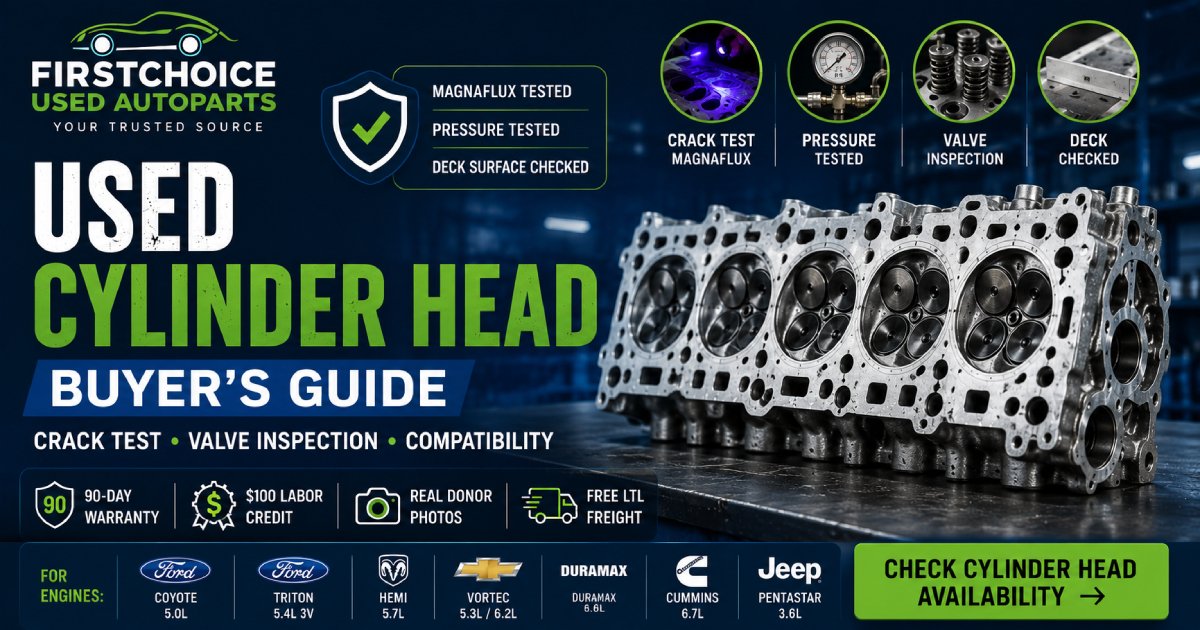
The inspection process is the entire reason a used cylinder head is a valid choice for a paying customer. Every head shipped from FirstChoice goes through four mandatory checks before it is approved for shipment.
MagnaFlux Crack Test (Dye Penetrant Inspection)
The head is cleaned, sprayed with fluorescent penetrant dye, wiped, and then inspected under UV light. Cracks invisible to the naked eye — hairline fractures between valve seats, fractures in the exhaust port floor, fractures around the water jacket — light up under UV. Any head with a crack is rejected. This is the single most important test on an aluminum head because thermal cycling and overheating events crack aluminum in places that visual inspection misses entirely.
Pressure Test
The head is sealed and pressurized with air while submerged in water (or sprayed with a soap solution). Any porosity, hidden crack, or coolant passage failure releases bubbles. This test catches what MagnaFlux misses — internal cracks between coolant and oil passages, casting porosity, and failed welds on previously-repaired heads.
Valve Guide and Valve Seat Check
Valve guides wear oval over high mileage and cause excessive valve stem play, which leads to oil consumption and valve seat recession. Each guide is checked with a dial indicator for stem play, and each seat is checked for recession depth and concentricity. Any head with sunken seats or worn guides beyond service limits is rejected.
Deck Surface Flatness
Aluminum heads warp from overheating events. The deck surface is checked with a precision straightedge across multiple axes. Warpage beyond 0.003 inches over the head length is rejected. A warped head will not seal a head gasket no matter how much torque is applied to the head bolts.
Every FirstChoice used cylinder head is MagnaFlux tested, pressure tested, valve-guide-checked, and deck-surface-measured. 30-day warranty plus Parts only.
Find Your Used Cylinder Head →5-Step Ordering Process
- Pull your casting number. Remove the valve cover or check the visible side of the head for the casting number. Write it down. This is the part identifier — not the displacement. If you can’t access it on the engine, look it up by VIN through a Ford / GM / RAM parts catalog.
- Confirm valve configuration and engine code. 5.4L 2V / 3V / 4V are different parts. 5.3L LM7 / L83 are different parts. HEMI MDS / non-MDS are different parts. State the full engine code when you call.
- Specify bare head vs. complete assembly. Bare casting ships without valves, springs, retainers, or rockers — appropriate when you have a good valvetrain to reuse. Complete assembly ships with valvetrain installed — appropriate when valvetrain components have unknown history.
- Request casting number, donor mileage, and inspection documentation. A real supplier will email you photos of the actual head with the casting number visible, document the donor vehicle mileage, and confirm MagnaFlux and pressure test results. If a supplier won’t provide these in writing, walk away.
- Order head bolts and head gasket alongside the head. Most modern engines use torque-to-yield (TTY) head bolts that are not reusable. Budget $80–$200 for a head bolt set and head gasket — these are mandatory replacements during a head swap.
Used vs Rebuilt vs Reman Cylinder Head Comparison
| Used OEM Head | Rebuilt | Remanufactured | New OEM | |
|---|---|---|---|---|
| Cost (5.4L 3V example) | $200–$400 | $400–$700 | $550–$900 | $1,200–$1,800 |
| Casting | Original OEM | Original OEM (your core or supplied) | Original OEM core, refurbished to spec | Factory new |
| Valvetrain | Original or replaced | Inspected, partial replacement | New valves, springs, seats | New |
| Crack test | MagnaFlux + pressure test required | Should be done | Always done | N/A |
| Warranty | 30 days (FirstChoice) | 30–90 days typical | 1–3 years typical | 2–3 years OEM |
| Best for | Donor under 120K miles; documented inspection | Builder with shop access | High-mileage vehicle; long-warranty preference | Newer vehicles still under factory coverage |
“I run an indie shop in Detroit and a regular customer brought in a 2008 F-150 5.4L 3V that ate a spark plug and cracked the head around the bore. Quoted a reman at $850 plus the spark plug repair kit and the customer balked. Called FirstChoice, gave them the casting number and asked for a head from a low-mileage donor. They sent me photos of a 78,000-mile head, casting matched, MagnaFlux clean, pressure tested clean, threads intact in every bore. Saved my customer $480 vs reman and the truck has been back twice for unrelated work — no head issues. The donor photos before shipment is what sold me on using them again.”
Related Cylinder Head Guides
Aluminum vs Cast Iron Cylinder Head
Material choice affects weight, thermal management, repair cost, and failure modes. Side-by-side spec table and which US engines use which material.
Read the Material Guide →Signs of a Cracked Cylinder Head
7 symptoms with confirmation tests. White exhaust smoke, milky oil, coolant loss with no leak, misfire, low compression. When used is the right answer.
Read the Symptoms Guide →Shop Used Cylinder Heads
Coyote, Triton, HEMI, Vortec, Duramax, Cummins, Pentastar. MagnaFlux tested, pressure tested, 30-day warranty.
Check Availability →Know your casting number and engine code? Call 1-888-383-2439 or WhatsApp 502-751-9602. Real donor photos before shipment, free LTL freight, 48 states.
Get a Cylinder Head Quote →Frequently Asked Questions
Is buying a used cylinder head worth it?
Yes — a verified used head from a low-mileage donor costs 50–70% less than a reman. The key is verification: MagnaFlux crack test, pressure test, valve guide check, deck surface measurement, donor mileage documentation, and casting number match. FirstChoice ships every head with all five items confirmed plus a 30-day warranty and Parts only.
How much does a used cylinder head cost?
Ford 5.4L 3V Triton: $200–$400. Ford 5.0L Coyote: $300–$600. GM 5.3L Vortec: $180–$380. GM 6.2L L86: $350–$700. RAM 5.7L HEMI: $250–$500. Cummins 6.7L: $600–$1,200. Duramax 6.6L: $700–$1,400. Jeep 3.6L Pentastar: $200–$450.
How do I know if a used cylinder head is cracked?
MagnaFlux dye penetrant inspection under UV light reveals hairline cracks invisible to the naked eye. A pressure test with the head submerged catches internal porosity. Both tests are mandatory before shipment at FirstChoice. Never accept a used head from a supplier who cannot confirm both tests in writing.
What does the casting number on a cylinder head mean?
The casting number is the part identifier stamped or cast into the head itself. It identifies valve configuration, port shape, combustion chamber volume, and bolt pattern. Two engines sharing displacement (5.4L 2V vs 5.4L 3V) use completely different heads with different casting numbers. Always match casting number to casting number, not displacement to displacement.
What warranty does FirstChoice offer on used cylinder heads?
Every used cylinder head ships with a 30-day warranty. Heads are MagnaFlux tested, pressure tested, valve-guide-checked, and deck-surface-measured. Real donor photos are sent before the unit leaves Louisville, KY. Free LTL freight, fully insured, 48 states. Call 1-888-383-2439 Mon–Fri 9 AM to 6 PM EST.