
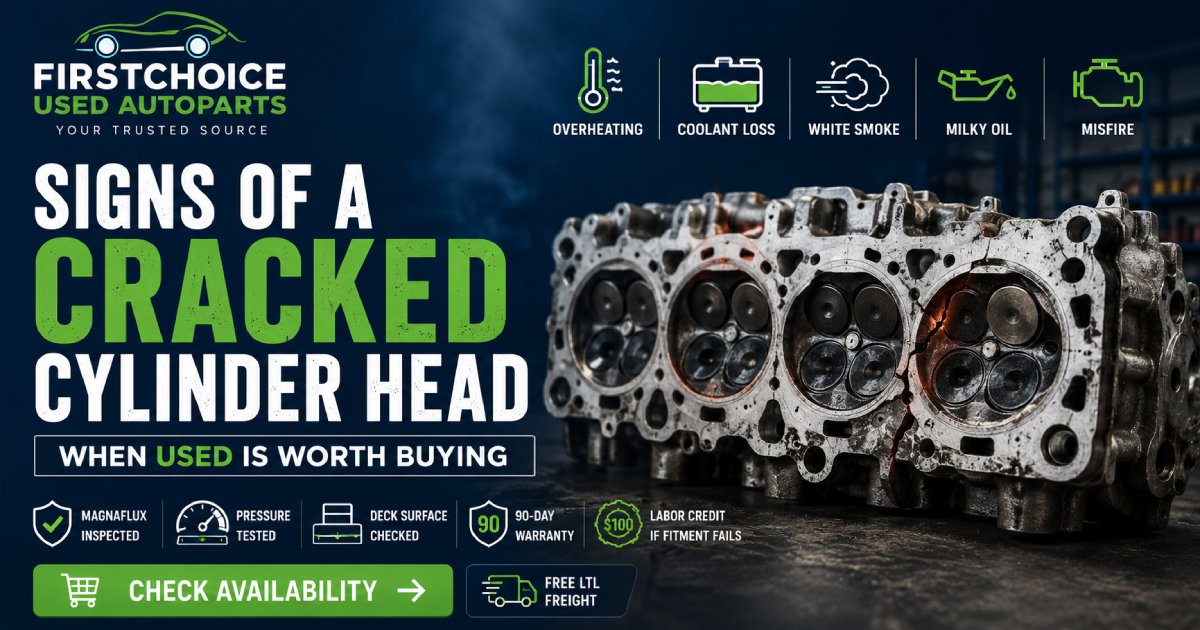
If the engine in your driveway is overheating, drinking coolant with no puddle underneath, and pushing white smoke out the tailpipe, you are most likely looking at a cracked cylinder head. This guide gives US truck and SUV owners the 7 symptoms that confirm the diagnosis, the simple combustion leak test that takes 10 minutes, and the cost-benefit math on used head replacement versus rebuild versus full reman.
FirstChoice ships verified used cylinder heads — Magnaflux-inspected, pressure-tested, deck surface checked for warpage — for Ford 5.0L Coyote, 5.4L 3V Triton, GM 5.3L Vortec, GM 6.2L L86, RAM 5.7L HEMI, Cummins 6.7L, Duramax 6.6L, and Jeep 3.6L Pentastar. 30-day warranty. But before you order, confirm it is actually a cracked head and not something cheaper.
Cracked head confirmed? Magnaflux-inspected used heads ship with photos. 30-day warranty.
Check Availability →The 7 Symptoms of a Cracked Cylinder Head
1. White Exhaust Smoke
Steady white smoke from the tailpipe — not the brief morning startup mist — means coolant is being burned in the combustion chamber. Smells slightly sweet (antifreeze odor). Worsens at idle and after warm-up. This is the single most reliable cracked-head indicator on gas engines.
2. Milky White Residue in the Oil
Pull the oil cap. If the underside shows a light tan or milky white paste, coolant is in the oil. This can be either a cracked head, a blown head gasket, or a cracked block. All three are serious. Stop driving and diagnose before further damage.
3. Persistent Overheating
The engine overheats even with a new thermostat, full coolant level, and a functional radiator. Cracks in the head allow combustion gases to push into the coolant passage, displacing coolant and creating hot spots. The cooling system cannot keep up.
4. Coolant Loss With No Visible External Leak
The reservoir drops a half-inch every week. You inspect the engine bay, the radiator, the hoses, the water pump — no drips. The coolant is going somewhere internal, most likely being burned in the combustion chamber or contaminating the oil. Either way, the head is the suspect.
5. Single-Cylinder Misfire
Your scan tool reads a P0301 (cylinder 1 misfire) or similar code. New spark plug does not fix it. New coil does not fix it. The misfire happens because coolant in the combustion chamber prevents proper ignition. The cracked head is directing coolant into that specific cylinder.
6. Low Compression on One Cylinder
Compression test reveals one cylinder at 80-100 PSI while the others are at 150-170 PSI. A leak-down test pumped into that low cylinder shows air bubbles in the coolant reservoir — confirming the leak path is from combustion chamber to water jacket.
7. Bubbles in the Coolant Reservoir During Warm-Up
The most diagnostic of the symptoms. Remove the radiator cap (when engine is cold), start the engine, and watch the reservoir. Steady bubbles rising into the reservoir as the engine warms up = combustion gases entering the cooling system. Almost always a cracked head or blown gasket.
10-minute confirmation test: The combustion leak test (block test) uses a blue dye that turns yellow when exposed to combustion gases. Available at any US auto parts store for $40. Pull a coolant sample into the test bulb, hold it over the open radiator, and watch the color. Yellow within 5 minutes = combustion gases in coolant = cracked head or blown gasket. This is the single most useful $40 you can spend before ordering parts.
Cracked Head vs Blown Head Gasket — How to Tell the Difference
The symptoms overlap, but the failure mechanism and the repair cost differ significantly.
| Test / Symptom | Cracked Head | Blown Head Gasket |
|---|---|---|
| Combustion leak test (block test) | Yellow — positive | Yellow — positive |
| Compression loss | Single cylinder, coolant path | Often between two adjacent cylinders |
| White smoke from tailpipe | Steady when warm | Intermittent, especially after sitting |
| Milky oil | Sometimes | Often |
| Visual inspection | Crack visible after removal (between valve seats, around bolt boss) | Gasket fire ring broken or burnt |
| Magnaflux test | Crack reveals magnetic flux disturbance | Head and block surface clean |
| Repair cost (without labor) | $200-$700 used head replacement | $80-$250 gasket plus head resurface |
| Total cost installed | $1,200-$2,400 | $1,000-$2,200 |
The repair labor is similar because you have to remove the head either way. The cost difference comes down to the part: a head gasket costs $80-$250, a used cylinder head costs $200-$700. If your head is warped from overheating (common on aluminum heads), the gasket-only repair will fail again within 3,000-15,000 miles. In that case the used head replacement is the right path even though it costs more.
The 3 Confirmation Tests
Test 1: Combustion Leak Test (Block Test)
The cheapest and most reliable confirmation. Buy a block test kit at any US parts store ($35-$50). Drain enough coolant to expose the reservoir surface, install the bulb of blue test fluid over the radiator neck, start the engine, and run for 5 minutes. Blue → yellow = combustion gases in coolant. Combined with overheating and white smoke, this is diagnostic for a cracked head or blown gasket.
Test 2: Coolant Pressure Test
Connect a coolant pressure tester to the radiator neck. Pump to 15 PSI. Watch for pressure drop:
- Pressure holds for 15 minutes: cooling system sealed. Internal leak unlikely.
- Pressure drops slowly: head gasket or head cracking small enough to seep slowly.
- Pressure drops in seconds, with coolant pushing back into the reservoir: cracked head or blown gasket with major path.
Test 3: Compression Test (Per Cylinder)
Remove spark plugs, install compression tester one cylinder at a time. Healthy gas engines read 130-180 PSI per cylinder with no more than 10% variation. One cylinder dramatically lower = leak in that combustion chamber. Two adjacent cylinders low = head gasket between them. One cylinder low plus the leak-down test showing air in the coolant = cracked head into that cylinder.
When a Used Head Beats Rebuilding Yours
The decision tree on US trucks and SUVs:
| Condition of Your Head | Best Path | Why |
|---|---|---|
| Crack between valve seats, no warpage | Replace with used head | Crack repair welding is expensive and may fail |
| Single crack repaired, deck warped past spec | Replace with used head | Resurfacing thins the head further; weak under thermal cycling |
| Aluminum head, overheated severely | Replace with used head | Aluminum loses strength after extreme heat exposure |
| Cast iron head, single small crack | Pinning repair viable | Cast iron repairs hold longer than aluminum welds |
| Multiple cracks, valve damage, severe warpage | Replace with used head | Cumulative damage makes rebuild uneconomic |
| Single valve seat issue, no cracks | Rebuild yours | Repair cheaper than replacement |
The Hidden Cost: Aluminum Head Warpage on Overheated Engines
Aluminum cylinder heads have a major weakness — when subjected to severe overheating, they warp permanently. The factory spec for aluminum head flatness is typically 0.002-0.004 inches over the length of the head. Severe overheating bows aluminum heads to 0.010-0.020 inches.
A bowed aluminum head can be resurfaced once, removing about 0.005-0.010 inches of material. But:
- Each resurface raises the compression ratio slightly
- The intake manifold no longer aligns properly with the head ports
- Cylinder timing marks become incorrect on overhead cam engines
- The repair is one-time — a second overheat ends the head
This is why a used aluminum head from a non-overheated donor is often the better path than resurfacing the existing warped one. FirstChoice pressure-tests deck flatness on every aluminum head before shipping. We disclose the measured flatness on request.
Cluster Reading
Used Cylinder Head Buyer’s Guide
Cost by engine, the 4 compatibility factors, inspection process, and 5- step ordering.
Read the Buyer’s Guide →Aluminum vs Cast Iron Cylinder Head
Material differences that matter at the used-parts counter. Strength, warpage risk, repair difficulty.
Read the Material Guide →Shop Used Cylinder Heads
Magnaflux-inspected, pressure- tested, deck flatness verified. Ford, GM, RAM, Toyota, Jeep.
Check Availability →“My 2014 RAM 1500 with the 5.7L HEMI overheated bad — water pump failed on the highway in 105-degree desert. Limped it home. Cracked head between exhaust valves. Local shop wanted $1,800 for a new head and $1,400 in labor. Found FirstChoice, they had a 62,000-mile 5.7L head from an insurance-totaled Ram donor, Magnaflux passed, deck flatness measured at 0.002 inches. $410 shipped including freight. Total job ran me $1,650 versus the $3,200 dealer quote. Engine’s been running clean for over 14 months.”
Pressure-tested, Magnaflux-verified used cylinder heads. Free LTL freight + 30-day warranty.
Get a Quote →Frequently Asked Questions
What are the signs of a cracked cylinder head?
The 7 most common symptoms of a cracked cylinder head are: white exhaust smoke (coolant burning), milky white residue in the oil, persistent overheating, coolant disappearing with no visible external leak, single-cylinder misfire, low compression isolated to one cylinder, and bubbles in the coolant reservoir during engine warm-up. A combustion leak test confirms the diagnosis in under 10 minutes.
How do I tell a cracked head from a blown head gasket?
Both have similar symptoms but the diagnostic confirmation differs. A blown head gasket usually shows compression loss between two adjacent cylinders. A cracked head shows compression loss to coolant (bubbles in reservoir, white smoke) without the inter-cylinder loss. Pull the head and inspect with dye penetrant or Magnaflux. Cracks often run between the valve seats or from a head bolt boss to a coolant passage.
Can you weld a cracked cylinder head?
Aluminum heads can be welded by a specialist using TIG and proper preheating, but the repair runs $400-$900 with no warranty on the weld holding under thermal cycling. Cast iron heads can be pinned or welded but similarly expensive. For most US buyers, a verified used head from a known-good donor costs less than the welding repair.
Is a used cylinder head a good replacement for a cracked one?
Yes, when the used head is from a low-mileage donor and properly inspected. A used head with verified Magnaflux or dye penetrant inspection, pressure-tested water jackets, and a checked deck surface for warpage costs $200-$700 versus $400-$1,200 for a rebuild. The labor to install is identical, so used wins on total cost when sourced from a quality supplier.
What causes a cylinder head to crack?
The four most common causes are: severe overheating (most common, especially on aluminum heads), freeze damage when coolant is replaced with water in winter, thermal shock from cold water hitting a hot head, and casting fatigue at high mileage. Engines that overheat once and continue to drive often crack the head within the next 500-2,000 miles.