
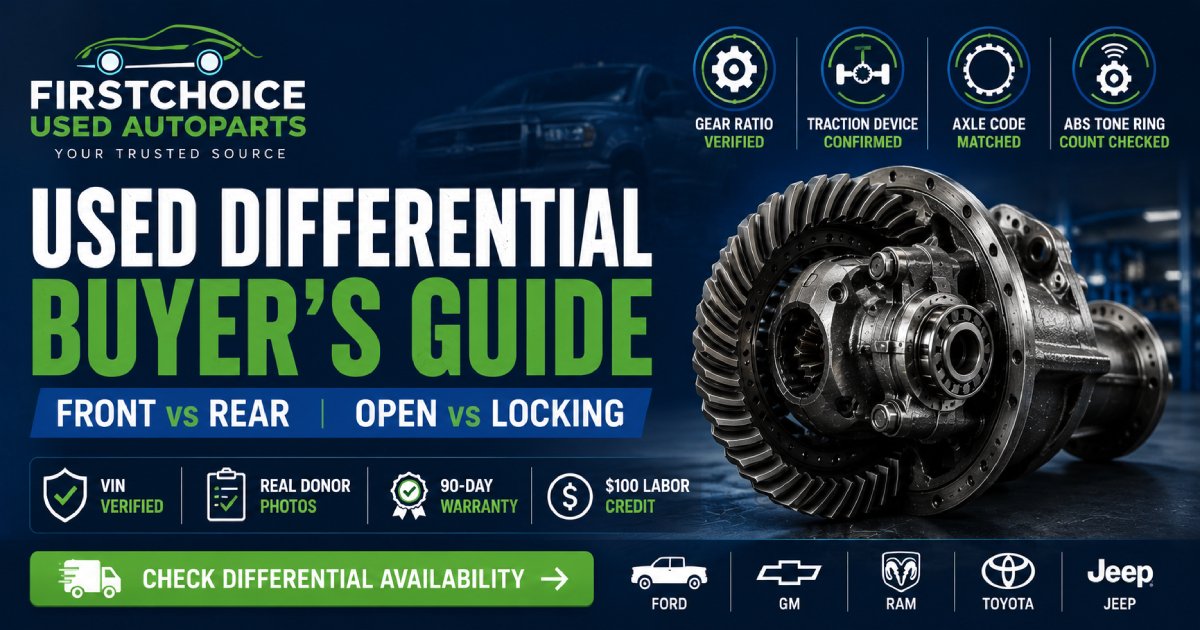
A truck differential is the single most expensive drivetrain component to replace new — and the single best-value used part you can buy, provided you order it correctly. New OEM differentials for half-ton trucks run $1,400-$2,600. Heavy-duty units (Ford Sterling 10.5, AAM 11.5) push past $3,000. Used differentials from verified low-mileage donors land between $260 and $740 depending on the platform, with VIN-confirmed gear ratio, identified traction device, and a 90-day warranty.
The difference between a successful used-diff swap and a destroyed transfer case three months later comes down to four data points: gear ratio, traction device, axle code, and ABS tone ring count. Get all four right and a used differential is one of the lowest-risk used part purchases in the truck market. Miss one and you’ll be paying twice — once for the part, once for the transfer case it ruins.
This guide walks through anatomy, cost by truck and SUV, the four compatibility factors, used vs rebuilt vs new, and the FirstChoice 5-step ordering process — built around the 98.2% first-fit rate we maintained across 3,400+ drivetrain parts shipped in 2025.
FirstChoice carries Ford 8.8 and 9.75, GM 8.6 and 9.5, RAM AAM 9.25 and 11.5, Toyota 8.4 and 9.5, Dana 35 and 44 — VIN-verified, gear ratio confirmed, real donor photos before shipping.
Check Differential Availability →What Is a Differential — and Why It’s the Most Expensive Part to Replace New
A differential is the gear set inside the axle housing (rear axle, or front axle on 4WD) that splits torque between the two driven wheels while allowing them to spin at different speeds during cornering. It is a precision assembly: a ring gear meshed with a pinion at a specific lash, supported by tapered bearings on a carrier that holds spider gears, all running in 75W-90 (or 75W-140) gear oil.
The reason new OEM differentials cost what they do is that the ring and pinion are factory-lapped together as a matched pair. You cannot buy a new ring without a new pinion. The bearings are matched to specific preload values. The carrier is shimmed to a tenth of a millimeter. When a new OEM rear differential for a Ford 9.75 lists at $1,800, you’re paying for that matched setup plus a fresh aluminum case.
Used differentials carry the same matched ring and pinion — broken in, but with the wear pattern established and most of the gear life ahead. The trick is sourcing from low-mileage donors (under 110K is our internal target) and verifying the four compatibility points before shipping.
Front vs Rear Differential — Anatomy and Failure Patterns
Rear Differential
The rear diff carries the primary drive load on every RWD and 4WD truck. It is larger, heavier, and uses a thicker ring gear (8.6, 9.25, 9.75, 10.5, 11.5-inch are the common diameters). Failure patterns on rear differentials are dominated by three causes:
- Pinion bearing wear — produces the classic howl under load that gets worse as the truck warms up. Most common on trucks over 150K miles.
- Ring and pinion wear — chipped or pitted teeth, often from a previous owner who ran the diff low on fluid.
- Carrier and spider gear failure — usually trauma-induced (one-tire spin-up on ice, towing beyond rating).
Front Differential
The front diff is smaller, runs cooler (engaged only in 4WD), but has its own failure modes: actuator failure on GM and Ford front axle disconnects, CV-shaft seal leaks, and on Jeep Dana 30 / Dana 44 front axles, ball joint contamination working its way into the housing. Front diffs also have to interface with the steering knuckles and CV shafts, so the axle code matters even more — flange patterns and stub-shaft splines vary year to year.
Quick anatomy check before ordering: The single most useful piece of information you can give us is the axle tag — the small metal plate bolted to the differential cover. It lists the gear ratio, build date, and axle code. Photograph it and text it to our WhatsApp at 502-751-9602. We’ll confirm the match against your VIN in under 15 minutes.
Used Differential Cost by Truck and SUV
The table below shows live FirstChoice pricing ranges for the most common truck and SUV differentials, alongside new OEM list prices. Ranges reflect the spread between standard open differentials and matching limited-slip or locker variants — the locker units price at the top.
| Platform | Differential | Used Price | New OEM | Savings |
|---|---|---|---|---|
| Ford F-150 (2004-2014) | Ford 8.8-inch | $280-$440 | $1,200-$1,600 | ~70% |
| Ford F-150 (2015+) | Ford 9.75-inch | $360-$580 | $1,500-$2,100 | ~70% |
| Chevy / GMC 1500 | GM 8.6-inch 10-bolt | $260-$420 | $1,100-$1,500 | ~70% |
| Chevy / GMC 2500HD / 3500 | GM 9.5-inch 14-bolt | $430-$680 | $1,800-$2,500 | ~70% |
| RAM 1500 (2002+) | AAM 9.25-inch | $310-$500 | $1,400-$1,900 | ~70% |
| RAM 2500 / 3500 HD | AAM 11.5-inch | $470-$740 | $2,100-$3,200 | ~75% |
| Toyota Tacoma 4WD | Toyota 8.4-inch | $300-$480 | $1,300-$1,800 | ~70% |
| Toyota Tundra | Toyota 9.5-inch | $370-$580 | $1,600-$2,200 | ~70% |
| Jeep Wrangler / Cherokee (front) | Dana 35 | $220-$360 | $900-$1,300 | ~70% |
| Jeep Wrangler / Grand Cherokee | Dana 44 | $340-$540 | $1,400-$2,000 | ~70% |
| Jeep Grand Cherokee (V8 rear) | AAM 9.25-inch | $310-$500 | $1,400-$1,900 | ~70% |
The 4 Compatibility Factors — Get These Right and It Bolts In
1. Gear Ratio (Critical on All 4WD)
The gear ratio (3.55, 3.73, 4.10, etc.) is the number of pinion rotations per ring gear rotation. On 4WD trucks, the front and rear differential ratios must be identical. A 3.73 rear paired with a 3.92 front produces constant driveline bind that overheats the transfer case viscous coupling within weeks. Even running the same nominal ratio across mismatched axle tag codes can produce binding if the manufacturer used slightly different cuts (rare but documented on early-2010s Ford Super Duty).
2. Traction Device (Open, LSD, Locker)
The carrier inside the housing is either open (no traction aid), limited-slip (clutches or gears that bias torque to the wheel with grip), or a locker (full mechanical or selectable lock-up). A used differential carrier marked G80 on a GM RPO sticker is the Gov-Lok locker. A Ford door jamb code with “L” suffix indicates Trac-Lok limited slip. RAM SPID code DSA = Anti-Spin LSD. Mismatching changes how your truck behaves and can violate fitment warranty terms.
3. Axle Code (Manufacturer-Specific)
The axle code is the alphanumeric stamping on the axle tag (Ford), the RPO code (GM), or the SPID label (RAM). Two trucks with the same year, make, model, and gear ratio can still have different axle codes if one came with a tow package, off-road package, or a running production change. The axle code captures these differences — pinion flange size, axle tube length, brake mounting hardware.
4. ABS Tone Ring Count
This is the one that catches people. The ABS reluctor ring (also called the tone ring) inside the axle has a specific tooth count — typically 40, 48, or 60 teeth. The wheel speed sensor reads it. If you install a used differential with a 48-tooth tone ring into a truck whose ECU expects 60 teeth, the ABS light will come on within 100 feet of driving and traction control will be disabled. We verify tone ring counts on every drivetrain shipment.
ABS tone ring is the #1 cause of post-install warranty calls. If you’re buying from anyone other than a VIN-verified supplier, ask explicitly how many teeth are on the reluctor ring. “Should be the same” is not an answer. Get the count.
Cluster Guides
Posi vs Limited-Slip vs Locking Differential
Posi-Traction, Trac-Lok, Anti-Spin, e-Locker — what each manufacturer calls their traction device and how to tell what you have.
Read the Traction Guide →Signs of a Failing Differential
The 8 symptoms of a dying diff, the symptom-to-component matrix, and the 4 confirm-before-you-buy tests every shop should run.
Read the Symptoms Guide →Shop Used Differentials
Ford, GM, RAM AAM, Toyota, Dana — VIN-verified, gear ratio confirmed, 90-day warranty, free LTL.
Check Availability →Used vs Rebuilt vs New Differential
| Used OEM (FirstChoice) | Rebuilt / Reman | New OEM | |
|---|---|---|---|
| Cost (half-ton truck) | $260-$580 | $650-$1,200 | $1,100-$2,100 |
| Cost (heavy-duty) | $430-$740 | $1,100-$1,800 | $1,800-$3,200 |
| What you get | Original OEM, donor-verified, mileage-confirmed | Original housing, new ring/pinion, new bearings | Factory new in crate |
| Warranty | 90 days | 1-2 years typical | 2-5 years |
| Gear ratio set | Yes — verified from axle tag | Yes — specified at order | Yes |
| Best for | Donor under 110K miles, budget-conscious repair, daily-driver and commercial use | High-mileage truck where ring/pinion is the confirmed failure | Late-model truck still under factory warranty or high-use commercial fleet |
| Lead time | 2-4 business days (free LTL) | 5-10 business days | 5-21 days from dealer |
5-Step Ordering Process
- Pull your VIN and your gear ratio. The VIN gives us the platform. The gear ratio gives us the exact match. Find the ratio on the axle tag (cover bolt), RPO sticker (GM glove box), door jamb code (Ford), or SPID label (RAM trunk or glove box). If you can’t find any of these, use the manual count method: jack one wheel off the ground, mark the driveshaft, rotate the wheel exactly two full turns, count driveshaft rotations. Drive shaft turns equals your ratio.
- Identify your traction device. Open, limited-slip, or locker. The 30-second test: jack both wheels, turn one. Same-direction spin on the opposite wheel = LSD or locker. Opposite-direction spin = open. We need this to match your original spec.
- Confirm the ABS tone ring count. If you have access to the failed axle, count the teeth on the reluctor ring. If not, give us the trim level and we’ll cross-reference. This single step prevents 80% of post-install warranty calls.
- Request donor photos and mileage. Every FirstChoice differential ships with real photos of the donor vehicle before disassembly and a written mileage statement. If a supplier won’t show you the donor, walk away.
- Schedule install around the freight window. Free LTL freight to 48 states, fully insured. Standard transit is 2-4 business days. Don’t pull the failed differential out of your truck until ours is on the truck delivery scheduler — that way the truck is only down 1 day for the swap.
Order your fluid and gasket at the same time. Every differential swap needs a new differential cover gasket and 75W-90 (or 75W-140 for LSD/locker units). Budget $25-$45. Forgetting this turns a clean install into a parts-store run halfway through the job.
“Replaced the rear diff in my 2014 Silverado 1500 last month — the original was howling so bad you could hear it inside the cab at 35 mph. My RPO sticker had GU6 (3.73) and G80 (Gov-Lok locker), and I needed both. Called FirstChoice and Simon walked me through the tone ring count on my truck — turns out the 2014 had 60-tooth reluctors and earlier years had 48. They pulled a 78,000-mile donor diff, sent me photos of the axle tag matching 3.73 and the G80 casting marks, and shipped it on free LTL. Installed it on a Saturday, ABS light never came on, locker engages exactly like the old one did. Saved me about $1,400 versus the dealer quote and the truck has been silent for 3,000 miles.”
Know your gear ratio and traction device? Get a fitment-confirmed quote from FirstChoice — 98.2% first-fit rate, 90-day warranty.
Find Your Differential →Frequently Asked Questions
Is buying a used differential a smart move?
Yes — for trucks and SUVs, a verified low-mileage donor differential costs 55-70% less than new OEM and 30-45% less than rebuilt. The ring and pinion retain significant life on a 70K-110K mile donor. FirstChoice ships used differentials with a 98.2% first-fit rate, 90-day warranty, and Parts only.
What is the difference between front and rear differentials?
Rear diffs carry primary drive load and are larger and heavier. Front diffs engage only in 4WD/AWD, run cooler, but interface with CV shafts and steering knuckles. On 4WD trucks the gear ratios must match exactly — even a 3.73 vs 3.92 mismatch ruins the transfer case in months.
How much does a used differential cost?
Ford 8.8: $280-$440. Ford 9.75: $360-$580. GM 8.6 10-bolt: $260-$420. GM 9.5 14-bolt: $430-$680. RAM AAM 9.25: $310-$500. RAM AAM 11.5: $470-$740. Toyota 8.4: $300-$480. Toyota 9.5: $370-$580. Dana 35: $220-$360. Dana 44: $340-$540.
Will a used differential from a different gear ratio work?
No on 4WD/AWD — front and rear must match exactly or you destroy the transfer case. On 2WD it will not damage anything but speedometer accuracy and fuel economy will be off. Always confirm your ratio from the axle tag, RPO sticker, door jamb code, or SPID before ordering.
Does FirstChoice warranty cover labor on a bad used differential?
Yes — 90-day parts warranty. VIN-verified, donor-photographed, gear-ratio-confirmed. 2025 first-fit rate: 98.2% across 3,400+ drivetrain parts shipped. Free LTL freight, fully insured, 48 states.
Call 1-888-383-2439 (Mon-Fri 9 AM to 6 PM EST) or WhatsApp 502-751-9602 with your VIN and gear ratio. We’ll confirm the match and quote freight in under 15 minutes.
Get a Fitment-Confirmed Quote →