
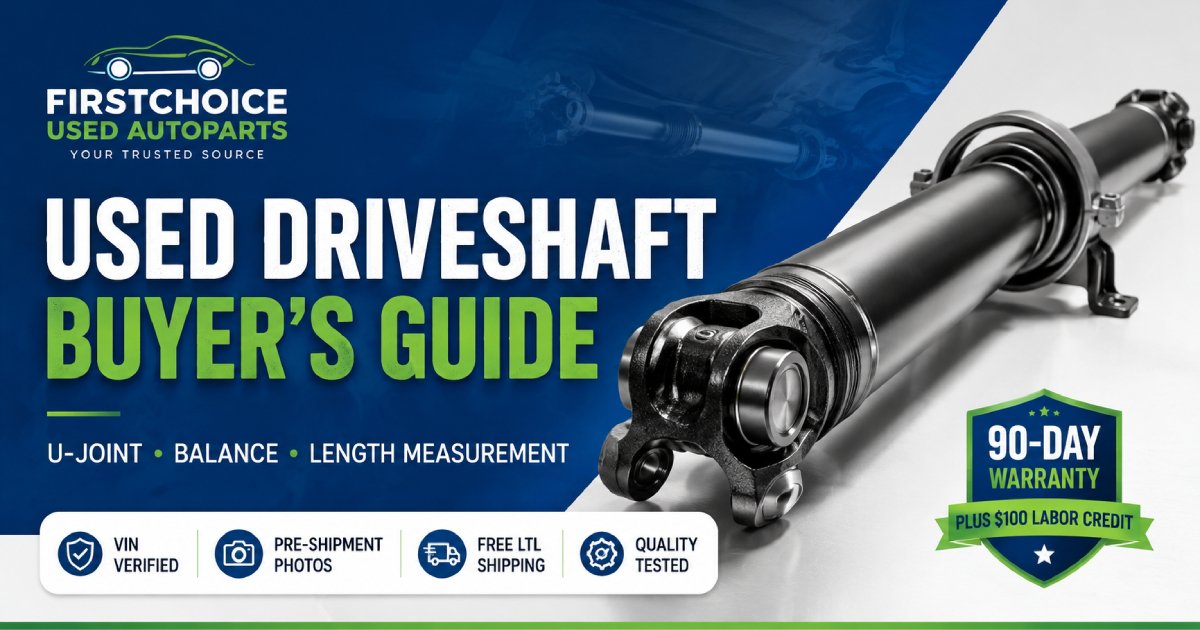
A used driveshaft is one of the smartest drivetrain purchases an American truck owner can make. New OEM driveshafts for half-ton trucks run $550-$1,200; heavy-duty 2-piece assemblies run $900-$1,900. A VIN-matched used driveshaft from a low-mileage donor — with healthy u-joints, intact balance weights, and correct length — costs $180-$650 depending on the truck. The reason: the steel tube does not wear. What wears are the u-joints and, on 2-piece shafts, the center support bearing. Both are bolt-on serviceable items costing $25-$80 each.
Getting it right requires four data points: length, yoke type, slip-yoke spline count, and balance condition. Miss any of these and you ship the part back. Nail all four and you get a part that performs identically to new at roughly half the cost. This guide walks through each one, with the cost table, the measurement procedure, and the ordering process FirstChoice uses to hit a 98.2% first-fit rate on driveshafts.
FirstChoice ships VIN-verified used driveshafts for F-150, Silverado, Sierra, RAM, Super Duty, Tundra, and more. 30-day warranty.
Check Driveshaft Availability →Why Used Driveshafts Are the Best-Kept Secret in Drivetrain Repair
Walk into any independent shop and ask the lead tech what part on a truck has the longest mean time between failure. The answer is almost always: the driveshaft tube. It’s a section of seamless steel — DOM tubing or similar — spinning at engine RPM divided by your gear ratio. Under normal driving it sees no shock loads, no heat cycling like an exhaust, no contamination like a transmission. As long as the balance weights are intact and the tube is straight, a 12-year-old driveshaft is mechanically identical to a 2-year-old driveshaft.
What fails on a driveshaft are the spinning interfaces — the u-joints at each end and (on 2-piece shafts) the center support bearing in the middle. Both are rebuildable for under $80 in parts. So when a shop quotes you $950 for a “new driveshaft” because a u-joint is shot, the real story is: $40 of u-joints failed inside a $700 tube that has decades of life left. A used VIN-matched driveshaft with good u-joints is the same engineering at 40-50% of the price.
The trust gap is real, though. Buyers worry about freight damage to a 6-foot steel tube, about getting a wrong-length shaft that doesn’t slip into the transmission, and about balance issues causing vibration at highway speeds. The fix is supplier-side: pre-shipment photos, VIN verification, length confirmation in writing, and freight insurance. The next sections cover exactly what to ask for.
Used Driveshaft Cost by Truck
Pricing reflects what FirstChoice has shipped in 2025 across the most common US truck platforms. Heavy-duty 2-piece shafts cost more because the assembly includes the center support bearing and double the u-joint count.
| Truck | Driveshaft Type | Used Price | New OEM | Typical Savings |
|---|---|---|---|---|
| Ford F-150 2WD (Reg/Ext Cab) | 1-piece | $180-$320 | $550-$850 | ~60% |
| Ford F-150 4WD (most configs) | 1-piece or 2-piece | $250-$450 | $700-$1,200 | ~60% |
| Chevy Silverado 1500 | 1-piece (Reg/Ext) or 2-piece (Crew) | $200-$360 | $600-$1,000 | ~62% |
| GMC Sierra 1500 | 1-piece or 2-piece | $200-$360 | $600-$1,000 | ~62% |
| RAM 1500 | 1-piece or 2-piece (Crew/Mega) | $200-$400 | $650-$1,150 | ~62% |
| Ford F-250 / F-350 (1-piece) | Heavy-duty 1-piece | $280-$500 | $900-$1,500 | ~65% |
| Ford F-250 / F-350 (2-piece) | HD 2-piece with center bearing | $350-$650 | $1,100-$1,900 | ~65% |
| Toyota Tundra 4WD | 2-piece | $280-$480 | $850-$1,300 | ~62% |
| Jeep Wrangler (front or rear) | 1-piece short shaft | $180-$340 | $550-$900 | ~62% |
The 4 Compatibility Factors
1. Length — Measured to the Nearest 1/8 Inch
Driveshaft length is the absolute dealbreaker. A shaft that is 1 inch too short pulls out of the transmission tail-housing at full suspension droop and leaves you on the side of I-10. A shaft that is 1 inch too long bottoms out the slip yoke against the transmission seal under compression and destroys the seal. The slip yoke gives you about 2 inches of total compliance — half in each direction. Anything outside that tolerance and the part won’t work.
2. Yoke Type — The Cross Pattern Has to Match
The yoke is the flanged end that bolts to the rear differential pinion or the transfer case output. It comes in several common patterns: Spicer 1310, 1330, 1350 series for light-duty trucks; 1410 and 1480 for heavy-duty. The u-joint cap diameter and bolt circle have to match your existing flange exactly. Same truck, different model year, sometimes different yoke series. The supplier should specify the yoke series when they quote you a shaft.
3. Slip-Yoke Spline Count
The slip yoke is the male spline end that slides into the transmission output shaft (on 1-piece shafts) or the transfer case (on 2-piece shafts). Spline counts vary: 27-spline, 31-spline, 32-spline are all common on full-size trucks. Wrong spline count means the shaft physically won’t engage the transmission. VIN matching eliminates the risk.
4. Balance Condition
Factory balance weights are tack-welded to the tube. A used shaft with all weights intact, no visible bends, and no rust pitting on the tube surface will run identically to new. Reject shafts with missing weights, evidence of welding repair, or visible damage to the tube — they will vibrate at 50+ mph and the vibration cannot be fixed without a balance shop.
Pro tip: Ask the supplier for pre-shipment photos showing both u-joint ends, the slip yoke splines, and a wide shot of the tube with balance weights visible. FirstChoice sends real donor-vehicle photos for every driveshaft order before it leaves the warehouse — VIN confirmed, weights confirmed, no surprises on delivery.
How to Measure Your Driveshaft Length
You have two options. Option one: pull the VIN off your truck and let the supplier match the factory spec — this is what 95% of buyers do and it works when the donor matches your cab, wheelbase, and drivetrain. Option two: measure the existing shaft yourself. This is the right call if your truck has been lifted, has a non-stock transmission, or you’re sourcing for a project build.
The center-of-bolt to center-of-bolt method:
- Park on level ground at normal ride height. No jack stands, no air bags inflated, no aftermarket leveling kit unloaded. The shaft length depends on suspension geometry — measure how the truck sits when you drive it.
- Identify the front u-joint and rear u-joint cap bolts. These are the four bolts on each end that hold the u-joint caps into the yoke ears.
- Mark the centerline of the rear u-joint bolt at the differential pinion flange. Use a paint pen or tape.
- Mark the centerline of the front u-joint bolt at the transmission yoke.
- Measure the distance between the two centerlines. Record in inches to the nearest 1/8 inch.
- For 2-piece shafts, also measure each half independently — front section center bolt to center support bearing, then center support bearing to rear section center bolt.
Don’t measure end-to-end: The overall tip-to-tip length includes the slip-yoke extension, which varies with suspension travel. Center-of-bolt to center-of-bolt is the only measurement that matches manufacturer spec sheets.
U-Joint Configuration — Greasable vs Non-Greasable
Factory u-joints on most modern trucks are non-greasable (sealed) units. They use a higher-grade synthetic grease packed at the factory and rely on the seal to retain it. Service life under normal driving: 100,000-180,000 miles typically. They are quieter and require zero maintenance until they fail.
Greasable u-joints have a Zerk fitting in the center cross. You pump grease in every 5,000-10,000 miles. The advantage: you can flush out water and contamination, which dramatically extends service life. The disadvantage: the Zerk fitting reduces the structural cross-section slightly, so peak torque capacity is marginally lower than a sealed unit of the same series.
For a stock truck driven on pavement, factory non-greasable is fine. For lifted trucks, off-road use, work trucks that wade through water, or anyone hauling heavy trailers, swap to greasable units when you install. A used driveshaft typically arrives with the original u-joints — confirm they are tight (no play when you twist the shaft), or budget $40-$80 for replacement u-joints during install.
5-Step Ordering Process
- Pull your VIN. 17 characters off the driver door jamb or dash plate. This tells the supplier your exact build configuration — cab, wheelbase, drivetrain, transmission, axle ratio. VIN matching is how FirstChoice hits 98.2% first-fit on driveshafts.
- Specify 1-piece or 2-piece. If you don’t know, look under the truck — a single steel tube from transmission to rear axle is 1-piece. A tube that joins in the middle at a hanger bearing mount is 2-piece. (We have a separate guide on the truck-by-truck breakdown linked below.)
- Note any lift, regear, or transmission swap. Anything that changes ride height, pinion angle, or transmission output configuration changes the required shaft length. Tell the supplier upfront so they can match accordingly.
- Request pre-shipment photos. The supplier should send photos of both u-joint ends, slip yoke splines, and the tube with balance weights visible. FirstChoice does this for every order before the truck rolls.
- Confirm freight terms and warranty. Free LTL freight, fully insured, 48 states. 30-day warranty. Get these confirmed in the order email before you wire payment.
“My 2014 RAM 2500 had a vibration that started around 60 mph and got worse the faster I went. Local shop wanted $1,400 for a new driveshaft. I called FirstChoice with my VIN — they pulled a 71,000-mile 2-piece shaft from a Crew Cab donor, matched ratio and yoke pattern, sent me photos of the u-joints and balance weights before shipping. Came in on free LTL, fitted first try, vibration completely gone. Saved me about $900 on the part alone, and the 90-day warranty gave me peace of mind. Honest dealing all around.”
VIN-verified used driveshafts shipped on free LTL freight, fully insured, 48 states. 30-day warranty. Call 1-888-383-2439.
Get a Driveshaft Quote →Cluster Guides
Frequently Asked Questions
Is buying a used driveshaft worth it?
Yes — the steel tube does not wear under normal driving. What fails are the u-joints and center support bearing, both inexpensive serviceable items. A VIN-matched used shaft costs 50-65% less than new with comparable remaining service life.
How much does a used driveshaft cost?
F-150 2WD $180-$320; F-150 4WD $250-$450; Silverado 1500 $200-$360; RAM 1500 $200-$400; F-250/F-350 1-piece $280-$500; F-250/F-350 2-piece $350-$650.
How do I measure my driveshaft length for a used replacement?
Center-of-bolt to center-of-bolt — from the rear u-joint bolt centerline at the pinion flange to the front u-joint bolt centerline at the transmission yoke. Measure at ride height on level ground, to the nearest 1/8 inch.
Does a used driveshaft need to be re-balanced?
No — if it is a VIN-matched donor pull with balance weights intact. Balance does not drift over mileage. Only re-balance if the shaft has been struck, bent, or had a u-joint replacement that disturbed the weights.
Will a used driveshaft from a different trim level fit my truck?
Sometimes. Match cab style, wheelbase, drivetrain (2WD/4WD), and transmission type. Length and slip-yoke spline count are the dealbreakers. VIN-to-VIN matching is the safest route.