
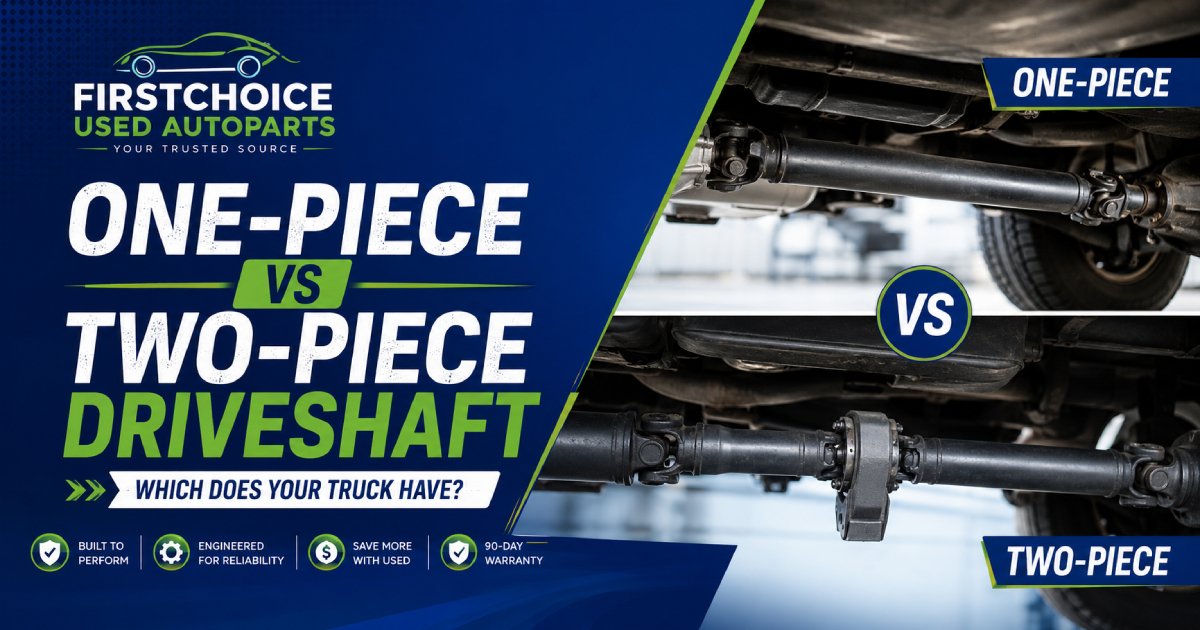
The 30-second answer for US truck owners: regular cab and short-bed trucks have a one-piece driveshaft running straight from the transmission to the rear differential with two U-joints. Crew cab, extended cab, and long-bed trucks have a two-piece driveshaft with three U-joints and a center support bearing bolted to the frame crossmember. The reason has to do with critical speed resonance — and so does the most common failure point on long-wheelbase trucks.
This guide explains how to identify your driveshaft type in 30 seconds, why the two-piece design exists, where the failure points are, and how the used-driveshaft economics work for both configurations. We ship both styles with VIN-verified fitment and a 30-day warranty.
One-piece or two-piece — we stock both. Length, yoke, and balance verified before shipping.
Check Availability →How to Identify Yours in 30 Seconds
Lie under the truck with a flashlight, looking up between the frame rails behind the transmission.
- One-piece: A single straight tube running from the transmission tail housing all the way back to the differential pinion yoke. Two U-joints — one at the transmission, one at the rear axle. Nothing in the middle.
- Two-piece: Two tubes connected in the middle by a rubber-mounted bearing assembly bolted to a frame crossmember. Three U-joints total — one at the transmission, one at the center (slip-yoke or splined coupling), and one at the rear axle. The bearing carrier itself is roughly the size of a fist.
If you still are not sure, use the cab-length shortcut: roughly any truck with a wheelbase under 144 inches (regular cab short-bed, extended cab short-bed in some makes) is one-piece. Above 144 inches (crew cab, mega cab, regular cab long-bed in many cases) is almost always two-piece.
Truck-by-Truck Driveshaft Configuration Reference
This table covers the most-common US trucks and SUVs sold from 2014 to current. Heavy-duty and chassis cab variants always run two-piece due to wheelbase length.
| Truck / SUV | Cab / Bed | Driveshaft Type |
|---|---|---|
| Ford F-150 | Regular cab, short bed | One-piece |
| Ford F-150 | SuperCab / SuperCrew | Two-piece |
| Ford F-250 / F-350 | Regular cab | One-piece (short wheelbase) / Two-piece (long bed) |
| Ford F-250 / F-350 | SuperCab / Crew cab | Two-piece |
| Chevy Silverado 1500 | Regular cab | One-piece |
| Chevy Silverado 1500 | Double cab / Crew cab | Two-piece |
| Chevy Silverado 2500HD/3500HD | Crew cab / Long bed | Two-piece |
| GMC Sierra 1500 | Regular cab | One-piece |
| GMC Sierra 1500 | Double cab / Crew cab | Two-piece |
| RAM 1500 | Regular cab | One-piece |
| RAM 1500 | Quad cab / Crew cab | Two-piece |
| RAM 2500/3500 | Mega cab / Crew cab | Two-piece |
| Toyota Tundra | Regular cab | One-piece |
| Toyota Tundra | Double cab / CrewMax | Two-piece |
| Toyota Tacoma | Access cab | One-piece |
| Toyota Tacoma | Double cab long bed | Two-piece |
| Jeep Wrangler JK/JL 2-door | — | One-piece (front and rear) |
| Jeep Wrangler JK/JL 4-door (Unlimited) | — | Two-piece rear |
| Jeep Grand Cherokee | — | One-piece |
Why this matters when ordering used: One-piece and two-piece shafts are not interchangeable across cab configurations even within the same model year. A crew cab F-150 driveshaft will not fit a regular cab F-150. Always confirm your cab and bed configuration with the supplier.
Center Support Bearing — The Two-Piece Weak Point
The single biggest reason crew cab trucks need driveshaft service is the center support bearing. It is a sealed roller bearing pressed into a rubber-isolated housing that is bolted to the frame crossmember between the two driveshaft sections. The rubber isolator dampens vibration; the bearing handles the rotational load.
It fails in three ways:
- Rubber isolator dry-rot (most common): After 10-15 years the rubber cracks and the bearing carrier moves vertically. Symptom: rumble or vibration at 35-55 mph, sometimes accompanied by a clunk on take-off as the slack takes up.
- Bearing race wear: Roller wear causes howl or whine that increases with speed. Different from a rear differential howl because it goes away when the driveshaft is unloaded (coasting in neutral at speed).
- Heat-related failure: Trucks used for heavy towing in summer can cook the grease out of the bearing. Often combines with rubber failure.
The bearing is not field-serviceable on most modern US trucks — the rubber-bearing assembly is a unit. You replace the whole carrier, which requires pressing the old one off the shaft.
Why a used complete driveshaft often wins: Pressing the old bearing off the driveshaft tube without damaging the tube requires a 20-ton press and specific support fixtures. Most independent shops do not have the setup. A used complete two-piece driveshaft with bearing already installed runs $250-$500, ships balanced as a unit, and skips the press work entirely.
Replacement Cost Comparison
| Repair Path | Parts Cost | Shop Labor | Total |
|---|---|---|---|
| Center bearing only (DIY press) | $60 – $130 | — | $60 – $130 (plus your time) |
| Center bearing replacement at shop | $60 – $130 | $250 – $450 | $310 – $580 |
| Used complete two-piece driveshaft (FirstChoice) + install | $250 – $500 | $120 – $200 | $370 – $700 |
| New OEM two-piece driveshaft + install | $900 – $1,800 | $120 – $200 | $1,020 – $2,000 |
| Used one-piece driveshaft (FirstChoice) + install | $180 – $350 | $80 – $150 | $260 – $500 |
| New OEM one-piece driveshaft + install | $500 – $900 | $80 – $150 | $580 – $1,050 |
Why 2-Piece Driveshafts Cost More (and Why Used Ones Save You Money)
A two-piece driveshaft assembly is more expensive new because it has more parts: two precision-balanced shaft sections, three U-joints, a slip yoke or splined coupling, plus the center support bearing carrier. Each of those components must be matched to the wheelbase for vibration-free operation, which means truck-specific tooling at the factory.
On the used market, those same precision parts hold their value when they come from a low-mileage donor. A 70,000-mile crew cab Silverado 1500 driveshaft pulled from an insurance-totaled truck has a perfectly serviceable center bearing — the bearing fails at 120K-180K, so a 70K donor unit has substantial life left.
This is why used two-piece shafts from FirstChoice are typically $250-$500 versus $900-$1,800 OEM new. The savings come from the original engineering already being there. You are not paying for engineering, just for the physical part.
The 4 Compatibility Factors
- Wheelbase / cab configuration: The single most important spec. Crew cab driveshafts will not fit regular cabs and vice versa, even within the same model year.
- Transmission tail spline count and slip-yoke type: Vehicles with the same engine but different transmissions (manual vs automatic, 6-speed vs 10-speed) often use different slip-yoke spline counts.
- Differential pinion yoke style: Confirm your pinion yoke uses U-joint straps or a flange connection, and that the pattern matches the new shaft.
- 2WD vs 4WD: 4WD trucks have a shorter rear driveshaft because the transfer case sits behind the transmission. 2WD trucks have a longer rear shaft. Not interchangeable.
Cluster Reading
“Had a 2018 Silverado 1500 Crew Cab with a center support bearing rumble at 40 mph that was driving me crazy. Local shop quoted $620 to press in a new bearing. FirstChoice had a 64,000-mile complete two-piece driveshaft, bearing already pressed and the whole shaft balanced as a unit, shipped to my door for $410 with free freight. My installer swapped it in 90 minutes, vibration completely gone. Saved me $200 and a week of waiting for the press job.”
Crew cab two-piece or regular cab one-piece — both styles in stock, VIN-matched, ready to ship.
Get a Quote →Frequently Asked Questions
How do I know if my truck has a one-piece or two-piece driveshaft?
Look under your truck. A one-piece driveshaft is a single tube running from transmission to rear differential with two universal joints. A two-piece driveshaft has two tubes connected by a center support bearing (a rubber-mounted bearing carrier bolted to the frame crossmember) and three universal joints total. Regular cab and short-bed trucks typically have one-piece; crew cab and long-bed trucks have two-piece.
Why do crew cab trucks use two-piece driveshafts?
A long single driveshaft above a certain length (typically 60 inches) develops a critical resonance speed that creates vibration. Splitting the shaft into two shorter pieces with a center support bearing keeps each section below the resonance threshold, eliminating the vibration. That is why every crew cab full-size truck uses two pieces.
Can I replace a two-piece driveshaft with a one-piece?
Only with a custom-built one-piece designed for your specific wheelbase, made from heavier-wall tubing and balanced for the longer length. Off-the-shelf one-piece swaps on crew cab trucks usually cause vibration. The factory two-piece design is engineered for that wheelbase — replacing it like-for-like with a used OEM two-piece is the safe path.
How much does a used center support bearing cost?
A used center support bearing alone runs $40-$90. A complete used two-piece driveshaft with the bearing already installed runs $250-$500 depending on truck. For most US buyers, replacing the whole assembly avoids the labor of pressing the old bearing off — and the new shaft is balanced as a unit.
What is the failure mileage on a center support bearing?
Center support bearings typically fail between 120,000 and 180,000 miles. Symptoms are a rumble or vibration at 35-55 mph, sometimes accompanied by a thump on takeoff. Replacement is the standard fix — these bearings are not serviceable in the field.