
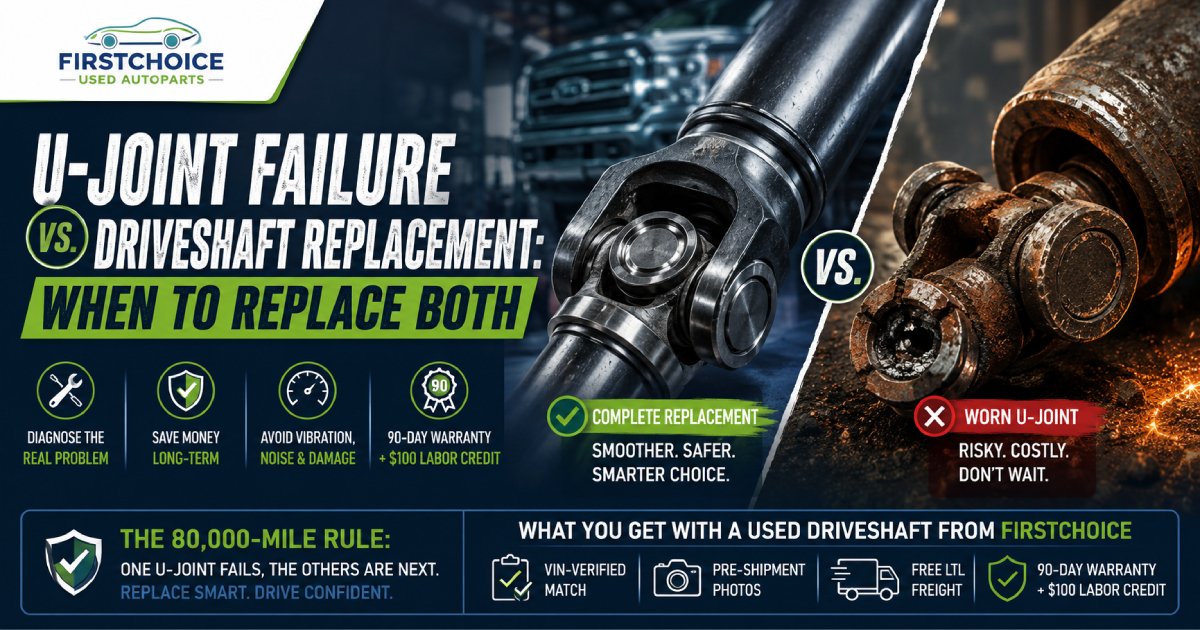
Truck owners face this fork in the road all the time: there’s a noise from underneath, the shop says you need “driveline work,” and the quote could be $150 for a single u-joint or $1,400 for a complete driveshaft. The right answer depends on what is actually failing, how many miles are on the existing shaft, and whether the symptoms point to a single bad bearing or a more systemic issue. This guide gives you the diagnostic, the cost comparison, and the 80,000-mile rule that experienced techs use to decide.
Need a used driveshaft assembly? FirstChoice ships VIN-verified shafts with 30-day warranty. Free LTL freight, 48 states.
Check Driveshaft Availability →The Diagnostic: Is It the U-Joint, the Driveshaft, or Both?
U-joints and driveshafts produce different symptoms because they fail differently. A u-joint is a cross-shaped bearing with four needle-bearing cups. When it wears out, the cross develops play in the cups and you get a clunk on torque reversal — the moment when engine torque switches direction (accelerator off then on, drive to reverse). A driveshaft tube, by contrast, doesn’t fail mechanically — it fails ballistically. Bent tube, lost balance weight, or cracked tube from impact. These produce vibration, not clunking.
The physical test: with the truck on jack stands and the parking brake off, grab the driveshaft near one u-joint with both hands and twist hard in opposite directions. Any visible rotational play between the shaft and the yoke means the u-joint is shot. Then push and pull along the axis of the shaft — any axial play means the slip yoke or transmission output bushing is worn. Then slide your hand along the tube — any dents, bend, or missing balance weights show up under your fingers.
6 Symptoms Decoded
Use this symptom decoder before you call any shop. Knowing what you’re hearing saves you from a misdiagnosis and an oversold repair.
| Symptom | Likely Cause | Urgency |
|---|---|---|
| Clunk on takeoff from a stop | Worn front or rear u-joint (most common) | Medium — fix within 2-4 weeks |
| Clunk when shifting drive to reverse | Worn u-joint or slip-yoke spline play | Medium — fix within 2-4 weeks |
| Vibration that builds with speed at 50-65 mph | Driveshaft balance issue, bent tube, or center bearing wear | High — replace shaft assembly |
| Squeak that changes with vehicle speed at low speed | Dry u-joint cross (sealed unit has lost grease) | High — u-joint is in stage 2 of 3 failure |
| Ratcheting or clicking sound on slow turns | Failed needle bearings inside u-joint cap | Critical — replace within 1 week |
| Grinding from middle of driveshaft (2-piece only) | Center support bearing failure | High — replace shaft assembly or rebuild bearing |
The squeak that gets ignored: A high-pitched squeak that speeds up with the truck and disappears above 35 mph is the most commonly ignored symptom on this list. It is your u-joint telling you it has lost its grease and is running dry. From the squeak stage to catastrophic failure is typically 3,000-8,000 miles. Don’t drive on it longer than necessary.
Cost Comparison: U-Joint Only vs Used Driveshaft Assembly
| U-Joint Replacement (single) | U-Joints + Center Bearing | Used Driveshaft Assembly | |
|---|---|---|---|
| Parts cost | $20-$60 | $80-$180 | $180-$650 |
| Shop labor | $120-$220 | $280-$420 | $120-$180 |
| Total shop bill | $140-$280 | $360-$600 | $300-$830 |
| Press required? | Yes (20-ton or larger) | Yes | No — bolt-in |
| Warranty | Parts only typically | Parts only | 30-day at FirstChoice |
| Best when | Single u-joint fail, shaft under 60K miles | One joint failed and shaft is 60-100K miles | Shaft over 100K miles, vibration symptoms, or center bearing involved |
When to Replace Both at Once — The 80,000-Mile Rule
The rule experienced shop techs use: if your truck has more than 80,000 miles on the original driveshaft and one u-joint has failed, replace the assembly rather than just the u-joint. The reason is operating-hour parity. Both u-joints on the same shaft saw the same miles, the same heat cycles, the same grease, the same contamination. When one fails, the other is typically running on borrowed time — sometimes 15,000 miles, sometimes 30,000, almost never beyond 50,000.
On 2-piece driveshafts, add the center support bearing to that logic. The bearing’s rubber isolator hardens with age and the sealed bearing eventually loses its grease. If you’ve already got the shaft on a press to do u-joints, the marginal labor to swap the center bearing is small. Doing both at once eliminates a second teardown later.
A used driveshaft assembly from a lower-mileage donor short-circuits all of this. You get fresh u-joints with their original factory grease, an intact center support bearing, and confirmed balance — for roughly the same out-the-door cost as a full shop u-joint job on your existing shaft.
FirstChoice trust signal: Every used driveshaft we ship is pulled from a VIN-confirmed donor, photographed before it leaves the warehouse, and shipped on free LTL freight, fully insured, to 48 states. 98.2% first-fit rate. 30-day warranty. We shipped over 3,400 drivetrain parts in 2025.
The DIY vs Shop Install Decision
Driveshaft removal is straightforward — four bolts at the rear pinion flange, slip the front yoke out of the transmission, lower the shaft. Reinstall is the reverse. A DIY-capable owner with a floor jack, a 12mm or 14mm wrench (depending on yoke), and a drain pan for the small amount of fluid that leaks past the transmission tail-housing seal can do the swap in 45 minutes to an hour.
U-joint replacement is a different story. You need a 20-ton press to push the old u-joint caps out of the yoke ears, and you need to align the new joint within a few thousandths or it will bind. Most DIYers either rent press time at an auto parts store, take the shaft to a driveline shop for the joint swap, or skip the whole thing and install a used assembly instead.
The math usually favors the used assembly. By the time you pay for press rental, two u-joints, a center bearing kit if applicable, and possibly a balance check, you’re approaching the cost of a VIN-matched used shaft that arrives complete, photographed, and warrantied.
“Replaced a u-joint on my 2017 F-150 last fall — front joint, $180 at a local shop. Eight months later, rear joint started clicking. Called FirstChoice instead. Got a complete 1-piece shaft from a 58,000-mile donor F-150, exact VIN match, with photos of the u-joints and slip yoke before shipping. $290 plus free LTL freight. Bolted it on in 50 minutes in my driveway. The 90-day warranty clinched the decision for me. Truck has been silent since.”
Skip the press, skip the second teardown. Get a complete VIN-matched used driveshaft — 30-day warranty, free freight. Call 1-888-383-2439.
Get a Driveshaft Quote →Cluster Guides
Frequently Asked Questions
How do I know if my u-joint or my whole driveshaft is bad?
Clunk on takeoff or shifting drive-to-reverse = u-joint. Vibration at 50-65 mph = driveshaft balance or center bearing. Squeak on slow speed = dry u-joint. Physical twist test — visible rotational play at the yoke means u-joint is shot.
Is it cheaper to replace just the u-joint or the whole driveshaft?
U-joint replacement: $140-$280 at a shop. Used driveshaft assembly: $300-$830 total. Single u-joint is cheaper if shaft is under 80K miles. Full assembly is better long-term if shaft is over 80K or multiple symptoms are present.
Should I replace both u-joints at the same time?
Yes. Both joints have the same operating hours. When one fails, the second is typically 15-30K miles behind. Replacing both eliminates a second teardown. On 2-piece shafts, also inspect the center support bearing.
Can I drive with a clicking u-joint?
Only briefly, at low speed, to get the truck home or to a shop. A failing u-joint can let go without warning — the broken shaft can damage the transmission, fuel tank, or floor pan. Catastrophic failures typically exceed $2,000 to repair.