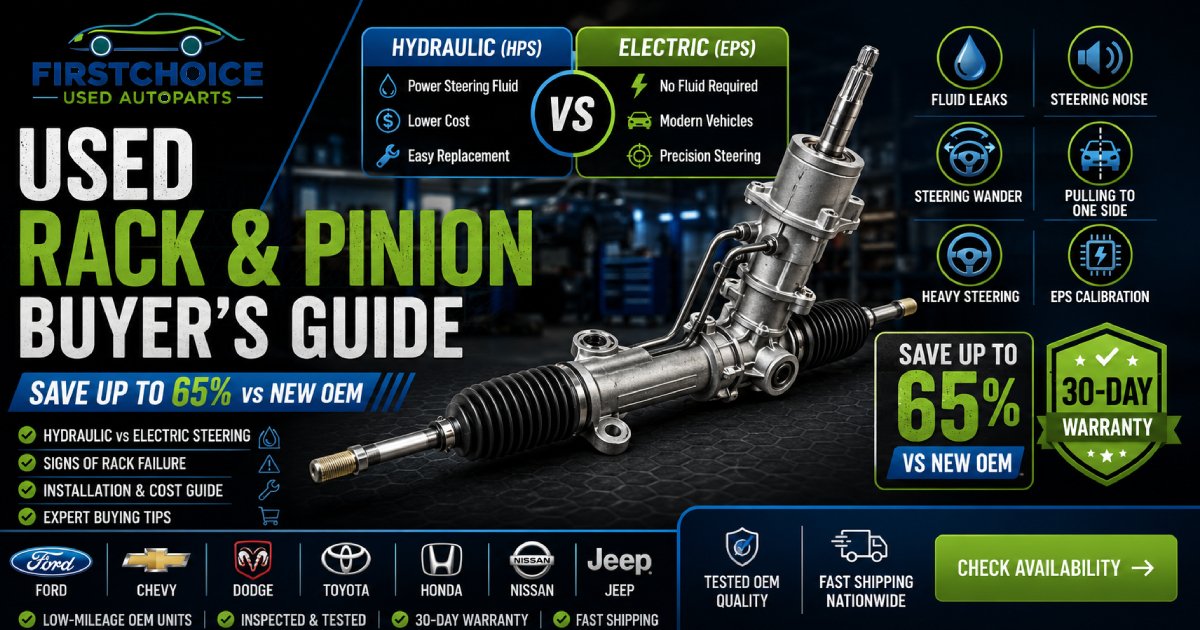
A used rack and pinion from a low-mileage donor is 50–65% less than new OEM and performs identically when the seals are intact and the internal rack shows no free play. The rack and pinion’s primary failure modes are seal degradation (causing fluid leaks) and internal wear on the gear teeth and piston (causing steering wander or noise). Low-mileage assemblies have minimal seal wear and intact gear geometry — which is exactly why the used market for rack and pinion is strong.
This guide covers how to identify the right unit, hydraulic vs. electric power steering differences, what to verify before ordering, companion parts, and the full cost breakdown.
Need a used rack and pinion? FirstChoice carries hydraulic and EPS units for Ford, Chevy, Toyota, Honda, Dodge, and more — 30-day warranty.
Check Availability →Hydraulic vs. Electric Power Steering — Know Your System
The single most important compatibility detail when ordering a used rack and pinion is whether your vehicle has hydraulic power steering (HPS) or electric power steering (EPS). These are fundamentally different systems — you cannot swap between them.
| Hydraulic Power Steering (HPS) | Electric Power Steering (EPS) | |
|---|---|---|
| How it works | Power steering pump pressurizes fluid to assist rack movement | Electric motor (on column or rack) provides assist — no fluid |
| Fluid required? | Yes — power steering fluid | No fluid — fully electric |
| Hose connections on rack | Yes — pressure and return lines | No hoses — electrical connectors only |
| Programming required? | No — bolt-on replacement | Sometimes — steering angle sensor calibration |
| Failure cost | Lower — mechanical seals are rebuildable | Higher — electric motor and PCM involved |
| Common vehicles | Most trucks pre-2015, most cars pre-2012 | Most vehicles 2012+; trucks increasingly from 2015+ |
Check your power steering reservoir: If your vehicle has a power steering fluid reservoir under the hood — you have hydraulic power steering. If there is no reservoir, only a reservoir for brake fluid — you have electric power steering. This is the simplest way to confirm before ordering.
Signs Your Rack and Pinion Is Failing
- Power steering fluid leak from the boots: The rubber bellows boots at each end of the rack protect the inner tie rod connection. When they crack, fluid escapes and the inner rack becomes exposed to contamination. Most visible as grease or wet stains inside the boot area.
- Clunking or knocking when turning at low speed: Internal rack gear wear or a loose adjuster plug. Common at parking lot speed during full-lock maneuvers.
- Steering wanders on a straight road: Excessive internal play from worn rack gear teeth. The vehicle requires constant small corrections to stay in a lane.
- Steering pulls to one side: Unequal internal friction or a bent rack from a front-end impact.
- Groaning when turning (hydraulic systems): Distinct from power steering pump whine. Low fluid from rack leak causes cavitation in the pump — the pump is groaning because it’s running dry.
- Heavy steering in one direction only: Internal piston seal failure allows hydraulic pressure to bypass — assist works in one direction but not the other.
What to Verify Before Buying a Used Rack and Pinion
- Confirm hydraulic vs. EPS type. Hydraulic racks have hose ports; EPS racks have wiring connectors. Non-interchangeable.
- Check boot condition. The rubber boots at each end should be intact and not cracked. Split boots allow contamination into the inner tie rod area and often signal the reason the rack was pulled. Minor boot wear is repairable; torn boots indicate the unit has been exposed to contamination.
- Move the rack by hand through its full travel. Push the rack tube from side to side through its full range. Movement should be smooth with consistent resistance. Any binding, rough spots, or loose “dead” zones with no resistance indicate internal wear.
- Check for fluid at the housing. Hydraulic racks should have no active leak from the piston bore. Dried residue from a past slow leak is acceptable; wet, active seeping means the internal piston seal is failing.
- Verify the tie rod connection threads. Inner tie rod threads must be intact and not cross-threaded. Confirm the inner tie rod is included — some suppliers sell the rack without inner tie rods.
Companion Parts — Always Replace These at the Same Time
Because a rack and pinion replacement requires removing the front wheels, disconnecting the tie rods, and realigning the front end, always address these at the same time:
| Part | Cost | Why Replace Now |
|---|---|---|
| Outer tie rod ends (both sides) | $15–$40 each | Wheels are already off; tie rod removed anyway; $80 labor if done separately |
| Inner tie rod ends (if worn) | $20–$50 each | Already disconnected from rack; inspect for play before deciding |
| Rack mounting bushings | $15–$30 | Often worn on high-mileage vehicles; contributes to steering slop if not replaced |
| Front alignment | $80–$120 | Required after any rack/tie rod replacement — non-optional |
| Power steering fluid (hydraulic) | $8–$15 | Flush old fluid when system is open — removes contamination from failed original rack |
Used Rack and Pinion Cost by Vehicle
| Vehicle | Type | Used Price | New OEM | Savings |
|---|---|---|---|---|
| Ford F-150 (2004–2014) | Hydraulic | $160–$320 | $480–$800 | ~60% |
| Ford F-150 (2015+) | EPS | $250–$450 | $700–$1,200 | ~60% |
| Chevy Silverado / GMC Sierra (2014+) | EPS | $220–$420 | $650–$1,100 | ~60% |
| Dodge RAM 1500 (2002–2018) | Hydraulic | $150–$300 | $440–$760 | ~60% |
| Toyota Tacoma (2005–2015) | Hydraulic | $130–$260 | $380–$680 | ~60% |
| Toyota Tacoma (2016+) | EPS | $220–$400 | $600–$1,000 | ~60% |
| Honda CR-V / Accord | EPS (2013+) | $160–$320 | $480–$820 | ~60% |
| Nissan Altima / Frontier | Hydraulic / EPS | $130–$300 | $380–$740 | ~60% |
| Jeep Grand Cherokee WK2 (2011+) | EPS | $200–$380 | $580–$980 | ~60% |
EPS Rack Programming — What You Need to Know
Electric power steering racks with an integrated motor (rack-mounted EPS, common on Tacoma 2016+, newer Silverado/Sierra, many crossovers) may require a calibration procedure after installation:
- Steering angle sensor reset: After rack replacement, the steering angle sensor zero point needs to be recalibrated to confirm that straight-ahead wheel position corresponds to zero degrees on the sensor. This is done with a scan tool that supports EPS calibration (Autel, Snap-on, dealer). Takes 10–15 minutes. Cost at a shop: $60–$100.
- EPS torque sensor initialization: Some vehicles require the EPS control module to relearn the new rack’s torque characteristics. This is often automatic after a drive cycle on the test route, but some vehicles need a manual initiation via scan tool.
- Vehicles that are typically plug-and-play: Column-mounted EPS (motor on the steering column, not the rack) does not require rack-level calibration. Common on: Honda Civic (2012–2020), Nissan Sentra, many compact cars.
Identify EPS type before ordering: Rack-mounted EPS has a large electrical connector and motor housing visible on the rack body. Column-mounted EPS has no motor on the rack — the rack itself has only tie rod connections and the pinion shaft input. Rack-mounted EPS is more expensive and may require calibration; column-mounted EPS racks are simpler replacements.
“My 2013 Accord’s steering was groaning and leaking fluid at 112,000 miles. Dealer quoted $950 for a new rack. FirstChoice had a used EPS rack for $185. I replaced it myself with new outer tie rod ends ($56 pair), had the alignment done ($95), and reset the steering angle sensor at a shop for $75. Total: $411. Dealer wanted $950 just for the rack.”
Need a used rack and pinion? Tell FirstChoice your vehicle and steering type — we’ll match the right unit. 30-day warranty, ships fast.
Get a Free Quote →5-Step Ordering Process
- Confirm hydraulic vs. EPS. Check for a power steering reservoir under the hood. If it exists — hydraulic. No reservoir — EPS. This is the most important step.
- For EPS: identify rack-mounted vs. column-mounted. Look at the rack under the vehicle — is there an electric motor and connector on the rack body itself? If yes, rack-mounted EPS. If the rack has only mechanical inputs — column-mounted EPS (simpler replacement).
- Provide year/make/model/drivetrain. 4WD vs. 2WD affects rack travel length on some trucks (4WD racks are shorter to clear the front differential). Always specify.
- Order companion parts simultaneously. Outer tie rod ends (both sides), alignment appointment, and power steering fluid (hydraulic). Don’t create a second trip to the parts store during installation.
- Plan steering angle reset for EPS. If you have a rack-mounted EPS system, identify a shop with EPS calibration capability before you start the job. Some independent shops have this capability; many don’t. Confirm before the rack arrives.
Frequently Asked Questions
What are the signs of a bad rack and pinion?
Power steering fluid leak from the boots or housing, clunking when turning at low speed, steering wander on straight roads, pulling to one side, groaning when turning (hydraulic systems running dry from leak), and heavy steering assist in one direction only.
Is it worth buying a used rack and pinion?
Yes — 50–65% savings vs. new OEM. Low-mileage racks have intact seals and minimal internal wear. Verify no active fluid leak, smooth rack travel through full range, and intact boot condition before ordering.
Does a used rack and pinion need to be programmed?
Hydraulic systems: no programming. Column-mounted EPS: usually no programming. Rack-mounted EPS: steering angle sensor calibration typically required — 15–30 minutes at a shop with compatible scan tool, $60–$100.
How much does a used rack and pinion cost?
Hydraulic (most trucks pre-2015): $130–$320. EPS rack-mounted (post-2015 trucks, many crossovers): $200–$450. New OEM: $380–$1,200. The used-to-new savings hold consistently at ~60% across all applications.
What other parts should be replaced when replacing a rack and pinion?
Always: outer tie rod ends (both sides, $15–$40 each) and a four-wheel alignment ($80–$120). Inspect and replace inner tie rod ends if worn. Flush power steering fluid (hydraulic). Total companion parts budget: $120–$240 in addition to the rack.