
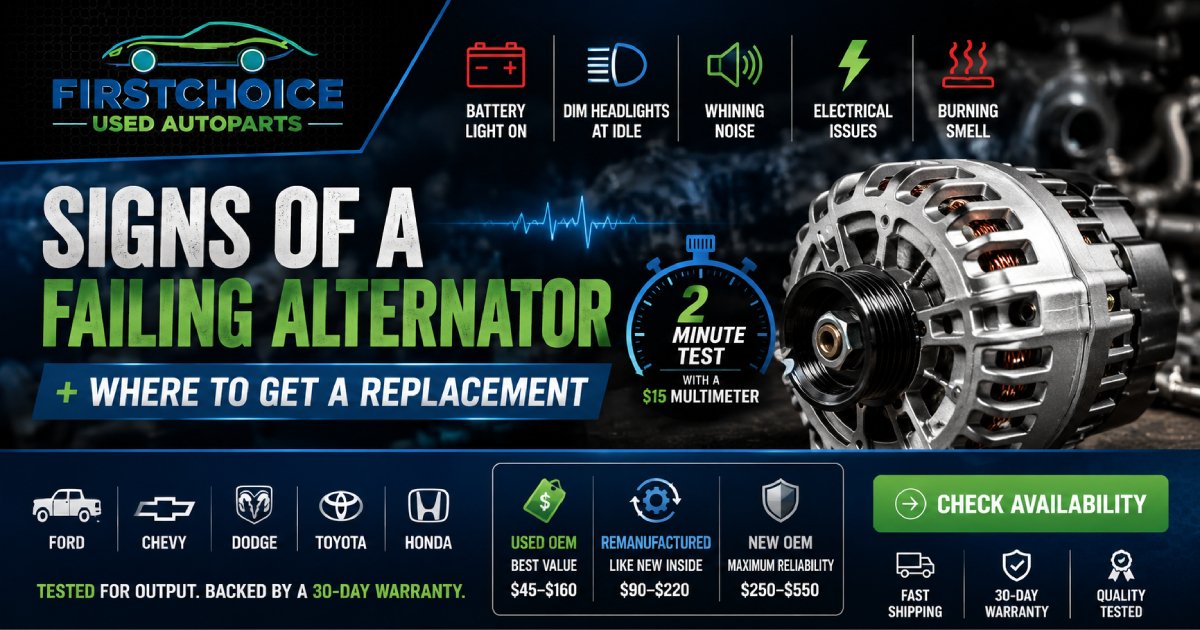
A failing alternator shows specific, diagnosable symptoms before it leaves you stranded. The most reliable test — 2 minutes with a $15 multimeter — tells you definitively whether the alternator is the problem or if it’s the battery. These two parts share symptoms and get misdiagnosed constantly. Testing both before replacing either saves you from buying the wrong part.
Confirmed it’s the alternator? FirstChoice carries Ford, Chevy, Dodge, Toyota, and Honda alternators — output verified, 30-day warranty.
Check Availability →7 Signs Your Alternator Is Failing
1. Battery Warning Light or ALT Light On
The battery-shaped warning light (or “ALT” on older vehicles) means the PCM detected charging voltage outside the normal 13.5–14.7V range. This is the most direct indicator — it doesn’t mean the battery is bad, it means the charging system has a problem. The alternator is the most common cause.
2. Headlights Dim at Idle, Brighten When You Rev
This is the clearest sign of a weak alternator. At idle, the alternator rotor spins slower and produces less current — not enough to meet demand. When you rev to 2,000+ RPM, the rotor spins faster, output improves, and the lights brighten. Normal electrical systems maintain consistent brightness regardless of RPM.
3. New Battery Dies Within Days
If you replace a dead battery and it’s dead again within a week, the alternator is not charging it. The new battery discharged because no charging current was being added during driving. This is the most expensive misdiagnosis — replacing the battery when the alternator is the actual fault.
4. Electrical Accessories Losing Power
Radio resets or cuts out, AC blower slows at idle, power windows feel sluggish, the dashboard dims — these are all signs that total system voltage has dropped. The alternator is no longer supplying enough current for all loads simultaneously.
5. Whining or Growling Noise That Changes With RPM
A worn alternator bearing produces a whining or growling sound that increases in pitch and volume as engine RPM increases. Distinct from power steering whine (changes with steering input) and transmission noise (changes with vehicle speed). The alternator noise tracks with engine RPM because the alternator shaft spins at a fixed ratio to the crankshaft.
6. Burning Smell Near the Alternator
Overheated stator windings or a failing diode pack produce a distinct burning electrical smell — similar to burning insulation. This indicates the alternator is overworking (possibly due to a battery that won’t hold a charge forcing continuous maximum output) or has an internal short. Address immediately — an overheating alternator can cause a fire.
7. Multiple Systems Failing Simultaneously
When the alternator output drops below the system’s minimum voltage threshold, the PCM begins shedding loads — it may disable non-essential systems to keep the engine running. If your fuel pump, ABS system, or transmission are simultaneously throwing codes or behaving erratically, low charging voltage is a common root cause. Scan codes and check charging voltage first.
How to Test Your Alternator in 2 Minutes
You need: a multimeter (DC voltage range). Available at any parts store for $15–$25 or free to borrow from AutoZone/O’Reilly. The test takes less time than driving to a parts store to have them test it — and you can do it at home.
- Start the engine and let it idle. Leave AC and major accessories off for the baseline test.
- Set multimeter to DC volts, 20V range. Touch red probe to positive battery terminal, black probe to negative.
- Read idle voltage. Normal = 13.8–14.7V. Below 13.5V = alternator undercharging. Above 15.0V = voltage regulator fault (overcharging).
- Load test. Turn on headlights, AC on max, rear defroster. Voltage should stay above 13.0V. Drop below 13.0V under load = alternator output insufficient.
- Rev test. While watching the multimeter, have someone rev the engine to ~2,000 RPM. Voltage should be stable or increase slightly. If voltage increases significantly from a low idle reading, the alternator is weak at low RPM (brush or bearing wear).
| Reading at Idle | Reading Under Load | Diagnosis |
|---|---|---|
| 13.8–14.7V | 13.0–14.5V | Alternator normal — check battery if symptoms persist |
| 13.8–14.7V | Below 13.0V | Alternator marginal — weak under load; consider replacement |
| Below 13.5V | Below 13.0V | Alternator failing — replace |
| 12.6V (no increase) | 12.6V | Alternator not charging at all — replace immediately |
| Above 15.0V | Above 15.0V | Voltage regulator fault — overcharging; replace alternator |
Free shop test: AutoZone, O’Reilly, and Advance Auto Parts all test alternators and batteries for free in-store or in the parking lot. If you don’t have a multimeter, drive the vehicle to one of these stores for a free test. The result tells you exactly which component has failed.
Where to Get a Quality Replacement Alternator
Option 1: Used OEM from a Salvage-Verified Source ($45–$160)
A used alternator from a low-mileage donor vehicle — tested for output voltage before shipping — is the best value option for vehicles 8+ years old. FirstChoice carries used alternators for Ford, Chevy/GMC, Dodge/RAM, Toyota, Honda, and Nissan — the top-volume makes based on actual order data. Expect 80,000–120,000 miles of additional service life from a properly sourced unit.
Option 2: Remanufactured ($90–$220 with core exchange)
A remanufactured alternator replaces the brushes, bearings, rectifier, and voltage regulator inside the original housing. It’s essentially new internally. Best choice when you’re planning to keep the vehicle another 5+ years, run high electrical loads, or want a longer warranty (typically 1–3 years).
Option 3: New OEM ($250–$550)
Best for newer vehicles (under 5 years old), warranty situations, or vehicles where the alternator is hard to access and you want to minimize the chance of a repeat job.
What to Avoid: Off-Brand “New” Alternators from Generic Marketplaces
Low-cost “new” alternators from generic marketplace sellers often use inferior rectifier diodes and sub-spec brushes that fail within 12–18 months. For the price difference between a $40 no-name unit and a $90 tested used OEM or $120 reman, the quality difference is significant. Stick with OEM-brand units — Denso, Bosch, Delphi, Motorcraft — whether new, rebuilt, or used.
“Battery light came on in my 2010 Tacoma at 139,000 miles. Tested it myself — 12.2V at idle, clearly not charging. Called FirstChoice, got a tested Denso used unit for $95. Installed it in 30 minutes — single bolt and two connectors. Tested at 14.1V immediately after install. Saved $200 over the reman at the dealer.”
FirstChoice carries Ford, Chevy, Dodge, Toyota, and Honda alternators — output voltage confirmed, 30-day warranty, fast shipping.
Get a Free Quote →Frequently Asked Questions
What are the signs of a bad alternator?
Battery warning light on, headlights dimming at idle and brightening when revving, new battery dying within days, electrical accessories losing power, whining/growling noise tracking with engine RPM, burning smell, and multiple system faults simultaneously. Test with a multimeter — under 13.5V at idle with the engine running confirms the alternator.
How do I test if my alternator is bad?
Start the engine, touch multimeter probes to battery terminals (DC volts, 20V range). Good alternator: 13.8–14.7V at idle, stays above 13.0V under full load (headlights + AC + defroster on). Below 13.5V at idle = alternator failing. No voltage increase from battery resting voltage (12.6V) = alternator not charging at all.
Can I drive with a bad alternator?
Short distances only — to a shop or home. With a failing alternator, the vehicle runs entirely on battery power. A fully charged battery provides roughly 30–60 minutes of driving before discharge drops too low for the PCM and fuel system to function. Do not drive long distances or leave overnight.
How much does alternator replacement cost?
Parts only: $45–$160 used, $90–$220 rebuilt, $250–$550 new OEM. Labor: $80–$200 depending on vehicle access (most trucks and SUVs are 30–60 minutes). Total: $125–$750 depending on choices made.
Does the battery need to be replaced when the alternator is replaced?
Only if the battery has been damaged by prolonged undercharging. Have the battery load-tested while you’re replacing the alternator — if the battery fails the load test, replace it too. A battery that was simply discharged (not deep-cycled repeatedly) will recover with normal charging after the new alternator is installed.