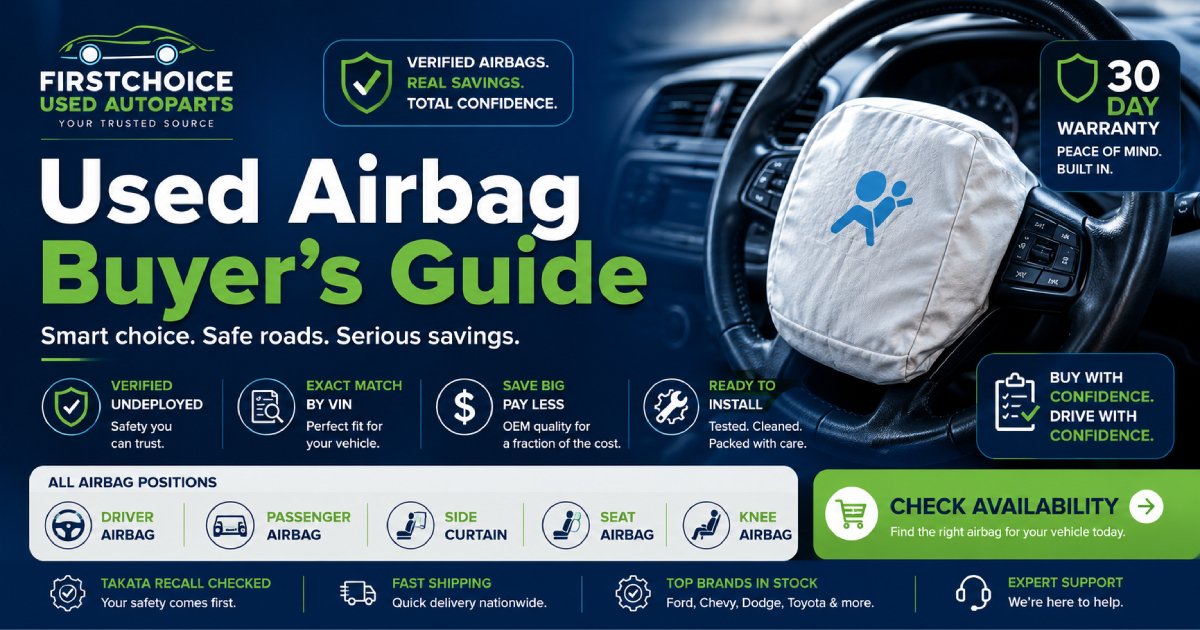
After a collision deploys your airbags, you’re looking at $400–$1,200 per airbag position for new OEM replacements — and a typical collision deploys 2 to 4 bags. Used airbags from verified, undeployed donor vehicles cost $80–$300 per position and are safe when three conditions are met: the airbag has never fired, the part number matches your vehicle exactly, and the SRS control module is reset after installation. This guide covers everything — safety verification, cost breakdown, compatibility matching, and the complete ordering process.
FirstChoice carries driver, passenger, side curtain, and seat-mounted airbags for Ford, Chevy, Dodge, Toyota, and more. Donor vehicle verified, 30-day warranty.
Check Availability →The Real Total Cost of Airbag Replacement
The airbag itself is only part of the total job cost. Plan for three components: the airbag, the SRS module reset, and installation labor.
Used Airbag Replacement — Total Cost Breakdown
| Component | Used Airbag Route | New OEM Route |
|---|---|---|
| Driver airbag (steering wheel) | $80–$180 | $400–$700 |
| Passenger airbag (dash) | $100–$250 | $500–$900 |
| Side curtain (per side) | $120–$280 | $500–$1,000 |
| Seat-mounted side airbag | $80–$200 | $400–$800 |
| SRS module reset (1 shop visit) | $80–$150 | $80–$150 (same) |
| Installation labor (per bag) | $100–$200 | $100–$200 (same) |
| Full replacement (driver + passenger + 2 curtains) | $780–$1,780 | $2,480–$4,950 |
The savings on a full airbag replacement using quality used parts: $1,700–$3,200 per vehicle compared to all-new OEM parts. On older trucks and SUVs where the vehicle’s value is $8,000–$15,000, this difference determines whether the vehicle is repaired or totaled by insurance.
Safety Verification Checklist — Do This Before Every Order
Before confirming any used airbag order, verify all five:
- Undeployed confirmation: Supplier must confirm the airbag has never fired. Ask: “Was this from a non-collision portion of the vehicle, or can you confirm no deployment?” Zero burn marks, no expanded fabric, intact inflator housing.
- Part number match: Provide your vehicle’s VIN and ask for the part number on the unit. Cross-reference against the part number on your existing airbag if accessible. SRS generation changes mid-model — year alone is not enough.
- Takata recall check: Request the donor vehicle VIN and check it at NHTSA.gov/vehicle/recalls. Any open Takata recall on that vehicle = do not use those airbags.
- Position and cab style match: Specify the exact position (driver / passenger / side curtain driver-side / seat-mounted / knee) and your cab configuration (regular cab / extended cab / crew cab) for curtain bags.
- SRS module plan: Confirm you have a shop or scan tool capable of SRS module reset lined up before the airbag arrives. This is required for the bag to arm — don’t skip it.
Top Makes for Used Airbags at FirstChoice
Ford, Chevrolet, and Dodge represent the majority of airbag orders based on actual sales data — reflecting their dominance in the truck market where collision damage is more common and repair-versus-total decisions are more frequently made in favor of repair.
| Make | Common Models | Notes |
|---|---|---|
| Ford | F-150, F-250, Explorer, Mustang, Escape | Strong availability; SRS generation changes 2009, 2013, 2015 — verify exact year |
| Chevrolet / GMC | Silverado, Sierra, Tahoe, Suburban, Equinox | GMT900 (2007–2013) and K2XX (2014–2018) are separate SRS generations |
| Dodge / RAM | RAM 1500/2500/3500, Durango, Charger, Challenger | 4th gen RAM (2009–2018) SRS updated at 2013 refresh — confirm year carefully |
| Toyota | Tacoma, Tundra, Camry, RAV4, Highlander | Takata recall affected many Toyota models 2001–2015 — check VIN at NHTSA |
| Honda | Civic, Accord, Pilot, CR-V | Heavy Takata recall exposure — always verify donor VIN before ordering Honda airbags |
| Jeep | Grand Cherokee, Wrangler, Cherokee | Wrangler JK curtain bags vary by soft-top vs. hard-top configuration |
Honda and Toyota buyers: These makes are among the most heavily affected by the Takata airbag recall. Always request the donor vehicle’s VIN and verify at NHTSA.gov before purchasing any Honda or Toyota airbag from a salvage source. Affected inflators can rupture violently during deployment.
Guide Library
Are Used Airbags Safe?
The complete safety guide — how airbag inflators work, what makes a used bag safe or unsafe, Takata recall explained, legal status, and the SRS module reset requirement.
Read the Safety Guide →Airbag Compatibility Guide
How to verify the exact airbag for your vehicle — SRS generation changes, position-specific matching, cab style for curtain bags, part number verification methods.
Read the Compatibility Guide →Shop Used Airbags
Driver, passenger, side curtain, seat-mounted — verified undeployed, Takata recall checked, 30-day warranty. Ford, Chevy, Dodge, Toyota in stock.
Check Availability →The SRS Module Reset: Why It Can’t Be Skipped
This is the step most DIY buyers overlook — and it’s the one that determines whether the new airbag is actually armed and ready to protect you.
The SRS (Supplemental Restraint System) module is the computer that monitors all airbag circuits, seat belt pretensioners, and crash sensors. When any airbag deploys, the module records the crash event in non-volatile memory and enters a fault state. In this state, the module sets the airbag circuit to a monitoring mode that will not allow the new airbag to arm — even if the replacement unit is perfectly installed and wired correctly.
The airbag warning light stays on. The replacement bag will not deploy in a future collision. You won’t know any of this unless you check the light.
Two solutions:
- SRS module reset ($80–$150): A shop with a capable scan tool (Autel MaxiSys, ALLDATA, Snap-on, or dealer-level equipment) clears the crash data and restores the module to pre-crash operating state. Works when the module itself was not physically damaged in the collision.
- SRS module replacement ($100–$300 + possible programming): Required when the module is physically damaged or when reset fails after three attempts. Used SRS modules must come from a non-crash vehicle. Some vehicles (Ford 2015+, GM 2019+) require VIN programming after module replacement.
How to confirm the SRS module reset worked: After reset and airbag installation, turn the ignition to ON. The airbag warning light should illuminate briefly and then go out within 6–10 seconds as the module completes its system check. If the light stays on — a fault is still present. Scan for codes before driving.
Used vs. New Airbag: Decision Framework
| Scenario | Recommended Choice | Reason |
|---|---|---|
| Vehicle 8–20 years old, repair cost > 30% of vehicle value | Used OEM | New OEM cost often exceeds economic repair threshold |
| Vehicle under 5 years old, under factory warranty | New OEM (dealer) | Warranty continuity; newer vehicle warrants new safety components |
| Vehicle is Toyota or Honda, 2001–2015 | Used OEM — verify Takata | High Takata exposure — donor VIN check is essential; quality used is safe if verified |
| Multiple airbag positions deployed | Used OEM | New OEM for 3–4 positions often exceeds vehicle value; used reduces to viable repair cost |
| Insurance claim open, insurer paying for repair | New OEM preferred | Insurance typically covers new OEM; no reason to use used when insurer is paying |
| Buyer needs fastest possible delivery | Used OEM | New OEM airbags for specific models can be on backorder 4–8 weeks; used ships same-day or next-day |
5-Step Ordering Process
- Pull the part number from your existing airbag. Before any disassembly, remove the steering wheel center cover and read the label on the back of the driver airbag module. Photograph it. This part number is the definitive match — use it as your primary identifier when contacting suppliers.
- Provide your VIN to the supplier. Let them cross-reference against the OEM database. Confirm that the unit they have on hand matches your VIN-specific part number — not just the general model application.
- Specify position and cab style. Driver / passenger / left curtain / right curtain / seat-mounted / knee. For curtain bags: regular cab, extended cab, or crew cab. Do not leave this ambiguous.
- Request donor vehicle verification. Ask for the donor VIN and check Takata recall status at NHTSA.gov. If the supplier can’t provide a donor VIN — that’s a yellow flag for undocumented salvage sourcing.
- Schedule SRS module reset before the airbag arrives. Find a shop in your area with SRS reset capability. Call and confirm they can reset your specific vehicle’s SRS module. This avoids a delay between airbag arrival and getting it properly armed.
“My 2015 Tacoma had both front airbags and both curtain bags deploy in a side collision. Insurance didn’t total it — I paid the deductible. Dealer quoted $4,200 just for four airbags. FirstChoice supplied all four used bags — verified Takata recall clear since it was a 2015 — for $820 total. Shop installed everything and reset the SRS module for $540. Total repair cost vs. dealer: I saved $3,380.”
Ready to order? Tell FirstChoice your VIN, position, and cab style — we verify compatibility and Takata recall status before shipping. 30-day warranty.
Get a Free Quote →Frequently Asked Questions
Is buying a used airbag safe and worth it?
Yes — when undeployed, part-number matched to your vehicle, from a Takata-recall-clear donor, and installed with the SRS module reset. The savings are $300–$1,000 per position compared to new OEM. On a full replacement (4 bags), the savings often determine whether a vehicle is repaired or totaled.
What is the total cost to replace a used airbag?
Airbag: $80–$300. SRS module reset: $80–$150. Installation labor: $100–$200. Total for a single driver airbag: approximately $260–$650. Compared to $900–$1,800+ at a dealer with new OEM parts.
How long does it take to replace an airbag?
Driver airbag: 30–60 minutes. Passenger airbag: 1–2 hours (dash disassembly). Side curtain: 1–2 hours per side (roof trim removal). SRS module reset adds 30–60 minutes. Full multi-bag replacement is typically a full-day shop job.
Do used airbags come with a warranty?
Reputable suppliers offer a 30-day warranty covering condition and function of the unit. Note: airbags are non-returnable once installed because installation completes the SRS circuit check. Order from a supplier who verifies condition — including undeployed status and Takata recall check — before shipping.