
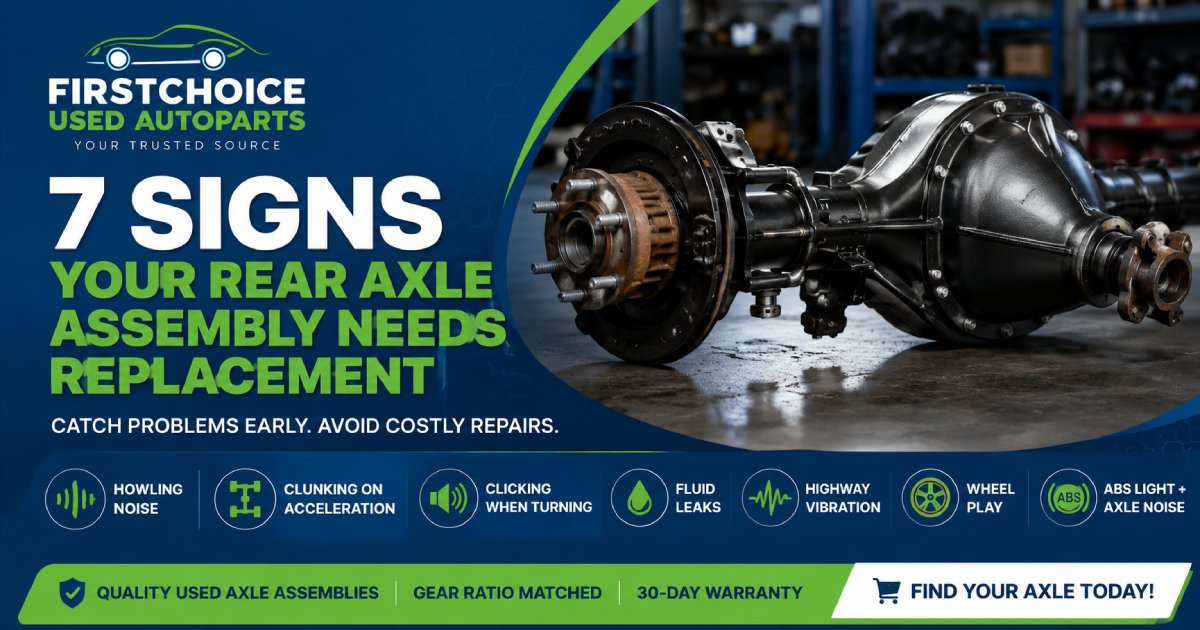
The most common signs of a failing rear axle assembly are a howling or whining noise that tracks with vehicle speed (not engine RPM), a clunking sound during acceleration or deceleration, a clicking noise when turning, and a differential fluid leak from the cover or pinion seal. Catching these early — before metal-to-metal wear progresses to complete gear failure — is the difference between a $500 used assembly swap and a $1,800 emergency repair with tow bill included.
This guide covers all seven major symptoms, explains what’s actually failing inside the assembly, and tells you what urgency level each symptom warrants.
Need a used rear axle assembly? FirstChoice carries Ford 8.8, GM 10-bolt, Chrysler AAM, and more — gear ratio matched, 90-day warranty.
Check Availability →Symptom 1: Howling or Whining Noise at Highway Speed
Symptom 1 — Most Common Indicator
What it sounds like: A continuous howl or moan that changes pitch with vehicle speed. May be louder under acceleration, coasting, or at a specific speed range (often 40–65 mph). Does not change with steering inputs.
What’s failing: Ring and pinion gear wear. As the gear teeth wear, the contact pattern degrades and the meshing gears produce a harmonic noise. Also possible: worn carrier bearings or pinion bearings creating a similar sound.
Urgency: Medium. A howl indicates wear in progress. Ignoring it for thousands of miles allows the wear pattern to worsen until gear teeth chip or break — converting a $500 repair into a complete assembly failure. Address within 2–4 weeks of first noticing.
How to distinguish rear differential howl from other noises:
| Noise Type | Behavior | Likely Cause |
|---|---|---|
| Howl changes with speed, not RPM | Changes at 45 mph regardless of gear | Rear differential (ring/pinion or bearings) |
| Howl changes with RPM, not speed | Changes when you rev in neutral | Engine or transmission bearing |
| Constant drone, steady with speed | Same at all throttle levels at a given mph | Wheel bearing or tire noise |
| Howl only under acceleration | Goes quiet on coast/deceleration | Ring/pinion backlash issue; drive side tooth wear |
| Howl only on coast | Goes quiet under power | Coast side ring/pinion tooth wear |
| Howl in specific speed band (e.g., 45–55 mph only) | Goes away above/below that speed | Carrier bearing resonance; gear harmonic |
Symptom 2: Clunking or Banging During Acceleration or Deceleration
Symptom 2 — Indicates Advanced Wear or Damage
What it sounds like: A distinct clunk, bang, or thud felt through the vehicle when you apply throttle from a stop, shift from drive to reverse, or lift off the throttle at speed. The clunk is often felt in the seat or floor.
What’s failing: Excessive backlash between the ring and pinion (gear teeth with too much slop between them), worn U-joints on the driveshaft (similar symptom), or broken spider gears inside the differential carrier.
Urgency: High. A clunk indicates significant play in the drivetrain. Spider gear failure can progress rapidly to complete loss of drive in one or both rear wheels. Diagnose within days — do not tow trailers or drive under heavy load.
Quick U-joint vs. differential clunk test: Mark the driveshaft and have a helper rock the vehicle from drive to reverse repeatedly while you watch the driveshaft U-joints. Movement at the U-joint before the driveshaft rotates = U-joint problem. If the U-joints move in sync with no perceptible delay but the clunk persists = differential internal wear.
Symptom 3: Clicking Noise When Turning
Symptom 3 — Limited Slip or Spider Gear Failure
What it sounds like: A rhythmic clicking, chattering, or binding sensation when turning — especially low-speed turns, parking lot maneuvers, or tight radius turns. More pronounced when the vehicle is warm.
What’s failing: In limited slip differentials: worn clutch packs that chatter instead of slipping smoothly. In open differentials: worn spider gear cross-shaft or side gear teeth. The clicking occurs because the differential gears are struggling to accommodate the speed differential between the inside and outside rear wheels during the turn.
Urgency: Medium. LSD chatter is often resolved with an LSD friction modifier additive in the gear oil before it requires full replacement. If the chatter persists after an oil change with the correct additive, the clutch pack is worn and replacement is required. Open differential clicking is more serious — it means metal wear is occurring.
Symptom 4: Fluid Leak From the Differential Cover or Pinion Seal
Symptom 4 — Address Immediately to Prevent Internal Damage
What it looks like: Oil spots under the center of the rear axle (cover leak) or directly under the front of the differential where the driveshaft connects (pinion seal leak). Gear oil is typically amber to dark brown and has a distinct sulfur-based smell.
What’s failing: The differential cover gasket or the pinion seal. Both are wear items that harden and crack with age and heat cycling. Neither indicates the differential internals are damaged — yet. But running a differential low on fluid causes rapid ring/pinion and bearing wear.
Urgency: High urgency to address the leak, even if the differential internals are fine. A slow leak can drain the housing in 2,000–3,000 miles of driving. Check the fluid level with a finger through the fill plug before driving any long distance.
Fluid level check: The differential fill plug is on the side of the housing. Remove it and insert a finger — fluid should be at the bottom of the fill hole. If you can’t reach fluid, the level is too low. Add the correct gear oil (75W-90 for most applications; 75W-140 full synthetic for heavy towing) before driving further.
Symptom 5: Vibration That Worsens at Highway Speed
Symptom 5 — May Point to Bearing or Shaft Issue
What it feels like: A vibration or shudder felt through the floor, seat, or drivetrain that increases in intensity as speed increases. May be accompanied by a drone or hum.
What’s failing: Several possibilities — worn rear wheel bearings (the bearing is pressed into the axle housing end), a bent axle shaft (from hitting a pothole or curb), or carrier bearing wear creating vibration as the carrier rotates. Distinguish from tire balance issues by testing on a smooth highway — tire vibration is usually in a specific speed band and resolves with balancing; bearing vibration is progressive and continuous.
Urgency: Medium-High. Wheel bearing failure can progress to a seized bearing, which locks the rear wheel — a serious safety emergency at highway speed. If you hear grinding along with the vibration, stop driving and have the vehicle towed.
Symptom 6: Rear Wheel Has Visible Side-to-Side Play
Symptom 6 — Advanced Bearing Failure, Do Not Drive
What it looks like: Jack up one rear wheel and grab it at 9 o’clock and 3 o’clock — rock it side to side. Any perceptible play (more than a very slight movement) indicates a worn wheel bearing or worn axle shaft bearing.
What’s failing: The rear axle bearing, which is pressed into the axle housing tube. On semi-float axle designs (most 1/2-ton trucks), the bearing supports the axle shaft itself. A failed bearing allows the shaft to shift laterally, which can cause the axle shaft to partially withdraw from the housing during turns — leading to sudden loss of drive and potential wheel separation.
Urgency: Do not drive. Axle shaft bearing failure with visible wheel play is a safety emergency. The vehicle should be towed.
Symptom 7: ABS Warning Light + Rear Axle Noise
Symptom 7 — ABS Tone Ring or Bearing Sensor
What it means: Many trucks have ABS tone rings pressed onto the rear axle shafts. When a rear axle bearing fails, the tone ring can shift or crack, triggering an ABS fault code (typically C0035, C0040, or similar wheel speed sensor codes for the affected rear wheel). The ABS fault and the axle noise together strongly suggest bearing failure.
Urgency: High. The ABS code is a direct indication that the rear axle bearing has deteriorated enough to affect the tone ring. Address immediately.
How Fast Does Rear Axle Wear Progress?
| Stage | Symptoms | Time Before Failure | Recommended Action |
|---|---|---|---|
| Early | Faint howl at specific speed range; no other symptoms | Months to 1+ year | Monitor fluid; plan repair |
| Moderate | Consistent howl; minor clunk on acceleration | Weeks to months | Schedule repair within 2–4 weeks |
| Advanced | Loud howl; clunking; possible vibration; fluid leak | Days to weeks | Repair immediately; limit driving |
| Critical | Grinding; seized bearing; wheel play; wheel lockup | Imminent | Do not drive — tow vehicle |
“My 2010 Silverado started howling at about 55 mph — I thought it was tires at first. Changed tires, no difference. Brought it to my mechanic, he said it was the rear differential and quoted $1,400 for a rebuild. Called FirstChoice, they had a 76,000-mile GM 8.6-inch assembly matching my 3.73 ratio. Total with install: $780. Howl is completely gone.”
— Doug F., Louisville, KY
Hearing rear axle noise? FirstChoice carries GM 8.6 / 14-bolt, Ford 8.8 / 9.75, and Chrysler AAM assemblies — gear ratio confirmed, 90-day warranty.
Find Your Rear Axle Assembly →Frequently Asked Questions
What are the signs of a bad rear axle assembly?
Howling or whining noise that tracks with vehicle speed; clunking during acceleration/deceleration; clicking when turning (LSD clutch wear or spider gear damage); differential fluid leak; highway vibration (bearing or bent shaft); visible wheel play; ABS warning light combined with rear noise.
What does a bad rear differential sound like?
A howling or whining that changes pitch with vehicle speed — not with engine RPM. Often louder under light throttle or coasting at 40–65 mph. Distinct from tire noise (steady drone) and transmission noise (changes with RPM).
Can I drive with a bad rear axle?
A faint early-stage howl: monitor and plan repair. A clunking or moderate howl: limit driving, arrange repair within 2 weeks. Visible wheel play, grinding, or locked wheel: do not drive — tow the vehicle.
How long does a rear axle assembly last?
150,000–200,000 miles with regular fluid changes every 30,000–50,000 miles. Heavy towing and neglected fluid significantly shorten life — heavy-tow trucks may show ring/pinion wear at 100,000–130,000 miles.