
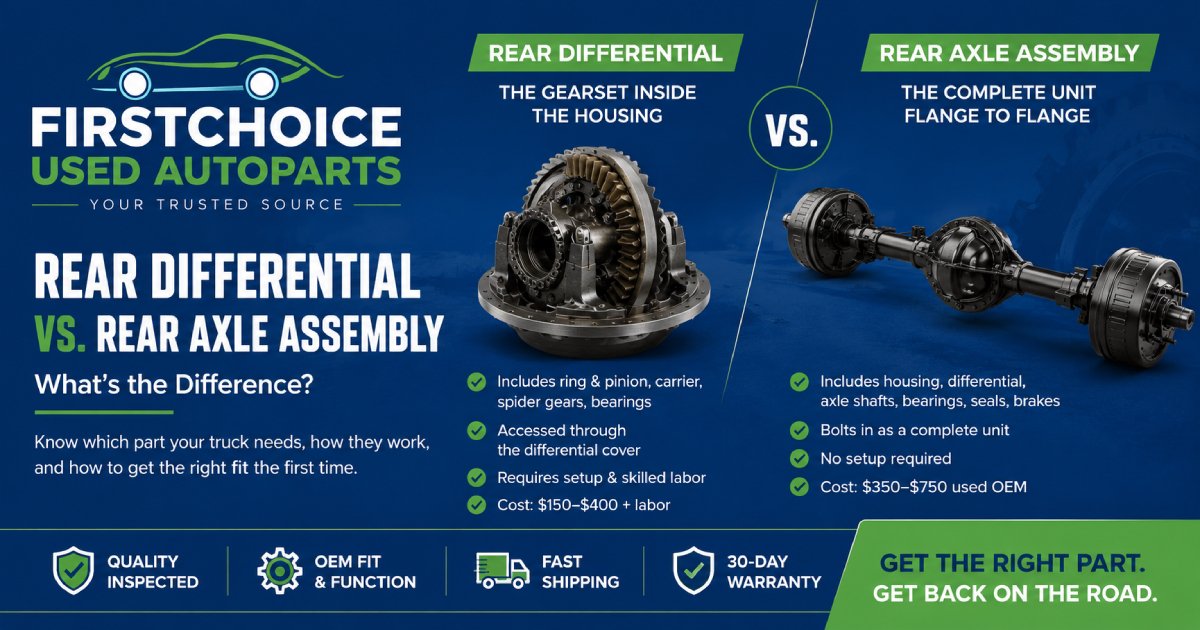
The rear differential is the gearset inside the axle housing — the ring gear, pinion, carrier, and spider gears that split engine torque between your two rear wheels. The rear axle assembly is the complete unit: the housing, differential gears, axle shafts, wheel bearings, seals, and brake backing plates — everything from wheel flange to wheel flange. Ordering the wrong one means getting a part that’s either incomplete or far more than you need.
The confusion is common because mechanics and parts suppliers use these terms interchangeably in casual conversation. This guide defines both precisely, explains which one your specific failure actually requires, and walks through the compatibility details that determine whether a used axle assembly will bolt up and work correctly in your truck.
Need a used rear axle assembly? FirstChoice carries Ford 8.8, GM 10-bolt, Chrysler AAM, and more — gear ratio matched, 90-day warranty.
Check Availability →What Is a Rear Differential?
The rear differential is the gearset that lives inside the center section of the rear axle housing. Its job is to allow the two rear wheels to rotate at different speeds during turns — the outside wheel travels a longer arc and must spin faster than the inside wheel. Without a differential, the rear axle would bind during every turn.
Components of the differential (inside the housing):
- Ring gear — large gear that bolts to the carrier; driven by the pinion gear from the driveshaft
- Pinion gear — connects to the driveshaft; drives the ring gear
- Carrier — holds the spider gears and rotates with the ring gear
- Spider gears (side gears) — allow each axle shaft to rotate independently of the other
- Pinion bearings and carrier bearings — support the ring/pinion under load
- Clutch packs or Torsen element — present only in limited slip differentials
The differential is accessed by removing the differential cover plate (bolted to the back of the axle housing). A differential rebuild involves replacing or setting up the ring/pinion, carrier, bearings, and seals — it requires a dial indicator, bearing press, and significant skill to set backlash and preload correctly.
What Is a Rear Axle Assembly?
The rear axle assembly is the complete unit — housing plus everything inside and attached to it. When you replace a “rear axle,” you’re swapping the entire assembly as a unit: unhooking the driveshaft, removing the brake lines, unbolting the control arms and trailing links, and dropping the whole thing out of the vehicle.
Everything included in a rear axle assembly:
- Axle housing (the steel tube that runs side to side)
- Differential gearset (ring, pinion, carrier, spider gears)
- Both axle shafts (left and right)
- Wheel bearings (press-fit into the housing ends)
- Inner and outer seals
- Brake backing plates (on most assemblies)
- Pinion flange (connects to driveshaft)
- Differential cover
Rear Differential Only
- Just the internal gearset
- Accessed through the differential cover
- Requires a skilled builder to set up correctly
- Right when: ring/pinion worn, carrier cracked, spider gears broken
- Housing must still be in good condition
- Cost: $150–$400 for the gears + rebuild labor
Complete Rear Axle Assembly
- Everything from flange to flange
- Bolts in as a complete unit
- No differential setup skill required
- Right when: housing damaged, multiple components worn, fastest repair
- Gear ratio and LSD type already set
- Cost: $350–$750 used OEM complete
Which One Do You Actually Need?
| Failure Scenario | What You Need | Why |
|---|---|---|
| Howling noise, worse at certain speeds | Differential rebuild (ring/pinion) | Ring/pinion wear pattern; housing usually fine |
| Clunking noise, especially on turns | Spider gears or complete assembly | Worn spider/side gears; evaluate housing condition |
| One wheel spins freely with no traction | LSD clutch pack rebuild or new LSD assembly | Limited slip worn out |
| Bent or cracked axle shaft | Individual axle shaft (if available) or complete assembly | Shaft replacement only if housing and diff are sound |
| Bent or cracked housing (collision damage) | Complete rear axle assembly | Housing cannot be reliably straightened |
| Leaking pinion seal + worn bearings + noisy diff | Complete assembly | Multiple failures = assembly swap is most cost-effective |
| Upgrading gear ratio (e.g., 3.55 to 4.10) | Complete assembly with target ratio | Swapping gears requires full differential setup — easier to swap assemblies |
| Severe fluid loss + bearing seizure | Complete assembly | Bearing seizure damages housing bores — not rebuildable |
Open Differential vs. Limited Slip — You Must Match This
This is the most overlooked compatibility detail in rear axle orders. An open differential and a limited slip differential are mechanically different inside the carrier. Replacing a limited slip assembly with an open differential assembly changes how the vehicle behaves under load — particularly in low-traction situations.
| Open Differential | Limited Slip (LSD) | |
|---|---|---|
| Torque distribution | 100% to wheel with least traction | Biased toward wheel with most traction |
| Off-road / snow performance | Poor — one wheel spins, one doesn’t | Good — both wheels pull |
| Noise | Silent | May chatter in tight turns without friction modifier |
| Fluid required | Standard 75W-90 gear oil | Requires LSD additive (friction modifier) |
| Identification | Spin one rear wheel — opposite wheel spins opposite direction | Spin one rear wheel — opposite wheel spins same direction |
How to identify your current differential type in 30 seconds: Jack up the rear of the vehicle. Turn one rear wheel by hand. If the opposite wheel spins in the same direction — you have limited slip. If it spins in the opposite direction — you have an open differential. Order accordingly.
Gear Ratio — The Non-Negotiable Match
The gear ratio (3.55, 3.73, 4.10, etc.) is the number of driveshaft rotations per single rear axle rotation. On rear-wheel-drive vehicles, you can technically run any ratio. On 4WD/AWD vehicles, the front and rear axle ratios must match — even a 0.05 difference causes constant driveline binding that destroys the transfer case over time.
How to find your current gear ratio:
- Axle tag: Metal tag attached to the differential cover bolts — most reliable
- GM RPO sticker (glove box): Look for codes GU4 (3.42), GU6 (3.73), GT4 (3.08), G80 (Gov-Lok LSD)
- Ford door jamb sticker: Axle code listed in the vehicle certification label
- Chrysler SPID sticker (trunk or glove box): Contains axle ratio code
- Manual count: Mark one rear wheel, rotate it 4 times while counting driveshaft rotations — 4 wheel rotations causing 14.92 driveshaft rotations = 3.73 ratio
Common Rear Axle Assembly Sizes by Vehicle
| Vehicle | Year Range | Axle Size / Name | Notes |
|---|---|---|---|
| Ford F-150 | 1986–2014 | Ford 8.8-inch | Most common Ford rear axle; huge aftermarket |
| Ford F-150 | 2015+ | Ford 9.75-inch | Larger ring gear; does NOT interchange with 8.8 |
| Ford F-250 / F-350 | 2000+ | Ford 10.5-inch Sterling | Dana 60 on older Super Duty models |
| Ford Explorer / Ranger | Various | Ford 7.5-inch or 8.8-inch | Check by year; Ranger used 7.5 through 2011 |
| Chevy/GMC Silverado Sierra 1500 | 1999–2018 | GM 8.6-inch (10-bolt) | G80 Gov-Lok = limited slip; confirm by RPO code |
| Chevy/GMC Silverado Sierra 2500HD/3500 | 2001+ | GM 9.5-inch (14-bolt) | Extremely strong; semi-float on 2500, full-float on 3500 |
| Dodge RAM 1500 | 1994–2001 | Chrysler 9.25-inch | Does not interchange with AAM unit |
| Dodge RAM 1500 | 2002+ | AAM 9.25-inch | American Axle Manufacturing; improved design |
| Dodge RAM 2500 / 3500 | 1994+ | AAM 11.5-inch | Dana 80 on pre-1994; 11.5″ on modern RAM HD |
| Jeep Grand Cherokee WK | 2005–2010 | Chrysler 8.25-inch or AAM 9.25-inch | Check by engine and trim — 5.7 Hemi gets 9.25 |
| Toyota Tacoma (RWD/4WD) | 2005–2023 | Toyota 8.4-inch | Very reliable; E-locker option on TRD models |
| Toyota Tundra | 2007+ | Toyota 9.5-inch | Does not interchange with Tacoma |
“I was searching for a ‘rear differential’ for my 2009 Silverado and kept getting confusing results — some sellers were quoting just the gears, others the full assembly. FirstChoice clarified the difference immediately, confirmed my RPO code showed a 3.73 ratio with G80 Gov-Lok, and matched me with a complete 8.6-inch assembly. Saved $740 over what a shop wanted to rebuild my existing diff.”
— Paul H., Columbus, OH
Ready to order? Tell FirstChoice your gear ratio and whether you have limited slip — we’ll match the right assembly.
Find Your Rear Axle Assembly →Frequently Asked Questions
What is the difference between a rear differential and a rear axle assembly?
The rear differential is the internal gearset (ring, pinion, carrier, spider gears) inside the housing. The rear axle assembly is the complete unit — housing, differential gears, axle shafts, bearings, and seals. Replacing an assembly is faster and often more cost-effective than rebuilding just the differential gears.
Do I need to replace the whole rear axle or just the differential?
Replace just the differential gears when the housing and shafts are in good condition and the failure is specifically inside the gearset (worn ring/pinion, broken spider gears). Replace the complete assembly when the housing is cracked, multiple components are worn, or you want the fastest repair without differential setup skill.
What gear ratio does my rear axle have?
Check the metal tag on the differential cover bolts, the RPO sticker in the glove box (GM), the door jamb sticker (Ford), or the SPID sticker in the trunk (Chrysler). The ratio must match the front axle on 4WD/AWD vehicles — a mismatch causes transfer case damage.
What is a limited slip differential vs. an open differential?
An open differential sends all torque to the wheel with least traction. A limited slip biases torque toward the wheel with traction. Test: spin one rear wheel by hand — same-direction spin on opposite wheel = limited slip. Replace like-for-like; installing an open diff where there was an LSD changes traction behavior.
What are the most common rear axle assembly sizes for trucks?
Ford F-150 (1986–2014): 8.8-inch. Ford F-150 (2015+): 9.75-inch. GM Silverado/Sierra 1500: 8.6-inch 10-bolt. GM 2500HD/3500: 9.5-inch 14-bolt. Dodge RAM 1500 (2002+): AAM 9.25-inch. RAM 2500/3500: AAM 11.5-inch.