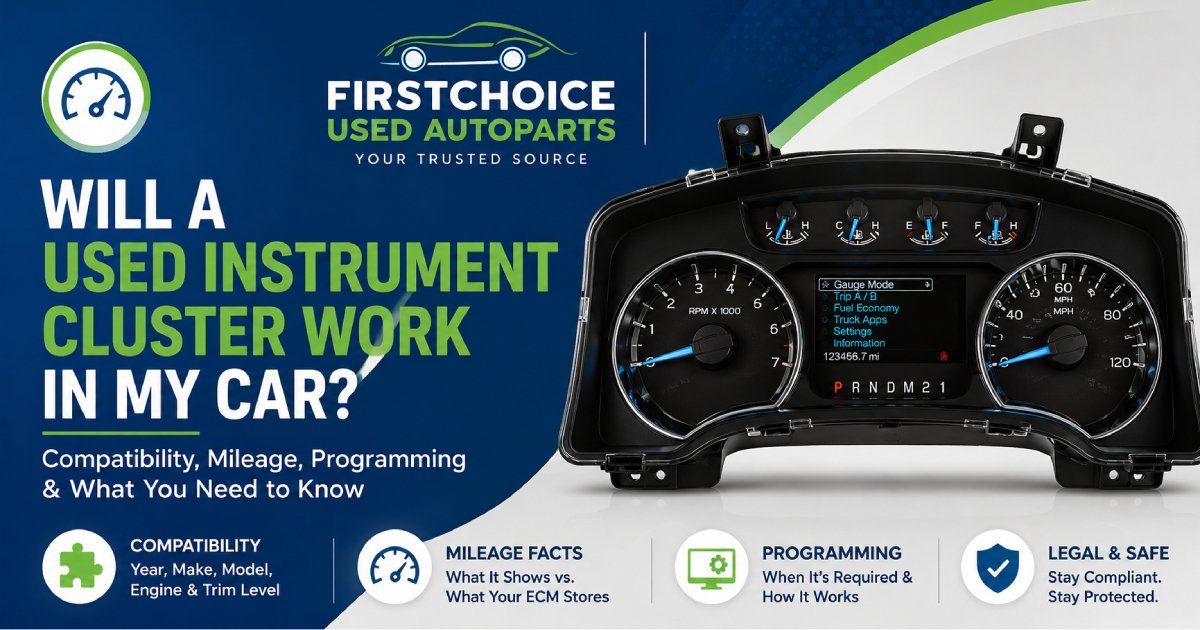
Yes — a used instrument cluster will work in your car
if it matches your exact year, model, engine, and trim level
It will physically install and all gauges will function correctly. The main thing buyers want to know: the cluster will initially display the
donor vehicle’s mileage
not yours. This is correctable through programming, and it does not affect your vehicle’s actual odometer data stored in the ECM. Vehicles from 2006 and newer typically require VIN programming — older vehicles are often plug-and-play.
Instrument cluster failure is one of the most frustrating repairs a vehicle owner deals with — gauges that stop working, a completely dark dashboard, or a speedometer that reads incorrectly. The good news: a used cluster from the right donor vehicle is a fully functional, cost-effective replacement. The hesitation most buyers have is around mileage and compatibility — both of which have clear answers.
Instrument clusters are our second-highest volume part by units sold. Ford, Chevy, and Dodge trucks are the most common, followed by Cadillac, GMC, Toyota, and Honda. Here’s what you need to know before ordering.
What Determines Instrument Cluster Compatibility
1. Generation / Body Style Year Range
Instrument clusters are compatible within a generation — not just a single year. A cluster from a 2012 F-150 will physically fit and electrically match a 2013 F-150 of the same trim because Ford used the same cluster design across the 2009–2014 generation. Crossing generations (e.g., using a 2015 F-150 cluster in a 2013) will not work — different connector pinouts and display systems.
When ordering, always confirm the generation range that applies to your vehicle — not just the exact year.
2. Engine Type
Gas and diesel variants of the same truck often use different instrument clusters. A diesel-equipped truck has a different tachometer range, different warning indicators (glow plug, DEF level, water in fuel), and sometimes different gauge layouts. Swapping a gas cluster into a diesel vehicle (or vice versa) results in missing indicators and incorrect readings.
3. Trim Level / Options Package
This is where most compatibility mistakes happen. A base-trim cluster does not have the same display capabilities as a premium-trim cluster, even from the same model year. Specifically:
- Ford: XL vs. XLT vs. Lariat clusters differ in DIC (Driver Information Center) screen size and feature set. A Lariat cluster in an XL truck will physically fit but some features won’t populate without the corresponding modules.
- GM: Base clusters lack the Driver Information Center of SLT/SLE/LTZ trims. Not interchangeable for full functionality.
- Dodge/Ram: “Uconnect” equipped trucks have larger display clusters. Non-Uconnect base clusters are different units.
- Cadillac: All clusters are premium — trim differences are minor but part numbers matter.
Best practice: Match the trim level of the donor vehicle to your vehicle’s trim for guaranteed full functionality.
4. 4WD vs. 2WD
On most trucks, 4WD models have a 4WD indicator in the cluster. This is typically a software/wiring difference rather than a separate cluster design — so cross-swapping between 4WD and 2WD is sometimes possible, but you may have a non-illuminated or always-lit 4WD indicator. Confirm with your supplier whether the donor vehicle’s drivetrain configuration matches yours.
The Mileage Question — Answered Clearly
This is what most buyers actually want to know. Here’s the direct answer:
What the cluster shows vs. what the ECM stores
Your vehicle has two places where mileage information exists:
- The instrument cluster display — the number you see on the odometer. This comes from the cluster’s internal memory.
- The ECM (Engine Control Module) — your vehicle’s main computer also stores mileage data independently of the cluster.
When you install a used cluster, the display will show the donor vehicle’s mileage. The ECM still holds your vehicle’s actual mileage. These are now two different numbers.
Is this a legal problem?
Federal odometer fraud law (49 U.S.C. § 32703) makes it illegal to knowingly tamper with an odometer with intent to defraud. Installing a used cluster that displays different mileage is not automatically a violation — the violation is in the intent to deceive a buyer. Keeping records of the repair (invoice from the parts supplier, installation receipt) documents that the mileage discrepancy is from a legitimate repair, not fraud. When you eventually sell the vehicle, disclose the cluster replacement in writing.
Can the mileage on the cluster be corrected?
Yes. During the programming process, a shop can write your vehicle’s correct mileage into the cluster’s memory — so the display matches your ECM. This is legal when done to accurately reflect actual mileage. See our instrument cluster programming guide for details on how this works by make.
Never instruct a shop to program a lower mileage than your vehicle’s actual mileage. Programming the cluster to show fewer miles than the ECM records is odometer fraud — a federal offense carrying up to $10,000 in fines per violation. The correct approach: program to match actual mileage or leave at donor mileage with documented disclosure.
Plug-and-Play vs. Programming Required — By Make and Year
| Vehicle | Years | Programming Required? | Notes |
|---|---|---|---|
| Ford F-150 / F-250 | 2004–2008 | Often plug-and-play (same part number) | Match exact part number; PATS security may require dealer reset on some |
| Ford F-150 / F-250 | 2009–2014 | Yes — IPC programming via IDS | VIN write + mileage correction available |
| Ford F-150 / F-250 | 2015+ | Yes — IDS required | More integrated with BCM; confirm trim match |
| Chevy/GMC Silverado / Sierra | 1999–2006 | Plug-and-play (same part number) | Stepper motor clusters — direct swap; mileage will show donor miles |
| Chevy/GMC Silverado / Sierra | 2007–2013 | Yes — SPS via Tech 2 / MDI | VIN programming + mileage correction available |
| Chevy/GMC Silverado / Sierra | 2014+ | Yes — MDI2 programming | Fully digital clusters; must match trim exactly |
| Dodge RAM 1500 / 2500 | 2002–2008 | Plug-and-play (most years) | Match part number; mileage will show donor miles |
| Dodge RAM 1500 / 2500 | 2009–2018 | Yes — wiTECH programming | VIN + mileage correction supported |
| Jeep Grand Cherokee / Wrangler | 2011–2020 | Yes — wiTECH | Uconnect-equipped models require trim match |
| Toyota Tacoma / Tundra / 4Runner | 2005–2015 | Plug-and-play (most) | Match part number; straightforward swap |
| Toyota Tacoma / Tundra | 2016+ | Yes — Techstream initialization | Multi-information display requires configuration |
| Honda Accord / CR-V / Pilot | 2003–2015 | Plug-and-play (most) | Match exact part number; some HFL/nav trims differ |
| Cadillac DTS / STS / Escalade | 2006–2014 | Yes — SPS via Tech 2 / MDI | DIC-equipped; VIN + mileage programming standard |
| Nissan Frontier / Titan / Pathfinder | 2005–2019 | Plug-and-play (most) | Match exact part number; Nissan clusters are generally simple swaps |
The Trim-Sensitive Vehicles — Where Most Mistakes Happen
These specific vehicles have the most trim-level variation in their clusters — ordering from the wrong trim results in missing displays or non-functional features:
Ford F-150 (2009–2014)
Three distinct cluster types based on trim: base analog (XL/STX), mid-level with 4-inch DIC (XLT/FX2), and premium with larger info display (Lariat/King Ranch/Platinum). The connectors are the same across trims, but the display capabilities are not — a base cluster in a Lariat truck will work but won’t show fuel economy, trip data, or SYNC integration messages.
Chevrolet Silverado (2007–2013)
Base clusters (WT/LS) use a simple analog layout. LT/LTZ clusters include a Driver Information Center screen. Some LTZ clusters are color display; others are monochrome. Part numbers vary even within the same trim across model years. When ordering, match trim level AND specific part number.
Dodge RAM (2009–2018)
Standard vs. “Uconnect” infotainment-equipped trucks have different cluster architectures. Trucks with the Uconnect 8.4 system typically have larger cluster displays with navigation turn-by-turn guidance. Non-Uconnect base clusters are entirely different units — not interchangeable for full functionality.
“My 2011 Silverado LTZ cluster went completely dark. I ordered a used LTZ cluster — not just any Silverado cluster — because FirstChoice specifically asked me for my trim level. Shop programmed it with Tech 2, mileage corrected to match my actual miles, and everything worked perfectly. $310 total vs. the $890 dealer quote.”
What Happens If You Install Without Checking Compatibility
| Mismatch Type | Symptom | Fix |
|---|---|---|
| Wrong generation (different body style year) | Cluster won’t plug in OR connector fits but no power | Return and order correct generation |
| Gas cluster in diesel truck | Missing DEF/glow plug/water-in-fuel indicators; tach reads wrong | Return and order diesel-specific unit |
| Wrong trim (base in premium) | Works but DIC/info screen blank or shows errors | Return and order matching trim |
| Correct cluster, no programming done | Shows donor mileage; some lights may stay on | Program to VIN — does not require returning the part |
| 4WD cluster in 2WD truck | 4WD indicator may be lit constantly or missing | Usually tolerated; can be disabled via programming on most |
Frequently Asked Questions
Will a used instrument cluster work in my car?
Yes — a used instrument cluster from the same year range, engine type, and trim level will physically install and function correctly. All gauges (speedometer, tachometer, fuel, temp) will work. The cluster will initially display the donor vehicle’s mileage, which can be corrected through programming. Vehicles from 2006+ typically require VIN programming; older vehicles are often direct plug-and-play.
What mileage will a used instrument cluster show?
It will show the donor vehicle’s mileage until programmed. Your vehicle’s actual mileage remains stored in the ECM (engine computer) and is not affected by the cluster swap. During programming, a shop can write your correct mileage into the cluster to make both numbers match. Keep documentation of the repair for disclosure when you sell the vehicle.
Is it legal to install a used instrument cluster with different mileage?
Yes — installing a used cluster with different mileage for legitimate repair purposes is legal. What is illegal is doing so with intent to defraud a buyer. Keep your repair invoice and disclose the cluster replacement when selling the vehicle. Having your shop program the cluster to display your vehicle’s actual mileage is the cleanest approach.
Do instrument clusters need to be programmed?
Vehicles from approximately 2006+ from Ford, GM, and Dodge/Chrysler/Jeep require VIN programming after cluster replacement. Most Toyota, Honda, and Nissan vehicles through 2015 are plug-and-play — direct swap without programming. Check the compatibility table above for your specific make and year.
Can I use a cluster from a higher trim on my base trim vehicle?
The cluster will physically fit and basic gauges will work, but premium display features (DIC screens, navigation prompts, fuel economy readouts) may not populate without the corresponding modules that higher trims have. For full functionality, match your trim level. For basic gauge replacement where DIC features are not a priority, a higher-trim cluster used in a base vehicle typically causes no harm.
How much does a used instrument cluster cost?
Used instrument clusters typically cost $120–$380 depending on make, year, and trim level. Total installed cost including programming (where required) is generally $280–$650. Dealer replacement with a new unit runs $600–$1,400 for the cluster alone, plus labor and programming.