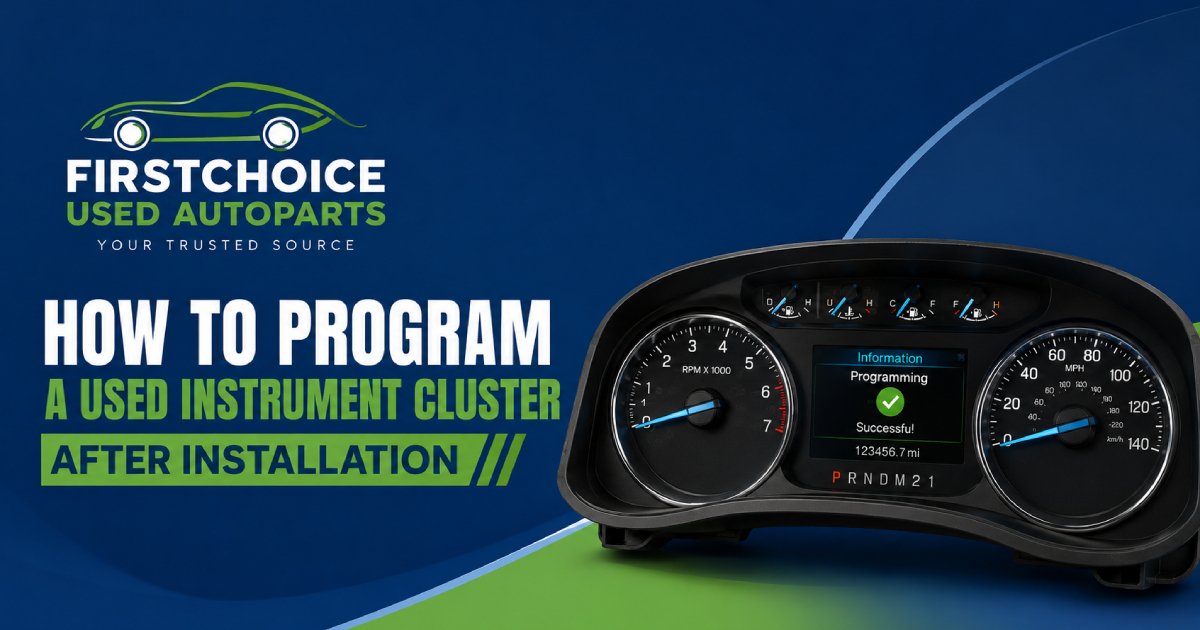
Programming a used instrument cluster involves two steps: (1) writing your vehicle’s VIN into the cluster’s memory so it communicates correctly with other modules, and (2) optionally correcting the mileage display to match your vehicle’s actual odometer. The tool required depends on your make — Ford uses IDS or Forscan, GM uses Tech 2 or MDI with SPS, and Dodge/Chrysler/Jeep uses wiTECH. Most Toyota, Honda, and Nissan clusters through 2015 are plug-and-play and require no programming at all.
Programming is the step most buyers don’t anticipate — and the one that causes the most post-installation confusion. The cluster is installed, the car starts, but the DIC shows errors, the mileage reads wrong, or some warning lights won’t clear. In almost every case, this isn’t a bad part. It’s the programming step that hasn’t been completed.
This guide explains what programming does, which vehicles need it, exactly which tools are required by make, and what mileage correction involves.
Need a used instrument cluster? We confirm programming requirements before your unit ships.
Get a Free Quote — Ships in 1–2 DaysWhat Instrument Cluster Programming Actually Does
When you install a used cluster from a donor vehicle, the cluster contains three types of data from that vehicle:
- The donor vehicle’s VIN — the cluster uses this to authenticate with the BCM and other modules on the CAN bus
- The donor vehicle’s mileage — stored in EEPROM memory inside the cluster
- Vehicle configuration data — engine type, options, DIC settings from the donor build
Programming replaces all three with your vehicle’s data. After programming:
- The cluster is recognized by your BCM, ECM, and other modules as a legitimate component of your vehicle
- Communication errors and false warning lights caused by VIN mismatch are resolved
- The mileage display shows your vehicle’s actual miles (if mileage correction is performed)
- DIC features and displays populate correctly based on your vehicle’s build options
Programming by Make — Tools, Process, and Cost
Ford — IDS and Forscan
| Vehicle | Years | Tool Required | What It Does | Shop Cost |
|---|---|---|---|---|
| F-150, F-250, Explorer, Expedition | 2009–2014 | Ford IDS or Forscan (extended) | VIN write, IPC configuration, mileage correction | $80–$140 |
| F-150, F-250, Super Duty | 2015+ | Ford IDS (dealer or authorized) | Full IPC setup — BCM integration required | $100–$180 |
| Mustang, Fusion, Edge | 2013+ | Ford IDS or Forscan | VIN + mileage correction | $80–$140 |
Forscan DIY possibility: Forscan with an extended license ($15/year) can handle IPC programming on many 2009–2014 Ford vehicles using an ELM327 OBD adapter. This is one of the more accessible DIY programming options — many Ford owners complete this step themselves with moderate technical comfort. For 2015+ vehicles, Ford IDS (the full dealer tool) is generally required.
What the Ford programming process looks like:
GM (Chevrolet / GMC / Cadillac) — Tech 2 and MDI with SPS
| Vehicle | Years | Tool Required | What It Does | Shop Cost |
|---|---|---|---|---|
| Silverado, Sierra, Suburban, Tahoe | 2003–2013 | GM Tech 2 with SPS | VIN programming, cluster configuration, mileage correction | $80–$150 |
| Silverado, Sierra, Suburban, Tahoe | 2014+ | GM MDI2 with GDS2 | Full IPC setup — GM SPS subscription required | $100–$180 |
| Cadillac DTS, STS, Escalade | 2006–2014 | GM Tech 2 / MDI | VIN + DIC cluster programming | $100–$160 |
| Cadillac ATS, CTS (2013+) | 2013+ | MDI2 + GDS2 | Full programming — complex integration | $120–$200 |
GM SPS (Service Programming System): GM clusters are programmed through the SPS online portal — the shop’s scan tool connects to GM’s server in real-time to download and write the correct software. This requires an active SPS subscription ($40/month or $450/year). Most established independent GM shops maintain this subscription. Without it, a GM dealer is needed for the programming step.
GM mileage correction: The 1999–2013 Silverado/Sierra uses stepper-motor clusters — the mileage is stored in the cluster’s EEPROM chip. Mileage correction on these is done through SPS programming. On 2014+ digital clusters, mileage correction is also available through MDI2/GDS2. This is the most common request after cluster replacement on GM trucks.
“My 2010 Silverado LTZ cluster had needle drop — all gauges went dead. Got a used LTZ cluster from FirstChoice for $195. My GM shop had Tech 2 and SPS — programmed it in 45 minutes, corrected the mileage to match my actual miles. Whole job was $340 out the door. GM dealer quoted me $920.”
Dodge / Chrysler / Jeep / RAM — wiTECH
| Vehicle | Years | Tool Required | What It Does | Shop Cost |
|---|---|---|---|---|
| RAM 1500, 2500, 3500 | 2009–2018 | wiTECH 2.0 (PC software) | EMIC VIN programming, mileage correction | $80–$150 |
| RAM 1500, 2500 | 2019+ | wiTECH 2.0 (updated) | Full cluster setup | $100–$170 |
| Jeep Grand Cherokee, Wrangler | 2011–2020 | wiTECH 2.0 | EMIC programming + Uconnect config | $80–$150 |
| Dodge Charger, Challenger | 2011–2022 | wiTECH 2.0 | VIN write, mileage correction | $80–$150 |
| Chrysler 300 | 2011–2022 | wiTECH 2.0 | EMIC programming | $80–$150 |
wiTECH 2.0 accessibility: Unlike GM’s SPS, wiTECH 2.0 is a PC-based subscription at approximately $30/month — more accessible for independent shops. Most established Dodge/Jeep/RAM independent shops carry it. Some mobile programmers also offer wiTECH-based cluster programming.
Toyota — Techstream
| Vehicle | Years | Programming Required? | Tool | Cost |
|---|---|---|---|---|
| Tacoma, Tundra, 4Runner, Sequoia | 2005–2015 | No — plug and play | None (clear codes only) | $0 |
| Tacoma, Tundra, 4Runner | 2016+ | Yes — initialization required | Techstream or Autel/Launch compatible | $80–$130 |
Toyota 2005–2015 owners: no programming needed. These clusters are among the most straightforward replacements in the industry — install the matching cluster, clear any stored fault codes with a basic scanner, and you’re done. The mileage will show donor miles, but the vehicle runs and reads correctly immediately.
Honda — HDS (Honda Diagnostic System)
| Vehicle | Years | Programming Required? | Tool | Cost |
|---|---|---|---|---|
| Accord, CR-V, Pilot, Odyssey | 2003–2015 | No — plug and play (most) | None (clear codes) | $0 |
| Accord, CR-V, Pilot | 2016+ | Yes — HDS initialization | Honda HDS or Autel compatible | $80–$130 |
Nissan — Consult III+
Most Nissan trucks and SUVs (Frontier, Titan, Pathfinder, Xterra) through 2019 are plug-and-play for cluster replacement. No programming is required — install and clear codes. The mileage will display the donor vehicle’s miles; Nissan does not offer dealer-level mileage correction on most models, so documentation is the appropriate approach.
Mileage Correction: What It Is and What It Costs
Mileage correction is the process of writing a specific mileage value into the cluster’s EEPROM — so the display matches your vehicle’s actual odometer reading rather than the donor vehicle’s reading.
This is a separate step from VIN programming and is optional but recommended for clarity and resale purposes.
| Make | Mileage Correction Available? | Tool Used | Typical Cost |
|---|---|---|---|
| Ford (2009–2014) | Yes — via IDS or Forscan | Forscan or IDS | Included in programming fee or $50–$80 extra |
| GM (all years with SPS) | Yes — via SPS | Tech 2 / MDI | Included in programming or $50–$80 extra |
| Dodge/Chrysler/Jeep | Yes — via wiTECH | wiTECH 2.0 | Included in programming or $50–$80 extra |
| Toyota (plug-and-play) | Not available through standard tools | N/A | Document repair instead |
| Honda (plug-and-play) | Not available through standard tools | N/A | Document repair instead |
| Nissan | Limited — not widely available | Consult III+ (some models) | Varies — document repair instead |
Mileage correction must reflect actual vehicle mileage — never less. Programming a cluster to show fewer miles than your vehicle’s ECM records is federal odometer fraud. Correction is legal and appropriate when it accurately represents actual mileage. Always document the repair with the installation invoice and the mileage value that was programmed.
Total Cost of Used Instrument Cluster + Programming
| Item | Cost Range |
|---|---|
| Used instrument cluster (unit) | $120–$380 |
| Installation labor | $60–$150 |
| VIN programming (if required) | $80–$180 |
| Mileage correction (optional) | $0–$80 (often included) |
| Total out-of-pocket | $280–$650 |
| Dealer (new cluster + programming) | $700–$1,800 |
“2015 RAM 1500 cluster went dark at 134K miles. Dealer quoted $1,100. FirstChoice shipped me a matching cluster for $275. RAM shop did the wiTECH programming and mileage correction same day — $130 for their time. Total $405. Everything works exactly as before including the Uconnect DIC display.”— Angela R., Charlotte, NC
We confirm the programming requirement for your specific vehicle before shipping — no surprises.
Get Your Instrument Cluster — Free QuoteFrequently Asked Questions
How do you program a used instrument cluster?
Programming is done through a make-specific scan tool connected to the OBD-II port. For Ford: Forscan (extended license) or IDS writes the VIN and configuration to the IPC module. For GM: Tech 2 or MDI with SPS programs the cluster and optionally corrects mileage. For Dodge/Chrysler/Jeep: wiTECH 2.0 handles EMIC programming. Toyota, Honda, and Nissan through 2015 require no programming — install and clear codes.
Can I program an instrument cluster myself?
On Ford vehicles (2009–2014), Forscan with an extended license ($15/year) and an ELM327 adapter handles most IPC programming steps — a genuine DIY option. On GM vehicles, the Tech 2 or MDI + SPS subscription ($40/month) is shop-level equipment. On Dodge/Chrysler/Jeep, wiTECH 2.0 is PC-based and technically accessible but requires a subscription. For Toyota, Honda, and Nissan through 2015, no programming is needed at all.
What happens if I don’t program a used instrument cluster?
On vehicles that require programming: the cluster displays donor mileage, some warning lights may stay illuminated (U-codes for module communication mismatches), and DIC/info screen features may not populate correctly. The vehicle will typically still drive and operate normally — programming is needed for full system integration and accurate display, not basic drivability.
How much does instrument cluster programming cost?
At an independent shop with the correct scan tool, cluster programming typically costs $80–$180. Mileage correction, when performed at the same time, is often included or adds $50–$80. Total out-of-pocket for a used cluster installed and programmed is typically $280–$650 depending on the vehicle.
Does programming fix the mileage on a used cluster?
Yes — on Ford, GM, and Dodge/Chrysler/Jeep vehicles, the programming process includes an option to write a specific mileage value to the cluster’s memory. This corrects the display to show your vehicle’s actual mileage rather than the donor’s. This step must reflect actual mileage — programming a lower value than your vehicle’s actual odometer reading is odometer fraud.
Will my shop know how to program an instrument cluster?
Most established independent shops that specialize in or regularly work on your vehicle’s brand will have the necessary scan tool. Ask specifically: “Do you have Ford IDS / GM Tech 2 with SPS / wiTECH 2.0 for cluster programming?” before dropping the vehicle. If they don’t, a mobile programmer or dealer service department are alternatives — confirm ahead of time that the dealer will program a module they didn’t supply.