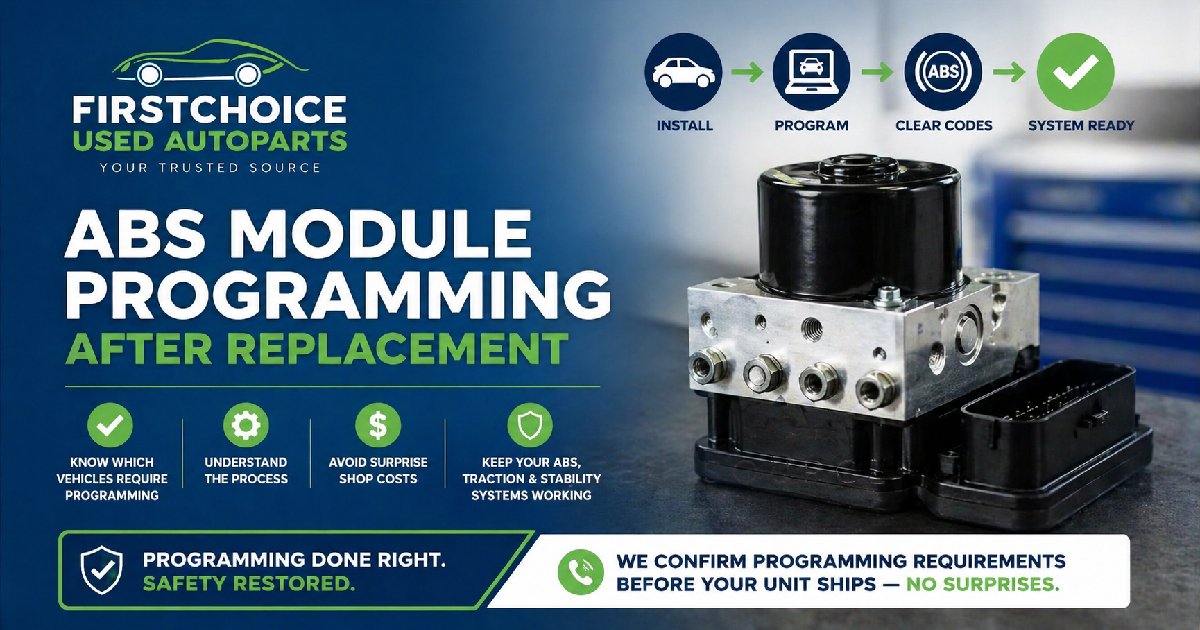
Some ABS modules require programming after replacement — some don’t. Vehicles where the ABS module is integrated with the BCM or shares VIN-specific security data (most GM vehicles 2006+, many Ford and Chrysler platforms) require programming with a dealer-level or advanced aftermarket scan tool. Older vehicles and many simpler ABS configurations are plug-and-play — install the unit and clear the codes. Knowing which category your vehicle falls into before you buy the part saves you from a surprise shop visit.
The number one post-installation complaint we hear: “I put in the ABS module and the ABS light is still on.” In most cases, this isn’t a defective part — it’s a missing programming step. The module was physically installed correctly, but it hasn’t been configured to recognize the vehicle it’s now in.
This guide tells you exactly which vehicles require ABS module programming, what the programming process involves, and how much it costs.
Looking for a used ABS module? Tell us your year, make, and model and we’ll confirm if programming is required.
Get a Free Quote — We Confirm Programming RequirementsABS Module Programming: Vehicle-by-Vehicle Breakdown
| Make / Vehicle | Years | Programming Required? | Tool Needed | Cost at Shop |
|---|---|---|---|---|
| Ford F-150, F-250, Explorer | 2004–2014 | Yes — VIN programming required | Ford IDS / Forscan (Advanced) | $80–$150 |
| Ford F-150, F-250, Explorer | 2015+ | Yes — module configuration required | Ford IDS only | $100–$180 |
| Chevy/GMC Silverado, Sierra (EBCM) | 1999–2013 | Yes — SPS programming required | Tech 2 / MDI + SPS subscription | $80–$160 |
| Chevy/GMC Silverado, Sierra (HECU) | 2014+ | Yes — module setup required | MDI2 or compatible | $100–$180 |
| Dodge RAM 1500/2500 (CAB) | 2002–2012 | Yes — VIN flash required | wiTECH / StarScan | $80–$150 |
| Dodge RAM 1500/2500 (HECU) | 2013+ | Yes — module configuration | wiTECH2 | $100–$160 |
| Jeep Grand Cherokee, Wrangler | 2005–2018 | Yes — VIN programming required | wiTECH / StarScan | $80–$150 |
| Toyota Tacoma, Tundra, 4Runner | 2003–2015 | No — plug and play | None | $0 (clear codes only) |
| Toyota Tacoma, Tundra, 4Runner | 2016+ | Yes — initialization required | Techstream or compatible | $80–$130 |
| Honda Accord, CR-V, Pilot | 2003–2015 | No — plug and play on most years | None (clear codes) | $0 |
| Honda Accord, CR-V, Pilot | 2016+ | Yes — initialization via HDS | Honda HDS | $80–$140 |
| Nissan Frontier, Titan, Pathfinder | 2004–2019 | No — plug and play | None (clear codes) | $0 |
| Cadillac (DTS, STS, Escalade) | 2002–2014 | Yes — SPS programming required | Tech 2 / MDI | $80–$160 |
Plug-and-play vehicles (no programming):
Most Toyota trucks and SUVs (2003–2015), most Honda cars and crossovers (2003–2015), most Nissan trucks (2004–2019), and many older domestic vehicles pre-2004. On these vehicles, install the unit, clear the codes, and the ABS light should go off immediately.
What ABS Module Programming Actually Does
When you install a used ABS module from a different vehicle, the module’s internal memory contains data from the donor vehicle — including its VIN, vehicle configuration (wheel size, axle ratio, brake bias settings), and potentially security credentials linked to the immobilizer system.
Programming does three things:
- Writes your vehicle’s VIN into the module’s memory so it recognizes itself as part of your car’s network
- Configures vehicle-specific parameters — brake bias, wheel diameter, ATC (active traction control) settings — to match your exact build
- Clears any donor-vehicle configuration data that would cause communication errors on your CAN bus
Without this step, the module may power up and communicate partially, but the ABS system will not function correctly. On most vehicles, this shows up as a persistent ABS warning light and potentially disabled traction control or stability control as well (since these systems share the ABS module on most modern vehicles).
Can You Program an ABS Module Without a Dealer?
Yes — on many vehicles, independent shops and some advanced DIYers can program ABS modules using aftermarket tools. Here’s the breakdown:
GM Vehicles (1999–2013 Silverado/Sierra EBCM)
The GM Tech 2 scan tool (used widely by independent shops) handles SPS programming for EBCM units on this generation. Many independent shops already own this tool. The subscription for software updates costs around $40/month but many shops maintain it. Cost at an independent shop: typically $80–$120.
DIY option: Forscan (Ford) and HPTuners (GM) can handle some module configurations, but SPS programming for EBCM specifically requires Tech 2 or MDI access. Not a true DIY job for most people.
Ford Vehicles
Ford IDS (Integrated Diagnostic Software) is the dealer tool. Forscan with an extended license can handle some ABS module functions on Ford — specifically the VIN write and configuration steps on 2004–2012 models. On 2013+ models, full IDS access is often required. An independent shop with Ford IDS (many have it) charges $100–$150 for this.
Dodge/Chrysler/Jeep
wiTECH is the Stellantis dealer tool. wiTECH 2.0 is a subscription-based PC software that independent shops can access — cost is around $30/month. Most established Dodge/Jeep shops have wiTECH access. Expect $80–$150 at an independent shop for CAB or HECU programming.
Toyota (2016+ vehicles)
Techstream is the Toyota dealer tool. Some aftermarket scan tools (Autel, Launch) offer Toyota ABS initialization support. An independent Toyota-specialized shop or dealer will typically charge $80–$130.
Don’t skip programming on vehicles that require it.
A non-programmed ABS module may leave your ABS, traction control, AND stability control all disabled — even if the vehicle still drives normally. You won’t notice until you need emergency braking on a slippery surface. Budget for the programming step before the car leaves the shop.
The Total Cost of ABS Module Replacement (With Programming)
| Component | Typical Cost |
|---|---|
| Used ABS module (EBCM or HECU) | $150–$450 |
| Installation labor (shop) | $80–$200 |
| Programming (if required) | $80–$180 |
| Code clearing and test drive | Often included with installation |
| Total out-of-pocket (typical) | $350–$800 |
| Dealer replacement (new unit + labor) | $900–$2,200 |
“I bought a used EBCM for my 2009 Silverado from FirstChoice for $175. My independent shop said they needed to do the SPS programming with their Tech 2 — $95. Total was $270 out the door. Dealer had quoted me $1,100 for the same repair. The ABS light went off immediately after programming and hasn’t come back in 9 months.”
— Larry M., St. Louis, MO
What If Your Shop Says They “Can’t Program It”?
Some shops don’t have the required scan tools. This doesn’t mean the repair can’t be done — it means you need the right shop. Options:
- Ask if they have dealer-level scan tool access for your specific make before you drop the car off
- Independent specialists often have more tooling than general shops — a Ford-specialist shop has IDS; a GM-specialist has Tech 2/MDI
- Mobile programmers exist in most metro areas — they come to your shop with the required tools and program the module for a flat fee ($80–$150 typically)
- Dealer service departments will program modules they didn’t supply — call ahead and confirm, as some will and some won’t
On plug-and-play vehicles (Toyota 2003–2015, Honda 2003–2015, Nissan trucks), this is a non-issue — your shop just clears codes after installation.
We confirm programming requirements before your unit ships — no surprises at the shop.
Find Your ABS Module — Free QuoteFrequently Asked Questions
Does an ABS module need to be programmed after replacement?
It depends on the vehicle. Most GM, Ford, Dodge, and Jeep vehicles from 2004 onward require programming after ABS module replacement — the new module must be configured with your VIN and vehicle-specific parameters. Most Toyota trucks (2003–2015), Honda cars (2003–2015), and Nissan trucks are plug-and-play — install and clear codes, no programming needed.
What happens if you don’t program the ABS module?
On vehicles that require programming, an unprogrammed ABS module will typically leave the ABS warning light on and disable the ABS, traction control, and stability control systems. The vehicle will still drive and brake normally, but you lose all the electronic safety intervention systems. On some vehicles, it may also trigger a check engine light or affect cruise control.
How much does ABS module programming cost?
ABS module programming at an independent shop with the proper scan tool typically costs $80–$180. At a dealer, expect $100–$250 as a standalone programming fee. Mobile programmers charge $80–$150 and come to your location.
Can I program an ABS module myself?
On some Ford vehicles, Forscan with an extended license can handle ABS module VIN programming. On most GM, Dodge, and Toyota vehicles, the required scan tools (Tech 2/MDI, wiTECH, Techstream) are shop-level tools not accessible to most DIYers. On plug-and-play vehicles (many Toyotas, Hondas, and Nissans), no programming is needed — just clear codes with a standard OBD-II scanner.
Can any shop program an ABS module or does it have to be the dealer?
Any shop with the correct scan tool for your vehicle’s brand can program an ABS module — it does not have to be the dealer. Most established independent shops have access to at least one brand’s dealer-level tool. Mobile programmers are another option if your shop lacks the tool.
Will a used ABS module cause problems if it came from a different vehicle?
On plug-and-play vehicles: no — the module configures itself to your vehicle automatically. On vehicles requiring programming: the used module will show errors until it is programmed to your VIN. This is expected behavior, not a defect. Once programmed, it functions as if it were installed new. The key is ensuring the physical unit itself is in good condition from a verified source.