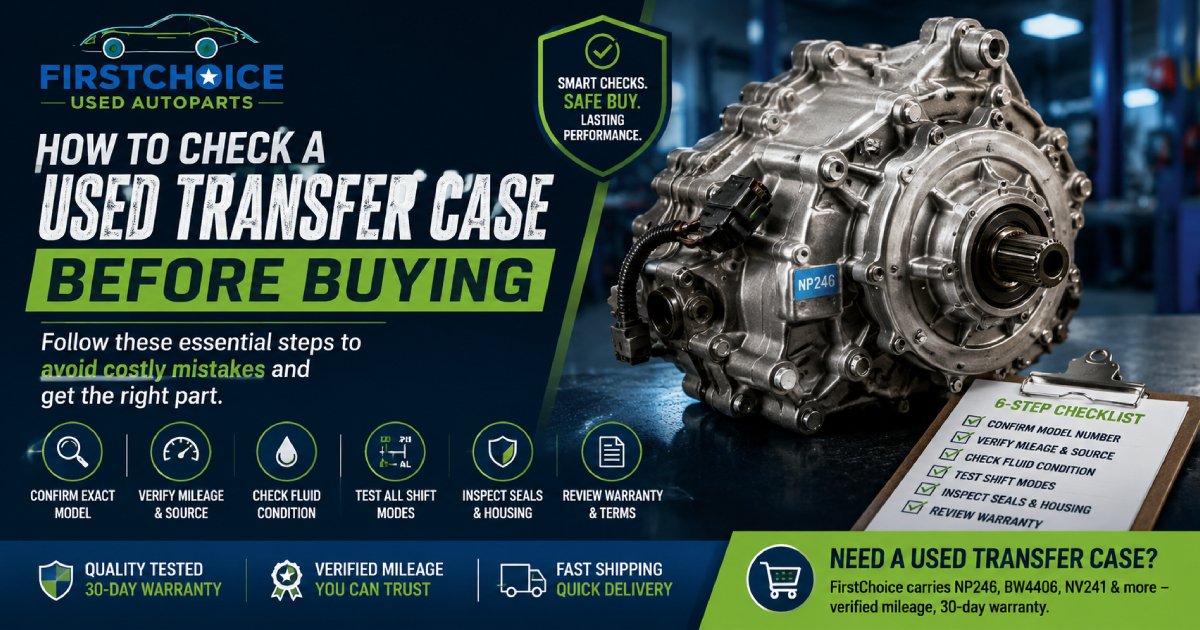
Before buying a used transfer case, verify the exact model number matches your vehicle, confirm the mileage from documentation, check the fluid condition for metal contamination, and test that all shift modes engage cleanly. A used transfer case that passes these checks will install and function correctly. One that doesn’t will fail within weeks — and warranty claims on transfer cases are more complex than most parts because damage from wrong fluid or overheat voids coverage.
This guide walks through every checkpoint in the order you should apply them — from confirming compatibility before you spend money, through what to inspect physically, to the warranty terms that actually matter.
Need a used transfer case? FirstChoice carries NP246, BW4406, NV241, and more — verified mileage, 90-day warranty.
Check Availability →Step 1: Confirm the Exact Transfer Case Model Number
Step 1 of 6 — Do this before anything else
Year, make, and model are not enough information to order a transfer case. A 2008 Silverado 1500 with Autotrac uses an NP246. A 2008 Silverado 2500HD uses an NV261HD. These two cases have completely different output shaft configurations, mounting bolt patterns, and internal gear sets. They will not interchange.
How to get the model number:
- Transfer case ID tag: Metal tag bolted to the case body, usually on the side or top. Contains model number, date code, and ratio. Most reliable source.
- GM RPO sticker: In the glove box of all GM vehicles. Find the 3-letter code: NP3 = NP246, NP8 = NP261, NP1 = NP241.
- Owner’s manual or window sticker: Lists drivetrain options including transfer case family (Autotrac, ControlTrac, Command-Trac, etc.)
- VIN decode + trim level: Use as backup confirmation only — not as primary identification.
Once you have the model number, provide it to the supplier directly. A supplier who can confirm the exact model number on their replacement case is the one to order from.
Step 2: Verify Mileage and Source Vehicle
Step 2 of 6
Transfer case internal wear — chain stretch, bearing wear, clutch pack degradation — is directly proportional to mileage. A case from a 75,000-mile vehicle has far more remaining life than one from a 165,000-mile donor.
What to ask:
- “What was the mileage on the donor vehicle when pulled?”
- “Is that mileage from the odometer record or documented from the vehicle?”
- “What year, make, and model was the donor vehicle?”
A reputable supplier can tell you the donor vehicle’s year/make/model and approximate mileage. If the answer is “I don’t know the donor vehicle,” that’s a yellow flag — it may mean the case came from a salvage pool without documentation.
| Donor Mileage | Expected Remaining Life | Risk Level |
|---|---|---|
| Under 80,000 miles | 100,000–140,000 miles | Low |
| 80,000–120,000 miles | 60,000–100,000 miles | Low-Medium |
| 120,000–150,000 miles | 30,000–60,000 miles | Medium |
| Over 150,000 miles | Variable — chain wear likely | High |
Step 3: Check Fluid Condition
Step 3 of 6
Transfer case fluid tells the story of what happened inside the case more accurately than any visual inspection. Metal particles in the fluid = internal wear. Milky fluid = water contamination = bearing and chain damage.
Ask the seller to drain a small sample from the drain plug (or use a fluid extraction tube through the fill hole). Then evaluate:
| Fluid Appearance | Meaning | Decision |
|---|---|---|
| Clear red or amber (ATF-based) | Normal — low wear | Good to buy |
| Dark brown, slight metal sheen | Normal aging — some wear particles | Acceptable; request price reduction |
| Black, heavy metallic particles | Significant internal wear | Pass unless deep discount |
| Milky or grey | Water contamination — bearing damage | Do not buy |
| Low fluid level (won’t extract) | Ran low — possible chain/bearing damage | Request internal inspection or pass |
Quick metal test: Run a magnet along the outside of the drain plug tip. Heavy metallic deposits = significant internal wear. A light coating of fine particles is normal on high-mileage cases.
Step 4: Test Shift Engagement in All Modes
Step 4 of 6
The most important functional test: do all shift modes — 2H, 4H, 4L — engage cleanly and completely? A case that won’t engage 4L or makes grinding noises during mode changes has a mechanical shift problem that won’t resolve after installation.
There are two ways a seller can demonstrate shift function:
Bench Test (for pulled cases)
The case can be connected to a 12V power source and the encoder motor (on electronic-shift cases like NP246) can be commanded through its full range. The case should shift from one position to another without binding, grinding, or stalling the motor. Ask the seller to power the encoder motor and confirm it cycles completely.
Running Vehicle Test
Ideally, the case is tested in a running vehicle before removal. If the seller pulled the case from a running, driving vehicle, ask for a short video of the truck engaging 4H and 4L before disassembly — this is the best proof of function.
Red flags during shift test:
- Grinding noise when engaging 4L — worn shift fork or synchronizer
- Case won’t move out of Neutral — shift linkage or fork failure
- Encoder motor stalls before reaching position — motor failure or detent spring broken
- Vibration felt through output shafts during rotation — chain slap or bearing failure
Step 5: Inspect Seals and Case Housing
Step 5 of 6
Oil leaks from output shaft seals are common on high-mileage transfer cases. A weeping seal is an easy fix ($15–$40 in parts). A cracked housing is not.
What to look at:
- Front output seal: Connects to front driveshaft yoke. Check for oil film or dried residue around the yoke. Minor weeping — acceptable. Heavy running leak — seal replacement needed before install (easy).
- Rear output seal: Same inspection at the rear yoke. Same standard.
- Case halves: Run your finger along the seam between the two aluminum or cast-iron case halves. Wet oil at the seam = gasket failure. Budget $30–$50 and a gasket set to reseal on the bench if buying this case.
- Case housing: Look for cracks radiating from the mounting ears or output shafts. These are stress points from impact damage. A cracked aluminum case cannot be reliably repaired — walk away.
- Weld marks: Any evidence of weld repair on the case body indicates a prior catastrophic failure. Do not buy a welded transfer case housing.
Step 6: Confirm Warranty Scope — Not Just Duration
Step 6 of 6
A 90-day warranty means nothing if the warranty language excludes the internal components you actually care about. Ask three specific questions before accepting warranty terms.
Three warranty questions to ask:
- “Does the warranty cover shift engagement function — specifically, if the case won’t engage 4H or 4L after install?”
- “Does the warranty cover internal mechanical failures, or just the case housing?”
- “If the case fails within the warranty period, do I need to return the case or can you ship a replacement first?”
Most reputable used parts suppliers will cover internal function within the warranty period. If a seller can only warranty “the housing” or “external condition,” they’re not offering a meaningful warranty on a transfer case.
5 Questions to Ask Your Supplier Before Ordering
- What is the exact transfer case model number on the unit you have? (Not just “it fits a 2008 Silverado” — the actual casting number or ID tag number.)
- What was the donor vehicle’s mileage and year?
- Has the fluid been inspected? Any metallic contamination?
- Was the unit tested for shift engagement in all modes before listing?
- Does the warranty cover shift function and internal operation, not just the housing?
One more thing before install: Always fill the replacement transfer case with the correct fluid type before starting the engine. GM Autotrac cases require Autotrac II fluid — not generic ATF. Ford ControlTrac cases require Mercon V. Dodge NV241 requires ATF+4. Running the wrong fluid even once damages the clutch pack and voids any warranty claim.
“I bought a used NP246 for my 2005 Tahoe. Before ordering from FirstChoice, they confirmed the model number matched, told me the donor was a 75,000-mile Silverado, and said shift engagement was tested before listing. Everything they told me checked out on delivery — clean fluid, no leaks, all modes engage. Filled it with Autotrac II, installed it, truck has been perfect for 18 months.”
Ready to order? FirstChoice verifies mileage and shift function on every transfer case — 90-day warranty, fast shipping.
Find Your Transfer Case →Frequently Asked Questions
What is the most important thing to check when buying a used transfer case?
Exact model number match first, then fluid condition for metal contamination, then shift engagement in all modes. A model mismatch means the part physically won’t install correctly. Metallic fluid means internal wear. Failed shift modes mean a broken shift fork or encoder motor.
How do I check the fluid in a used transfer case before buying?
Ask the seller to drain a small sample from the drain plug or extract fluid with a syringe through the fill hole. Clear red or amber fluid is acceptable. Black fluid with metallic particles indicates heavy wear. Milky or grey fluid means water contamination — avoid that case.
Can I install a used transfer case myself?
Yes, for most trucks. The process requires a transmission jack, driveshaft removal, and basic hand tools. The most common DIY issue is forgetting to fill the case with the correct fluid type before starting the engine. Allow 3–6 hours for a first-time transfer case swap.
Do used transfer cases need to be programmed?
Most 4WD mechanical-shift cases (NP246, NV241, BW4406) require no programming. Late-model electronic-shift-only cases on 2015+ vehicles may require a module reset or calibration. Confirm with your supplier before ordering.
What fluid goes in a used transfer case after installation?
GM NP246/NP261: GM Autotrac II fluid. Ford BW4406/BW4411: Mercon V ATF. Dodge NV241/NV243: ATF+4. Toyota Aisin: Toyota transfer case fluid (Part# 08885-02306). Using the wrong fluid causes clutch pack damage — always verify the correct spec before filling.
How long will a used transfer case last?
A case from a vehicle under 100,000 miles should last another 80,000–120,000 miles with correct fluid maintenance. Chain wear (NP246) is the main long-term failure point — fluid changes every 30,000 miles extend case life significantly.