
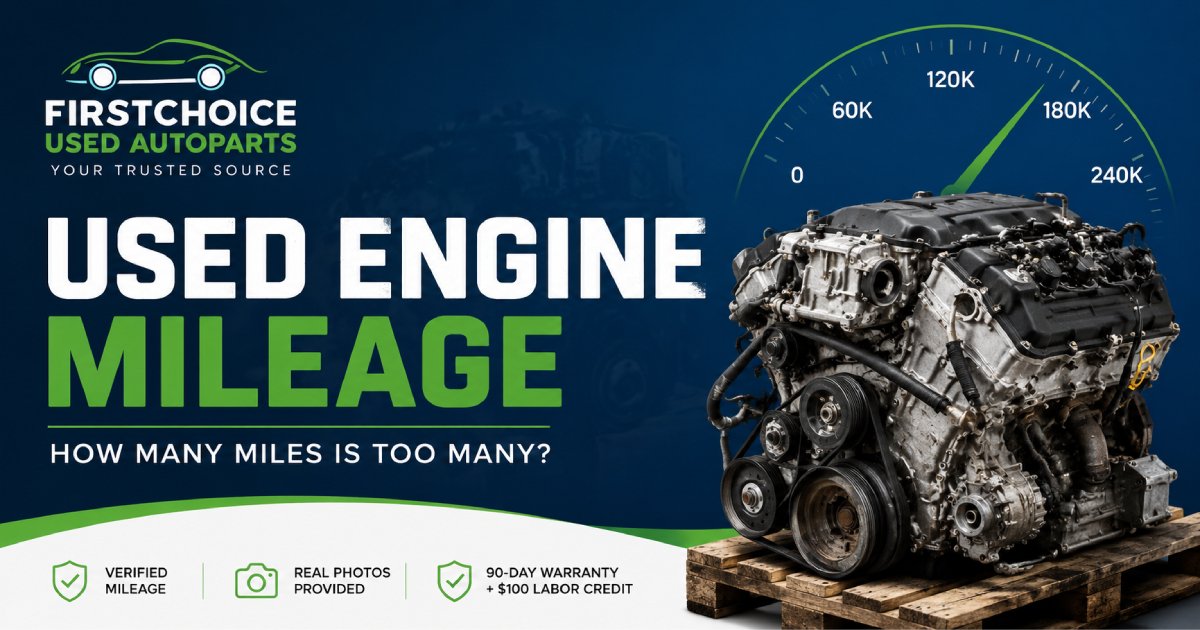
The honest answer most sellers will not give you: mileage is the second most important factor in used engine quality, not the first. The first is donor vehicle history. A 95,000-mile Ford 5.0L Coyote that came out of a regularly-driven daily driver in Texas will outlast a 35,000-mile Coyote that sat in a wrecking yard for two winters in Pennsylvania. This guide gives US truck and SUV owners the actual mileage sweet spots by engine family — plus the four red flags that matter more than the odometer.
FirstChoice ships under 120,000 miles on standard gas engine inventory and under 250,000 miles on diesels — both ranges are inside the sweet spots described below. Every shipment includes the donor vehicle’s recorded mileage, real photos of the long block, and the 90-day warranty. Read on for the per-engine breakdown.
Looking for a used engine with verified mileage and donor history? Quote in 10 minutes.
Check Availability →The Real Question: How Long Will an Engine With X Miles Last?
When you ask “is 80,000 miles too many on a used Coyote 5.0L?” the underlying question is: will this engine give me 100,000 more miles before I need to do this again? The math works out something like this:
- A modern US gas engine designed to last 300,000 miles with maintenance.
- Buy it at 80,000 miles → 220,000 miles of theoretical remaining life.
- Subtract for previous owner maintenance gaps and wear → realistically 120,000 to 180,000 miles of usable life left.
- That is 8 to 12 years of typical US driving on a swapped engine.
For most truck owners that math is winning math. The new engine outlives the rest of the truck’s body, suspension, and electronics. The trick is buying inside the sweet spot — neither so low that you are paying a premium with little upside, nor so high that the major wear components are already used up.
Mileage Sweet Spots by Engine Family
Each engine family has a different durability curve. Here are the ranges where US buyers get the best value-per-remaining-mile based on FirstChoice 2025 shipment data.
| Engine | Sweet Spot | Acceptable Stretch | Avoid Above |
|---|---|---|---|
| Ford 5.0L Coyote (F-150, Mustang) | 60,000 – 100,000 | up to 130,000 | 150,000+ |
| Ford 3.5L EcoBoost (F-150) | 50,000 – 90,000 | up to 120,000 | 140,000+ (turbo wear) |
| Ford 5.4L 3V Triton | 70,000 – 110,000 | up to 140,000 | 150,000+ (spark plug, cam phaser) |
| Ford 6.7L Powerstroke Diesel | 100,000 – 200,000 | up to 250,000 | 300,000+ (EGR) |
| GM 5.3L L83/L84 Vortec | 70,000 – 120,000 | up to 150,000 | 170,000+ (AFM lifter) |
| GM 6.2L L86/L87 | 60,000 – 110,000 | up to 140,000 | 160,000+ |
| GM 6.6L Duramax Diesel | 100,000 – 200,000 | up to 280,000 | 320,000+ (injector wear) |
| RAM 5.7L HEMI | 60,000 – 110,000 | up to 140,000 | 160,000+ (MDS lifter) |
| RAM 6.7L Cummins Diesel | 100,000 – 250,000 | up to 350,000 | 450,000+ (turbo, injectors) |
| Jeep 3.6L Pentastar (Wrangler, Grand Cherokee) | 50,000 – 100,000 | up to 130,000 | 150,000+ (rocker arm) |
| Toyota 5.7L 3UR-FE (Tundra, Sequoia) | 60,000 – 130,000 | up to 180,000 | 220,000+ |
| Toyota 1GR-FE 4.0L V6 (Tacoma) | 70,000 – 140,000 | up to 200,000 | 250,000+ |
Why diesels run further: Diesel engines operate at lower RPM, with thicker oil pressure, and are over-engineered for the loads they pull. A 250,000-mile Cummins with maintenance records can be a better buy than a 90,000-mile gas engine with no history. Always ask about the donor vehicle’s service paper trail on a diesel.
Sweet-spot mileage engines are not the cheapest, but they last the longest. Through Paytomorrow you can spread the cost over 12, 24, or 36 months — making the higher-quality, mid-mileage choice the right call without taking the cash hit up front.
From $185/month on a typical $4,200 engine · From $245/month on a $5,500 Cummins
Soft credit check (no impact on your score), instant pre-approval, decision in about 60 seconds. Ask for the monthly math when you request your quote.
Why “Low Mileage” Isn’t Always Better
This is the part the average used-engine ad will not tell you. An engine that sat in a wrecked vehicle through two winters in Buffalo or Cleveland may show 28,000 miles on the odometer but the seals have dried out, the cylinder walls have surface rust, and any condensation inside the oil pan turned to varnish. When you install it and start it cold for the first time, the dry start scores the cylinder walls and you have just bought a 30K-mile engine that runs like 200K.
Three storage scenarios that ruin “low-mileage” engines:
- Wrecked vehicle sat outdoors for 12+ months. Rust on the cylinder walls, dry valve stem seals, possibly water in the oil pan.
- Insurance total stored in unheated warehouse through a salt-belt winter. Condensation cycling on the inside of the block. Visible rust on the head bolts.
- Engine pulled from a flooded vehicle. If the donor was a Hurricane Helene or Ian flood vehicle, even with low miles, it is a no-go. Internal corrosion is invisible from the outside.
FirstChoice rejects flood-history and long-storage engines at intake. Every engine in inventory has a verified donor vehicle history — usually from running insurance claims, not abandoned wrecks.
What to Ask About a Used Engine’s Donor Vehicle
If you take five questions to a used-engine call, take these five:
- What is the donor vehicle’s mileage at pull? A real number, not a range.
- How long has the engine been out of the donor vehicle? Fresh-pulled is best. Anything over six months should have been preservation-oiled.
- Was the donor a running vehicle or salvage? Wrecked but running is the gold standard. Engine knock or overheating disclosed in the salvage record is a stop.
- What state did the donor come from? Sun-belt (Arizona, Texas, Florida, California) is preferred over salt-belt (Ohio, Pennsylvania, Michigan, New York) for body parts; for engines it matters less but still affects exterior corrosion of head bolts and exhaust studs.
- Can you send photos of the long block, intake, and oil pan? A supplier who hesitates here is hiding something.
The 4 Mileage Red Flags
These four signals trump the odometer reading every time. If any one of them is present, walk away regardless of miles.
Mismatched Service Sticker
Oil change sticker reads 47K but the engine has carbon buildup consistent with 90K+. Someone rolled the odometer or did not change the sticker. Either way, the number is unreliable.
Heavy Sludge in Valve Cover
Dark, paste-like sludge under the valve cover indicates skipped oil changes regardless of stated miles. Internal wear progression is far worse than the odometer suggests.
Visible Coolant Crust on Head Bolts
White/green deposits around the head bolt boss area suggest a prior overheat or head gasket leak. Combined with low miles, this often means the donor was scrapped because of an engine problem.
Rust on Cylinder Walls (Visible Through Spark Plug Hole)
Long-term storage damage. Engine will not seal properly on first start. Lower mileage means nothing if the rings are seizing in a corroded bore.
Common sales trick to watch for: “Low mileage from a clean Carfax.” Carfax does not show wrecks before insurance reporting and never shows storage history. A clean Carfax is meaningful for the body, not the engine. Ask the supplier for the donor stock photos plus a fresh photo of the engine — not just paperwork.
Engine Family Quirks That Affect Mileage Buying Decisions
Some US engines have known weak points that shift the “too many miles” line one way or the other:
Ford 5.4L 3V Triton
Spark plug breakage and cam phaser failure are mileage-related. Buy at 70-110K when phasers are likely still original; avoid above 150K unless phasers were replaced.
GM 5.3L AFM (Active Fuel Management)
Lifter failure on cylinder 1 and 7 around 120K-170K. Buy under 120K to be ahead of the failure window; or buy a post-2014 with AFM delete.
RAM 5.7L HEMI MDS
MDS lifter and rocker arm wear around 130K-160K. Sweet spot is 60-110K. Hemi tick is mileage-related — verify quiet operation in photos/video.
Jeep 3.6L Pentastar (Pre-2016)
Cylinder head rocker arm failure on Bank 1 around 90K-130K. Post-2016 redesigned head solved it. Verify model year before buying high miles.
Ford 3.5L EcoBoost
Turbo wastegate and water pump (internal) drive replacement decisions. Sweet spot 50-90K. Avoid past 140K unless water pump was already done.
Toyota 5.7L 3UR-FE
Longest-living US gas engine on this list. 180K is normal. Sweet spot is 60-130K with no known wear cliff.
Companion Reading
Used Engine Buyer’s Guide
The full playbook — cost by make, fitment factors, inspection checkpoints, ordering process.
Read the Buyer’s Guide →Signs of a Bad Used Engine
7-point inspection before installation. Catches problems before they cost you a second teardown.
Read the Inspection Guide →Shop Used Engines
Ford, GM, RAM, Toyota, Jeep — donor mileage verified, photos on request, 90-day warranty.
Check Availability →“Bought a 78,000-mile 5.0L Coyote for my 2014 F-150 from FirstChoice in fall 2022. My original engine had spun a rod bearing at 197K. The replacement engine — exactly inside the 60-100K sweet spot — has been running for almost four years now, just rolled past 41,000 added miles. Donor came from a Texas insurance vehicle, photos were exactly as described, no surprises. Easily the best repair decision I’ve made on this truck.”
Engine sweet spot mileage with verified donor history. Free LTL freight, 90-day warranty.
Get a Quote →Frequently Asked Questions
How many miles is too many for a used engine?
For most US gas engines (Coyote 5.0L, HEMI 5.7L, Vortec 5.3L, Pentastar 3.6L), the sweet spot is 60,000 to 120,000 miles. Past 150,000 miles risk rises sharply. Diesel engines (Cummins 6.7L, Duramax 6.6L, Powerstroke 6.7L) hold value to 200,000 miles when properly serviced. Mileage alone is not the whole story — donor vehicle history matters more.
Is low mileage always better on a used engine?
Not always. An engine that sat in a wrecked vehicle for two years has dried-out seals, varnished oil, and possibly rusted cylinder walls regardless of its odometer. A 90,000-mile engine that ran weekly is often a safer bet than a 35,000-mile engine that sat for 18 months. Storage history matters.
What is the sweet spot mileage for a Ford 5.0L Coyote?
The Ford 5.0L Coyote (F-150 and Mustang) sweet spot is 60,000 to 100,000 miles. Coyotes are durable to 200K with maintenance, but used pricing rises and supply drops above 100K. At 60-100K you get proven reliability plus enough running life to make the swap worthwhile.
Can I buy a used Cummins diesel engine with 200,000 miles?
Yes. Cummins 6.7L diesels routinely run to 400,000-500,000 miles when serviced. A 200K Cummins from a verified fleet donor with maintenance records is often a better value than a 90K gas engine. Inspect the turbo, injectors, and EGR cooler before buying.
What is FirstChoice’s mileage policy on used engines?
FirstChoice discloses donor vehicle mileage on every engine and provides photos of the engine before shipment. Standard inventory is under 120K miles on gas engines and under 250K on diesel. All engines ship with 90-day warranty plus Parts only.