
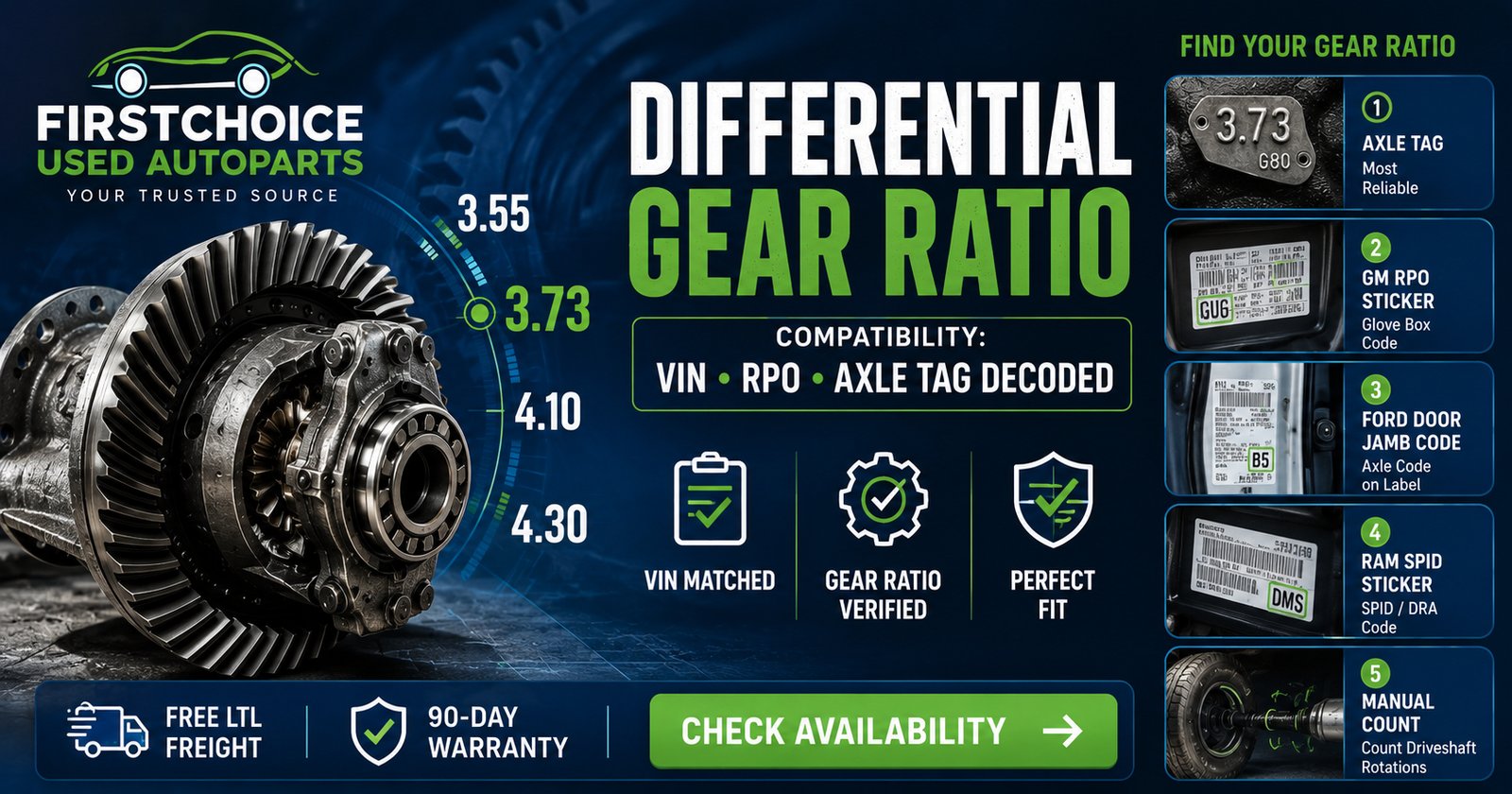
The single most expensive mistake in used differential and rear axle ordering is the wrong gear ratio. A 3.73 ring and pinion in a truck originally spec’d for 3.55 looks identical at install — the truck drives, the gears mesh, no immediate noise. Then a month later the transfer case starts grinding, fluid changes color, and you have a $2,000-$3,500 transfer case repair to do because the ratios were not matched. This guide walks US truck and SUV owners through every reliable way to find your gear ratio before you order.
FirstChoice confirms gear ratio against your VIN before pulling any differential or rear axle from inventory. We never ship a “should be 3.73” — we ship the verified ratio from the axle tag on the donor unit. That is why the first-fit rate sits at 98.2 percent. But you can speed up the call dramatically by knowing your own ratio first.
Know your gear ratio and need a used diff or rear axle? VIN-match in 10 minutes.
Check Availability →Why Gear Ratio Mismatch Destroys Transfer Cases on 4WD Trucks
A 4WD truck’s transfer case sends equal driveshaft rotation to the front and rear axles when 4WD is engaged. The wheels turn at whatever speed the gear ratio determines.
- Matched ratios: Both front and rear axles turn at the same wheel-RPM for a given driveshaft-RPM. The transfer case sees zero internal binding.
- Mismatched ratios (3.73 rear, 3.55 front): The rear wants to spin faster than the front for the same driveshaft input. With 4WD engaged on dry pavement, neither end can slip — so the transfer case takes the bind internally. Chain stretch, planetary gear wear, and clutch pack damage follow within months.
The damage is invisible from a road test the day after install. It shows up at 3,000-8,000 miles as transfer case fluid contamination, then noise, then failure. The total cost of “saving $100” by buying a slightly-different-ratio diff often hits $2,500 in transfer case repair.
RWD trucks are also affected — just less severely. Even on a 2WD truck, the wrong ratio changes engine RPM at highway speeds, reduces fuel economy by 8-15 percent, and changes shift points on automatic transmissions. The truck runs, but the ECU is confused and the speedometer reads inaccurately.
How to Find Your Gear Ratio — 5 Methods
Method 1: The Axle Tag (Most Reliable)
A small metal tag bolted under one of the differential cover bolts. Stamped or paint-marked with the gear ratio (e.g., “3.73”) and often an axle code. This is the most reliable source because it reflects what is actually installed, not what was ordered from the factory.
Look for it: at the rear differential, kneel down behind the truck and look at the cover bolts at 12 o’clock, 10 o’clock, or 2 o’clock positions. Many trucks have lost the tag to age or rust — if missing, use method 2 or 5.
Method 2: GM RPO Sticker (GM Vehicles)
Open the glove box. On the inside of the glove box door is a printed sticker with 50+ three-character RPO (Regular Production Option) codes. Find the axle code:
| RPO Code | Axle Ratio | Limited Slip? |
|---|---|---|
| GT4 | 3.08 | No |
| GT5 | 3.42 | No |
| GU4 | 3.42 | No (different axle code) |
| GU6 | 3.73 | No |
| GU5 | 3.73 | No (heavy-duty) |
| GU2 | 4.10 | No |
| GU8 | 4.30 | No |
| G80 | Limited Slip / Gov-Lok | Yes (combined with ratio code) |
Method 3: Ford Door Jamb Axle Code
Open the driver door. On the inside of the door (B-pillar or door jamb) is the white Ford certification label. It includes an axle code — usually a two-character code in the bottom row. Common Ford axle codes:
| Ford Axle Code | Ratio | Type |
|---|---|---|
| 15 | 3.31 | Conventional |
| 16 | 3.31 | Trac-Lok LSD |
| 19 | 3.55 | Conventional |
| 27 | 3.55 | Trac-Lok LSD |
| B5 | 3.73 | Conventional |
| 26 | 4.10 | Conventional |
| X9 | 4.10 | Trac-Lok LSD |
| H9 | 3.73 | Electronic Locking |
Method 4: RAM / Chrysler SPID Sticker
SPID = Sales Parts ID label. Found in different locations by model: in the glove box, on the radiator support, on the inside of the trunk lid, or inside the underbody jack storage compartment. Look for “DRA” axle code in the list:
| RAM SPID Code | Ratio | Type |
|---|---|---|
| DLE | 3.21 | Conventional |
| DM3 | 3.55 | Conventional |
| DMH | 3.55 | Anti-Spin LSD |
| DMS | 3.92 | Anti-Spin LSD |
| DMA | 3.92 | Conventional |
| DMP | 4.10 | Anti-Spin LSD |
| DM7 | 4.10 | Conventional |
Method 5: Manual Count (Universal — Works on Any Vehicle)
Use this when the tag is missing or you cannot find the sticker. You need a piece of chalk and 10 minutes.
- Jack up only one rear wheel. Leave the other on the ground (this lets the differential rotate).
- Mark the raised tire with chalk at the 12 o’clock position. Mark the driveshaft at any point.
- Slowly rotate the raised tire exactly 2 full revolutions (because one wheel rotates twice for one driveshaft rotation in an open differential when the other wheel is held).
- Count how many times the driveshaft mark passes the reference point during those 2 tire rotations.
- The number of driveshaft rotations is your gear ratio.
Example: 2 tire rotations and you count 3.73 driveshaft rotations (roughly 3 and 3/4 turns) → ratio is 3.73. Round to the nearest standard ratio: 3.08, 3.21, 3.31, 3.42, 3.55, 3.73, 3.92, 4.10, 4.30, 4.56.
Tip on manual count accuracy: The count is not perfectly precise (it is hard to read 3.73 vs 3.55 by visual count). Use it to confirm what the sticker or tag tells you. If sticker says 3.73 and manual count gives “about 3.75 turns,” you are confirmed.
Toyota Axle Codes
Toyota does not use a glove-box sticker the same way. Check the axle tag on the differential cover, or decode the build sheet at a Toyota dealer using your VIN. Common Toyota Tundra ratios are 4.10 (5.7L 4WD), 4.30 (TRD Pro), and 3.91 (5.7L 2WD). Toyota Tacoma: 3.73, 3.91, 4.10, or 4.30 depending on engine and trim.
Gear Ratio Selection for Towing vs Fuel Economy
| Use Case | Recommended Ratio | Trade-off |
|---|---|---|
| Daily driving, light loads, max MPG | 3.08 – 3.42 | Reduced towing capability |
| Mixed daily + occasional towing under 7,500 lbs | 3.42 – 3.55 | Balanced compromise |
| Tow package, 7,500-12,000 lbs | 3.73 | Sweet spot — most-common factory tow |
| Heavy towing 12,000+ lbs, hilly terrain | 4.10 | ~2 MPG loss vs 3.73 |
| Off-road crawl, oversized tires (35″+) | 4.10 – 4.88 | RPM increases at highway speed |
Speedometer Recalibration After Ratio Change
If you intentionally change ratios (3.55 to 3.73 for towing, for example), the speedometer will read incorrectly because the ECU still expects the old ratio. Options:
- Handheld tuner (SCT, DiabloSport, Edge): $300-$500. Reads VIN, lets you enter new ratio, recalibrates speedometer instantly.
- Dealer reflash: $100-$200 at most dealers. They program the new ratio into the BCM.
- Stay with the original ratio: Skip the recalibration. Simplest path for most US buyers.
Cluster Reading
Used Differential Buyer’s Guide
Cost by truck, the 4 compatibility factors, used vs rebuilt vs new comparison.
Read the Buyer’s Guide →Posi vs Limited Slip vs Locking
Once you have the ratio, the next decision is the traction device type. Side-by-side comparison.
Read the Type Guide →Shop Used Differentials
Gear ratio verified from the axle tag of the donor unit. Free LTL freight + 90-day warranty.
Check Availability →“Almost made a $3,000 mistake. Bought a used Dana 60 rear from a backyard seller for my 2017 F-350, thought it was 3.73 because the truck is. Didn’t check the tag. Installed it, drove 4,200 miles, transfer case started binding hard in 4WD. Pulled the cover — the diff was actually 4.10. My front was 3.73, ratios were off. Found FirstChoice, gave them my VIN, they pulled a verified 3.73 from a 60K F-350 donor with the tag photo confirmed. $720, ratios matched, transfer case saved before total failure. Lesson learned about verifying that tag before install.”
Verified gear ratios from the donor unit’s axle tag — not “should be” guesses. Order with confidence.
Get a Quote →Frequently Asked Questions
How do I find my differential gear ratio?
Five ways: 1) Read the axle tag bolted to the differential cover — most reliable. 2) GM owners check the RPO sticker in the glove box for codes like GU6 (3.73) or GU4 (3.42). 3) Ford owners check the door jamb axle code. 4) RAM/Chrysler owners check the SPID sticker in the glove box. 5) Manual count — mark one rear wheel, count driveshaft rotations for 4 wheel rotations.
Does my gear ratio have to match on a 4WD truck?
Yes, exactly. On 4WD and AWD vehicles, the front and rear differential gear ratios must be identical. Even a small mismatch like 3.73 vs 3.92 causes the transfer case to bind constantly when 4WD is engaged. This destroys transfer case clutches or chains over time. RWD vehicles are not affected, but ratio still affects performance and fuel economy.
What is the GM RPO code for 3.73 gear ratio?
GM RPO codes for common gear ratios: GU4 = 3.42, GU6 = 3.73, GT4 = 3.08, GU2 = 4.10, GT5 = 3.42 (10-bolt), GU5 = 3.73 (heavy-duty). Limited-slip G80 (Gov-Lok) is a separate code combined with the ratio. Check the glove box door for the full RPO sticker list.
What gear ratio is best for towing?
For towing 7,500-12,000 lbs, the 3.73 ratio is the most common factory tow package. For trailers above 12,000 lbs, 4.10 or 4.30 ratios trade fuel economy for towing capability. For light-duty trucks used mostly for daily driving, 3.42 or 3.55 gives the best fuel economy but lower towing capacity.
Can I change my gear ratio with a used differential swap?
Yes, but you must change both differentials on a 4WD truck (front and rear must stay matched). You also need to recalibrate the speedometer for the new ratio, either through a tuner or a dealer reflash. Most US buyers stay with the original ratio unless intentionally re-gearing for towing or off-road.