
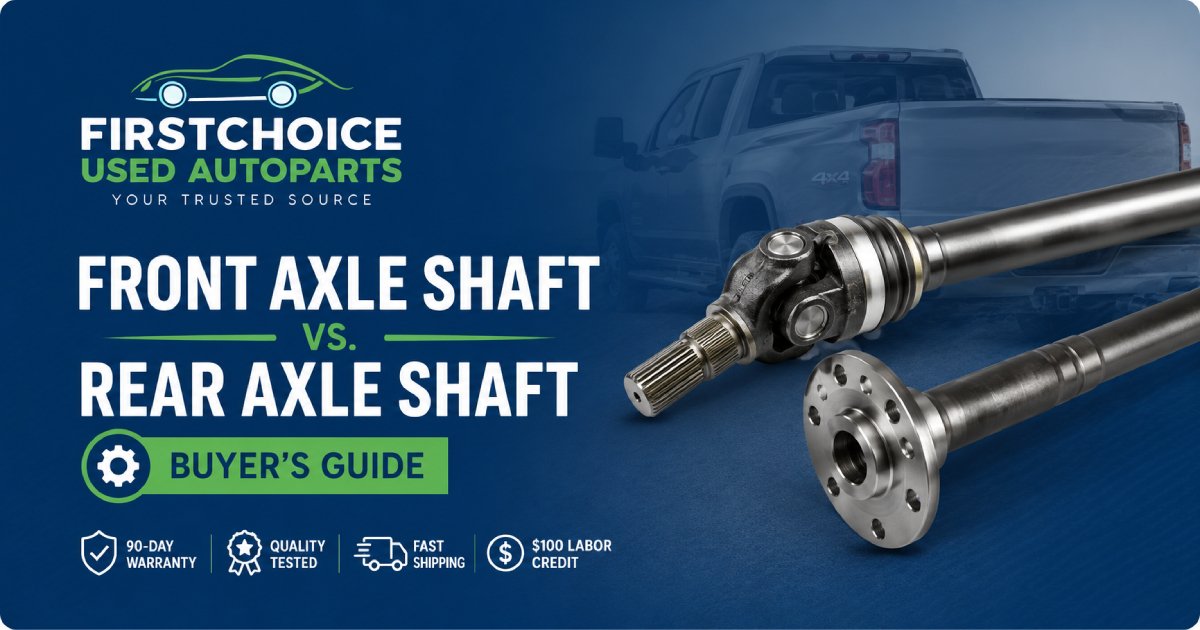
“I need an axle shaft” is one of the most under-specified phone calls we get. Half the time the customer means a rear C-clip axle shaft on a Ford 8.8 or GM 10-bolt. The other half means a front solid-axle inner shaft from a Jeep Wrangler or older heavy-duty truck. Same words, very different parts. This guide walks US truck and SUV owners through the four common axle shaft configurations, how to identify yours, and what a fair used price looks like.
FirstChoice ships all four types — semi-floating rear, full-floating rear, solid-axle front shaft (with U-joint or CV), and rear C-clip — with VIN-verified fitment, the 30-day warranty,. Read on for the specifics.
Semi-floating, full-floating, C-clip, or solid-axle front — we stock all four. VIN-matched in 10 minutes.
Check Availability →Front Axle Shaft Anatomy (Solid Axle 4WD)
On solid-axle 4WD trucks and SUVs — Jeep Wrangler, Jeep Gladiator, older Ford Super Duty (1999-2004), older RAM 2500/3500, older Bronco — the front axle has axle shafts inside the housing. Because the front wheels also steer, the front axle shaft needs to bend at the wheel end. There are two designs:
- Single-piece with U-joint at the knuckle: Used on Dana 30, Dana 44, and the front of older Ford and Dodge solid-axle setups. A standard u-joint at the steering knuckle handles the steering angle. Reliable but limited steering angle.
- Single-piece with CV joint at the knuckle: Used on newer Jeep Wrangler (Rubicon) and modified setups. A constant-velocity joint gives smoother power delivery at high steering angles but costs more and wears faster.
Front axle shafts on solid-axle 4WD vehicles are exposed to more wear than rear shafts because they handle both rotation and steering articulation simultaneously.
Rear Axle Shaft Anatomy
Rear axle shafts come in two retention styles and two structural categories.
Retention: C-Clip vs Bolt-In
- C-Clip: A small C-shaped clip on the inner end holds the shaft in the differential carrier. Common on Ford 8.8 (F-150 2004-2014), GM 8.6 10-bolt (Silverado/Sierra 1500), GM 9.5 14-bolt semi-float. Removable by dropping the differential cover and pulling the carrier cross-pin.
- Bolt-In (no C-clip): The bearing retainer at the outer end bolts to the housing flange. The shaft slides out from the outside after removing four bolts. Common on Ford 9-inch, older GM 12-bolt, and most pre-1980 designs.
Structure: Semi-Floating vs Full-Floating
- Semi-floating: The axle shaft carries both the vehicle’s weight and the torque. Wheel bearing is pressed onto the shaft. Standard on light-duty trucks (F-150, RAM 1500, Silverado 1500). Lower payload capacity, simpler, cheaper.
- Full-floating: The axle housing tube carries the vehicle’s weight; the shaft only transmits torque. Identifiable by the protruding hub cover on the outer end of the housing. Standard on heavy-duty (F-350, RAM 3500, Silverado 3500HD). Higher payload, serviceable wheel bearings, the shaft can be removed without lifting the truck.
How to tell semi vs full at a glance: Walk to the back of the truck and look at the rear hub. If you see lug nuts on a flat hub face that bolts directly to the brake rotor — semi-floating. If you see a protruding cylindrical hub cover (often with a center cap that says “DUALLY” or covers a snap ring) bolted on with multiple bolts — full-floating.
Truck-by-Truck Axle Shaft Type Reference
| Truck / SUV | Front Axle Shaft | Rear Axle Shaft |
|---|---|---|
| Ford F-150 (2004-2014) | CV axle (4WD) | 8.8″ semi-float, C-clip |
| Ford F-150 (2015+) | CV axle (4WD) | 9.75″ semi-float, C-clip |
| Ford F-250 (1999-2004) | Solid-axle shaft (Dana 50/60) | 10.5″ full-float |
| Ford F-250/F-350 (2005+) | Solid-axle shaft (Dana 60) | 10.5″ full-float Sterling |
| Chevy Silverado 1500 | CV axle (4WD) | 8.6″ semi-float, C-clip |
| Chevy Silverado 2500HD | CV axle (4WD, IFS) | 11.5″ full-float |
| Chevy Silverado 3500HD | CV axle (4WD, IFS) | 11.5″ full-float |
| RAM 1500 (2002+) | CV axle (4WD) | 9.25″ semi-float, C-clip |
| RAM 2500/3500 (2003+) | Solid-axle shaft (AAM) | 11.5″ full-float |
| Jeep Wrangler JK/JL | Solid-axle shaft (Dana 30 or 44) | Dana 35 or 44, semi-float |
| Jeep Grand Cherokee | CV axle (AWD/4WD) | 8.25″ or 9.25″ semi-float |
| Toyota Tundra | CV axle (4WD, IFS) | 9.5″ semi-float |
| Toyota Tacoma | CV axle (4WD, IFS) | 8.4″ semi-float |
Symptom Differences: Front Failure vs Rear Failure
The symptoms differ because the front and rear shafts have different jobs.
- Front axle shaft failure (4WD vehicles): Most common symptom is loss of 4WD engagement — the truck still drives in 2WD mode but you cannot pull yourself out of mud. If the front shaft broke catastrophically you may hear a bang and feel a clunk on shifting. Often diagnosed only when 4WD is attempted.
- Rear axle shaft failure: Loss of drive entirely. On a 2WD truck the vehicle stops moving. On a 4WD truck you can still drive in 4WD with the front shafts engaged. C-clip failures may result in a wheel separating from the vehicle — known catastrophic failure on GM 1500.
Replacement Cost Comparison
| Vehicle | Axle Position | Used Cost | New OEM |
|---|---|---|---|
| Ford F-150 (2004-2014) | Rear 8.8″ semi-float | $130 – $220 | $320 – $480 |
| Ford F-150 (2015+) | Rear 9.75″ semi-float | $140 – $240 | $340 – $520 |
| Ford F-250/F-350 | Rear 10.5″ full-float | $220 – $380 | $560 – $900 |
| Ford F-250/F-350 | Front solid-axle (Dana 60) | $180 – $320 | $480 – $720 |
| Chevy Silverado 1500 | Rear 8.6″ 10-bolt | $140 – $240 | $340 – $520 |
| Chevy Silverado 2500HD/3500HD | Rear 11.5″ full-float | $240 – $400 | $600 – $950 |
| RAM 1500 | Rear 9.25″ AAM | $150 – $260 | $380 – $580 |
| RAM 2500/3500 | Rear 11.5″ full-float | $240 – $420 | $620 – $980 |
| Jeep Wrangler | Front Dana 30/44 | $160 – $260 | $420 – $640 |
| Jeep Wrangler | Rear Dana 35/44 | $160 – $280 | $420 – $660 |
| Toyota Tundra | Rear 9.5″ semi-float | $160 – $280 | $420 – $640 |
Order both sides together when one breaks at high mileage. If your truck is past 150,000 miles and you snap a rear axle shaft, the other side is usually within 20,000 miles of the same failure mode (especially on C-clip designs). Pricing two shafts at once typically saves freight cost and second-installation labor.
Cluster Reading
“Broke a passenger-side rear axle shaft on my 2008 F-350 dually pulling a trailer back from Yellowstone. Full-floating 10.5 Sterling shaft, full splined design. New OEM was quoted at $720. FirstChoice had a used unit pulled from a clean 92,000-mile F-350 donor for $310, including freight to Salt Lake. Installed the next weekend. Pulled my trailer back from Glacier two months later with no issues.”
Front or rear, semi-float or full-float, C-clip or bolt-in — VIN-matched and ready to ship.
Get a Quote →Frequently Asked Questions
What is the difference between a front and rear axle shaft?
On modern US trucks the front axle shaft (when present on a solid-axle 4WD) is shorter and equipped with a CV joint or U-joint at the wheel end to allow steering. The rear axle shaft is straight, longer, and rotates as a single rigid unit. On most modern light-duty 4WD trucks the front uses CV axles, not axle shafts.
What is a C-clip axle shaft?
A C-clip axle shaft is retained in the differential by a small C-shaped clip on the inner end of the shaft. Used on Ford 8.8, GM 8.6, and GM 9.5 rear axles. The clip can fail under hard load, allowing the shaft and wheel to slide out of the housing — a known failure mode on 1999-2013 GM 1500 trucks.
What is a full-floating axle?
A full-floating axle uses the axle housing tube (not the axle shaft) to support vehicle weight. The shaft only transmits torque. Found on heavy-duty trucks (F-350, RAM 3500, Silverado 3500HD) and rated for higher payload. Identifiable by the protruding hub cover bolted to the outer end of the housing.
What is a semi-floating axle?
A semi-floating axle shaft carries vehicle weight through the shaft itself, with the wheel bearing pressed onto the shaft. Standard on light-duty trucks (F-150, RAM 1500, Silverado 1500, Tacoma) and most SUVs. Cheaper, simpler, lower payload rating than full-floating.
How much does a used rear axle shaft cost compared to new?
Used rear axle shafts run $120-$280 each versus $320-$640 new OEM. A used full-floating axle shaft for an F-350 or RAM 3500 runs $200-$400 versus $550-$900 new. The labor cost is identical either way, so used shafts often cut the total repair cost by 40-50 percent.