
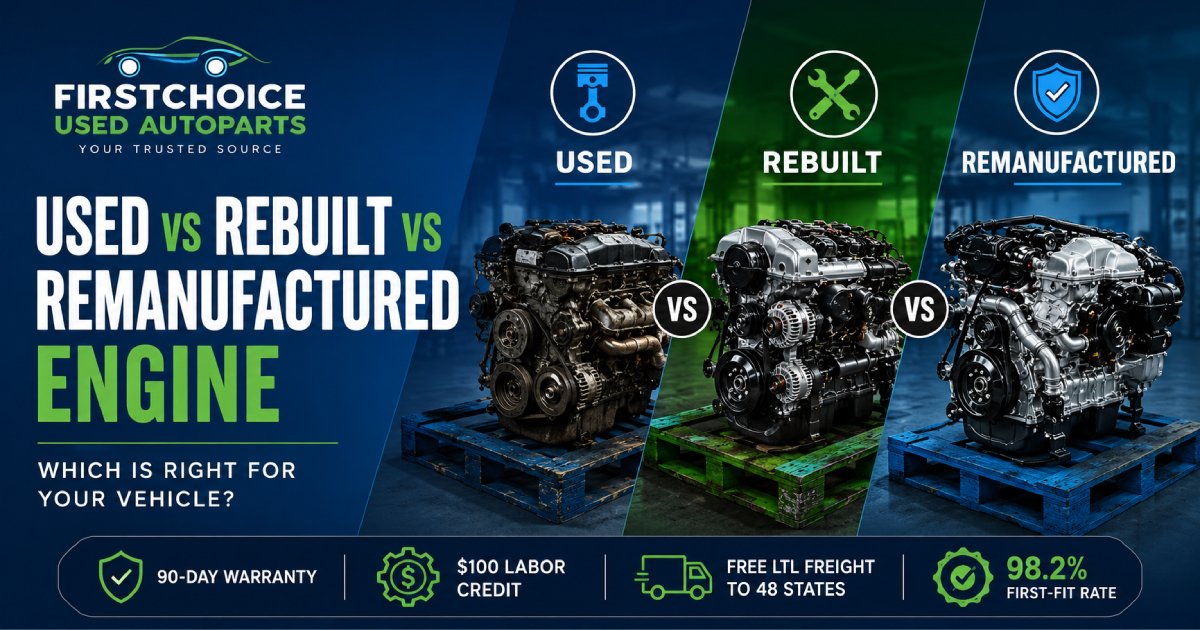
The short answer: choose a used engine when your truck or SUV is worth under $20,000 and you want it back on the road in two weeks. Choose a remanufactured engine when you intend to keep the vehicle for 200,000 more miles. Rebuilt sits in the middle and is only as good as the shop that built it. This guide walks through cost, warranty, lifespan, and decision-making for each.
The mistake most US buyers make is treating these three options as the same product at different price points. They are not. They are three completely different industrial processes with different risk profiles, lead times, and outcomes. Get the choice right and you save thousands. Get it wrong and you pay twice.
VIN-verified used engines with 90-day warranty. 98.2% first-fit rate.
Check Availability →Definitions: What “Used,” “Rebuilt,” and “Remanufactured” Actually Mean
Most buyers don’t realize these terms describe completely different products. Sellers exploit that confusion. Here is what each actually means in 2026.
Used Engine
An intact engine pulled from a donor vehicle — typically a wrecked truck or SUV with body or frame damage but a healthy drivetrain. The engine is inspected, tested for compression, photographed, and sold as a complete long-block (and often as a complete dropout with accessories). Nothing inside is replaced. You get exactly what came out of the donor.
Rebuilt Engine
A core engine that has had specific worn components replaced — usually rings, bearings, gaskets, timing components, and sometimes the head. The depth and quality vary enormously by shop. A “rebuilt” engine from a one-man garage in Florida and a “rebuilt” engine from a high-volume builder in Texas are not the same product. The block itself is not always machined back to factory tolerances.
Remanufactured Engine
A full production-line restoration. The engine is completely disassembled. The block deck is resurfaced, cylinders are honed or sleeved, the crankshaft is polished or replaced, all bearings and rings are new, and every gasket is replaced. Machining is done to factory blueprints. Output is QC tested on a dyno. A reman is the closest you can buy to a brand-new engine.
The honest framing: Used = factory-built engine with miles on it. Reman = factory-spec rebuild with zero miles. Rebuilt = somewhere in between, depending entirely on the builder.
Cost Comparison Table
Pricing ranges below reflect 2025 US market data for popular truck and SUV engines (Coyote 5.0L, Vortec 5.3L, HEMI 5.7L, Pentastar 3.6L, 6.7L Cummins). Diesel engines sit at the top of each range.
| Option | Price Range | What’s Included | Lead Time |
|---|---|---|---|
| Used | $1,200 – $3,500 | Long-block or dropout, donor photos, compression test | 5-9 business days |
| Rebuilt | $2,500 – $5,500 | Long-block with selected replaced parts, varies by shop | 2-6 weeks |
| Remanufactured | $3,500 – $8,000 | Full long-block restored to OEM spec, dyno tested | 3-8 weeks |
Hidden costs to watch: Reman and rebuilt engines often charge a “core charge” of $300-$1,500 that is refunded only when you ship back your old engine. Used engines from FirstChoice have no core charges, no hidden freight fees, and free LTL freight to 48 states.
The monthly cost gap between used, rebuilt, and reman is smaller than the total price gap. Through Paytomorrow you can spread any of these options over 12, 24, or 36 months with a soft credit check (no impact on your score) and instant pre-approval.
$2,500 used = ~$110/mo · $4,200 rebuilt = ~$185/mo · $6,500 reman = ~$290/mo (24-mo terms)
For most US shop owners and DIY buyers, financing turns the “used vs reman” decision from a $4,000 cash gap into a $180/month gap — which makes the longer reman warranty more attractive if your engine sees daily highway use.
Warranty Comparison Table
Warranty length matters less than warranty terms. Read the fine print: many warranties only cover parts, not labor — which means a $4,000 reman that fails at 18 months can still cost you $1,500 in shop time.
| Option | Typical Warranty | Labor Coverage | Mileage Limit |
|---|---|---|---|
| Used (FirstChoice) | 90 days | Parts only | Unlimited |
| Rebuilt | 1 – 3 years | Usually parts only, varies by shop | 12,000 – 36,000 miles |
| Remanufactured | 3 – 5 years | Some include up to $500 labor | 36,000 – 100,000 miles |
Lifespan Expectations
Real-world lifespan depends on starting condition, install quality, and how the vehicle is driven. These are the averages we see across our 3,400+ drivetrain customers.
- Used engine, 80K-120K starting miles: Typically 80,000-150,000 additional miles before the next major service event. Some customers report 200K+ on a clean 5.0L Coyote or 5.3L Vortec sourced from a Southern donor.
- Rebuilt engine: 100,000-180,000 miles. The variance comes from the quality of the rebuild — a full machine shop rebuild lasts as long as a reman, while a “rings and gaskets” rebuild may only buy you 60K-80K more miles.
- Remanufactured engine: 150,000-300,000 miles. A properly maintained reman 6.7L Cummins or 6.6L Duramax routinely runs past 300K because the rotating assembly is back to factory clearance.
Reality check: The engine doesn’t determine lifespan alone. Cooling system condition, oil change intervals, and install precision (especially head bolt torque and timing chain tension) matter just as much. Many “failed reman” complaints trace back to install errors, not the engine.
When to Choose Each: Decision Matrix
| Your Situation | Best Option | Why |
|---|---|---|
| Daily driver pickup, vehicle worth $8K-$18K | Used | Best $/mile, fastest delivery, 90-day warranty covers install errors |
| Customer’s only vehicle, need it back in 1-2 weeks | Used | 5-9 day delivery beats 3-6 week rebuild lead time |
| Diesel work truck, planning 150K+ more miles | Remanufactured | Cost amortizes over long ownership; 3-5 year warranty |
| Fleet vehicle with documented service history | Remanufactured | Predictable lifespan, dyno-tested before shipping |
| Collector or specialty vehicle, original engine spec | Used (matching VIN code) | Preserves originality; reman often uses updated internals |
| Limited budget, vehicle market value under $10K | Used | Reman cost can exceed vehicle value |
| Selling vehicle within 1-3 years | Used | No need to amortize reman premium over short ownership |
| Frame-off restoration or full mechanical refresh | Remanufactured | Matches the quality level of other restored components |
Not sure which path is right? Send your VIN and we’ll quote real options across all three categories.
Get a Quote →The Hidden Cost of “Cheap” Rebuilds
The most common phone call we get from shop owners starts with “I bought a rebuilt engine off Marketplace and it just blew up at 14,000 miles.” This is what’s usually going on:
- The block was not decked or machined — old wear patterns are still on the deck surface.
- The crankshaft was not polished or measured for taper.
- Only the failed components were replaced; everything else is original wear.
- The warranty is from an LLC that doesn’t answer the phone after 90 days.
A used engine with documented mileage, a real donor VIN, and photos is more transparent than a “rebuilt” engine with no paperwork. That is why for under-$3,500 budgets, a verified used engine is usually the better risk than a budget rebuild.
US Customer Story: 2015 Silverado 5.3L Vortec — Phoenix, AZ
“My 2015 Silverado 1500 with the 5.3L Vortec dropped a valve at 196,000 miles. I got three quotes: $5,800 reman from a chain shop with a 3-year warranty, $4,200 from a local rebuilder, and $2,350 used from FirstChoice for a 76K-mile L83 out of a wrecked Tahoe. I’m a contractor and the truck is paid off but Blue Books at $13,500 — putting six grand into a reman didn’t pencil. Went with the used engine. They sent VIN-matched options, photos of the actual engine in the donor, and a compression report. Showed up in eight days on a freight pallet, no damage. My mechanic installed it in a day and a half. That was 14 months and 22,000 miles ago. Still runs smooth, no leaks, no codes. I would do it the same way again.”
Related Reading
Ready to compare real options? Send us your VIN and we’ll quote used inventory with photos and mileage.
Start Your VIN Match →Frequently Asked Questions
What is the difference between a used, rebuilt, and remanufactured engine?
A used engine is pulled intact from a donor vehicle and sold as-is after inspection. A rebuilt engine has worn components (rings, bearings, gaskets) replaced by an individual shop without a standardized process. A remanufactured engine is fully torn down, every wear part is replaced to OEM spec, and machined surfaces are restored on a production line.
Is a used engine reliable?
Yes, when sourced correctly. A VIN-verified used engine with under 120,000 miles, a compression test, and donor vehicle photos typically delivers 80,000 to 150,000 additional miles. FirstChoice’s first-fit rate on used engines is 98.2 percent across 3,400+ drivetrain shipments in 2025.
Which lasts longer: rebuilt or remanufactured?
Remanufactured engines typically last longer because the entire engine is restored to OEM tolerances on a standardized line. Rebuilt engines vary by shop — some are excellent, others only replace what failed. Remans come with 3-5 year warranties; rebuilds usually 1-3 years.
When should I choose a used engine over a reman?
Choose used when the vehicle’s market value is under $20,000, you need the swap done in under two weeks, or you plan to sell within three years. Choose reman when the vehicle is a long-term work truck, a fleet vehicle, or a diesel you intend to keep for 200,000+ additional miles.
Does a used engine come with a warranty?
FirstChoice ships every used engine with a 90-day parts warranty. Free LTL freight to 48 states is included.