
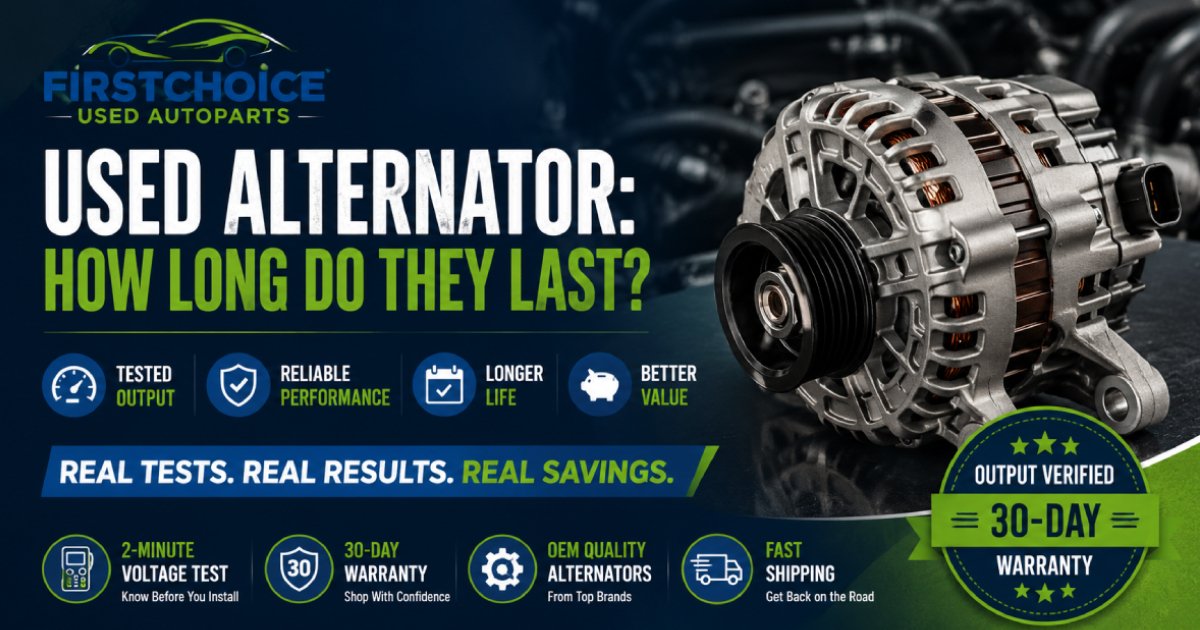
A used alternator from a donor vehicle with under 100,000 miles typically delivers another 80,000–120,000 miles of reliable service. That’s the honest answer — and the caveat is that alternator lifespan is more variable than most powertrain parts because it depends on how hard the alternator was worked: electrical load, operating temperature, and whether the original vehicle had any charging system issues that accelerated brush and bearing wear.
The good news is that alternator output is easy to test. A 2-minute test with a multimeter tells you definitively whether a used alternator is producing the correct voltage before you install it. A unit that tests good will last. One that doesn’t — you know before you put time into installing it.
Need a used alternator? FirstChoice carries Ford, Chevy, Dodge, Toyota, and Honda alternators — output verified, 30-day warranty.
Check Availability →What Determines a Used Alternator’s Remaining Life
An alternator has several internal wear components — each ages at a different rate:
| Component | Wear Rate | Failure Effect |
|---|---|---|
| Carbon brushes | High — contact wear against slip rings | Reduced or no output; most common alternator failure |
| Slip rings | Medium — worn by brushes over time | Rough surface causes brush wear acceleration |
| Front and rear bearings | Medium — heat and load dependent | Whining/growling noise; eventual lockup |
| Rectifier (diode pack) | Low — solid-state; fails from heat/overvoltage | AC ripple in DC output; electrical interference, battery drain |
| Voltage regulator | Low — solid-state; fails from heat | Overcharging (>15.5V) or undercharging (<13.5V) |
| Stator / rotor windings | Very low — fails from extreme heat or moisture | No output or intermittent output |
On a 70,000-mile alternator, brushes have consumed roughly 40–50% of their total wear life. Bearings are in early-middle life. The rectifier and regulator are essentially new. This is why a low-mileage used alternator has substantial remaining life — the components that wear fastest (brushes, bearings) still have significant material remaining.
The 2-Minute Test Before Any Used Alternator Installation
This test takes a multimeter and 2 minutes. It tells you with certainty whether the used alternator is producing correct output before you commit to installation.
- Start the vehicle with the alternator installed (or have a helper hold the alternator while you start the vehicle with the belt on and the output wire connected)
- Set your multimeter to DC voltage (20V range)
- Touch probes to the battery terminals — red to positive, black to negative
- Read the voltage at idle:
| Voltage Reading | Alternator Status |
|---|---|
| 13.8 – 14.7V at idle | Normal — alternator is charging correctly |
| 14.8 – 15.5V | Overcharging — voltage regulator fault; do not use |
| 13.0 – 13.7V | Borderline low — acceptable in some vehicles; retest under load |
| Below 13.0V | Undercharging — brush wear or rectifier failure; do not use |
| 12.6V (battery voltage only) | No charge output — alternator not functioning |
Load test: After checking idle voltage, turn on headlights, AC blower on max, and rear defroster. Voltage should stay above 13.5V under this full load. If it drops below 13.0V under load, the alternator’s output capacity is diminished — brushes or stator are worn.
Signs Your Current Alternator Is Failing
These symptoms point specifically to the alternator rather than the battery or starter:
- Battery warning light or ALT light on — the PCM detected charging voltage outside normal range
- Dimming headlights at idle that brighten when RPM increases — classic low-output alternator sign; output improves with RPM because the rotor spins faster
- Battery dies despite being recently charged or new — if a new battery dies, the alternator isn’t charging it
- Electrical accessories losing power — radio resets, AC fan slows, windows move sluggishly
- Whining or growling noise that changes with engine RPM — bearing failure; distinct from power steering whine (which changes with steering input)
- Burning smell near the alternator — overheated windings or diode pack; address immediately
Battery vs. alternator: Before replacing either, test both. A battery load test costs nothing at AutoZone or O’Reilly. If the battery fails the load test, replace the battery first — a weak battery can cause false alternator symptoms. If the battery tests good and voltage at the battery reads below 13.8V with the engine running, the alternator is the problem.
How to Extend a Used Alternator’s Life
The factors within your control that determine how long a replacement alternator lasts:
- Keep electrical load reasonable. Stock electrical systems are designed for the alternator’s rated output. Adding a large aftermarket amplifier, multiple USB charging adapters, or a light bar adds continuous load that accelerates brush wear. Size the alternator to your actual load — a higher-amperage used unit from a police package or tow package vehicle is a better choice if you run high loads.
- Maintain the serpentine belt and tensioner. A loose belt causes the alternator pulley to slip under load, generating heat and reducing charging efficiency. A worn tensioner creates the same problem. Replace belt and tensioner proactively at 80,000–100,000 miles.
- Check battery terminals for corrosion. High resistance at the battery terminals forces the alternator to work harder to push current through the connection. Clean terminals every two years.
- Don’t let the battery go deeply discharged repeatedly. Deep discharge cycles force the alternator to push maximum current for extended periods, generating heat that degrades the rectifier and stator insulation over time.
Used vs. Remanufactured Alternator
| Used OEM | Remanufactured | New OEM | |
|---|---|---|---|
| Cost | $45–$160 | $90–$220 (with core) | $250–$550 |
| What’s new inside | Nothing — original components | Brushes, bearings, rectifier, voltage regulator | Everything |
| Warranty | 30–90 days | 1–3 years | 2–5 years |
| Best for | Vehicle 10+ years old; budget repair; standard electrical load | High-electrical-load vehicle; want longer coverage | Newer vehicle or low availability of used units |
“My 2007 F-150’s alternator died at 148,000 miles — headlights dimming, battery light on. AutoZone confirmed bad alternator. Got a used replacement from FirstChoice — confirmed it tested at 14.2V before shipping. Installed it in 45 minutes. Two years later still charging perfectly. Paid $88 vs $320 for the reman at the parts store.”
Need a replacement alternator? FirstChoice tests output voltage before shipping — 30-day warranty, fast delivery.
Find Your Alternator →Frequently Asked Questions
How long does a used alternator last?
80,000–120,000 miles from a donor under 100,000 miles in normal use. Higher electrical loads (aftermarket audio, light bars, multiple charging devices) reduce lifespan. Test output voltage — 13.8–14.7V at idle — before and immediately after installation to confirm the unit is performing correctly.
Is a used alternator reliable?
Yes, when tested. A used alternator that produces correct voltage at idle and under load is reliable for everyday use. The voltage test takes 2 minutes with a multimeter and removes the guesswork entirely.
What are the signs of a failing alternator?
Battery warning light on, dimming headlights at idle (brighten when revving), new battery dying repeatedly, electrical accessories losing power, whining/growling noise that tracks with engine RPM, burning smell near the alternator. Test battery first — a failing battery causes similar symptoms.
Should I buy a used or remanufactured alternator?
Vehicle 10+ years old with standard electrical load: used is the cost-effective choice. High-electrical-load vehicle or want longer warranty: remanufactured. Under 5 years old: new OEM or remanufactured.
How much does a used alternator cost?
$45–$160 for standard 130–160A units (most trucks/SUVs). Higher-output 180–220A units: $80–$160. New OEM: $250–$550. Remanufactured with core exchange: $90–$220.