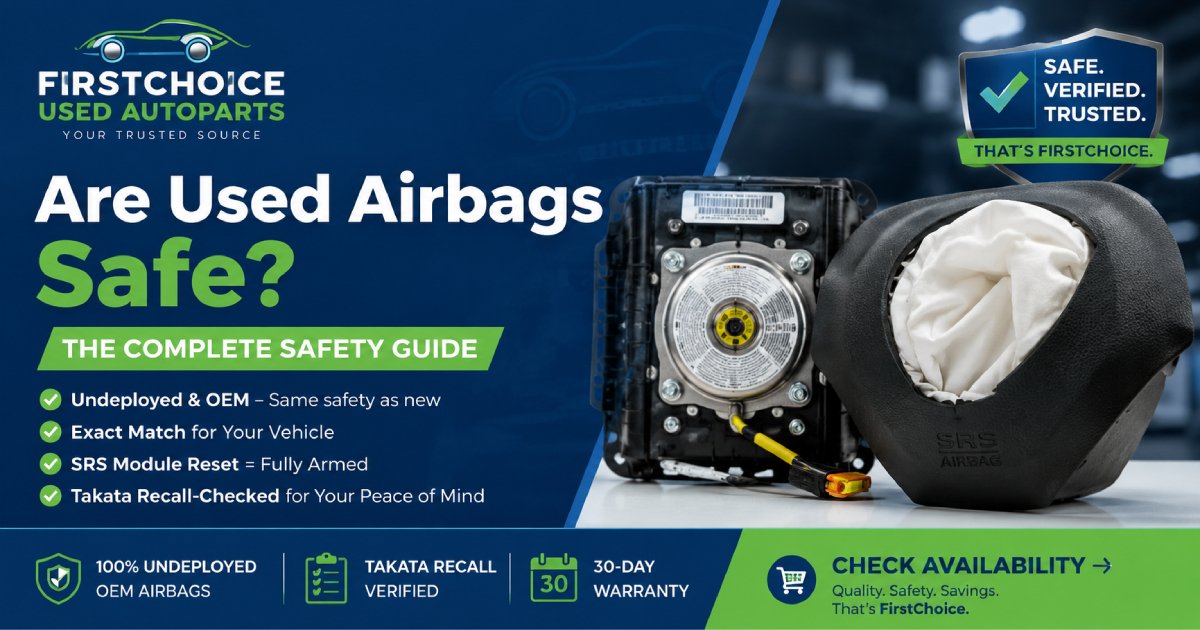
A used airbag that has never deployed, matches your vehicle’s exact SRS specifications, and is installed with the SRS module properly reset is safe. The airbag inflator is a sealed pyrotechnic device — if it hasn’t been fired, its chemistry is intact and its deployment reliability is the same as a new unit. The risks with used airbags are not mysterious — they are specific and preventable: don’t install a deployed airbag, don’t skip the SRS module reset, and don’t use a recalled Takata inflator from an affected donor vehicle.
This guide answers the safety question directly and specifically — what makes a used airbag safe or unsafe, what to verify before buying, what the law says, and when used is the right choice versus when you should buy new.
FirstChoice supplies undeployed, OEM airbags — driver, passenger, side curtain — with donor vehicle documentation. 30-day warranty.
Check Availability →The Short Answer: What Makes a Used Airbag Safe
A used airbag is safe when all four of these are true:
- It has never deployed — the inflator housing is intact, no burn marks, no expanded fabric, no chemical residue
- The part number matches your vehicle’s year/make/model/trim and airbag position exactly
- The SRS control module is reset or replaced after installation — a module in crash-lock state will not arm the new airbag
- The donor vehicle does not have a Takata recall affecting that airbag — check NHTSA.gov with the donor VIN
A used airbag is NOT safe when any of these apply:
- It has been deployed — the inflator fired and cannot be reused under any circumstances
- The part number doesn’t match your specific vehicle and position
- The SRS module is not addressed and remains in crash-lock state
- The donor vehicle is subject to a Takata airbag recall
- There are any signs of heat damage, moisture intrusion, or physical damage to the inflator
How an Airbag Inflator Works — And Why Undeployed Matters
An airbag inflator is a sealed canister containing a solid propellant — typically sodium azide or guanidine nitrate in modern units. When the SRS module detects a crash event above the deployment threshold (typically 8–14 mph for frontal bags), it sends an electrical signal to the inflator’s squib (a small igniter). The squib fires, igniting the propellant, which generates nitrogen gas that fills the airbag fabric in 20–30 milliseconds.
This is a one-time, irreversible chemical reaction. Once fired, the propellant is consumed and the inflator cannot be recharged or reused. A deployed airbag is inert and worthless as a safety device — full stop.
An undeployed airbag has the propellant fully intact. Age does affect propellant chemistry over long periods — inflators older than 10–15 years may have some degradation — which is why FirstChoice sources airbags from vehicles under 10 years old whenever possible.
The SRS Module: The Part Most People Forget
Replacing the airbag alone is not enough. The SRS (Supplemental Restraint System) module is the computer that monitors all airbag sensors, clock spring continuity, seat belt pretensioners, and deployment status. After any airbag deploys, the SRS module stores hard fault codes and enters a crash-lock state. In this state, the module will not arm any replacement airbags — even brand new ones.
You have two options after airbag replacement:
- SRS module reset — A shop with a capable scan tool (Autel, ALLDATA, or dealer-level equipment) clears the crash data and resets the module to its pre-crash state. Cost: $80–$150. Works when the module itself was not physically damaged in the crash.
- SRS module replacement — If the module was damaged or if reset fails, replace the module with a used unit from a non-crash vehicle. The replacement module may need VIN programming on some vehicles (Ford, GM 2015+). Cost: $100–$300 used + possible programming.
The airbag warning light tells you whether the module is cleared. After replacing the airbag and resetting the module, the airbag warning light should go out within the first ignition cycle. If it stays on, the module is still in fault state and the airbag is not armed. Do not drive with an active airbag warning light.
The Takata Recall — What You Must Check
Between 2014 and 2020, the Takata Corporation airbag inflator recall affected approximately 42 million vehicles in the United States. Defective Takata inflators used ammonium nitrate as a propellant stabilizer — this degrades with moisture and heat cycling, and can cause the inflator to rupture violently during deployment, shooting metal fragments into the vehicle.
This recall affects vehicles from multiple manufacturers across many model years. The specific inflators subject to recall are primarily in the driver and passenger positions.
Before buying any used airbag, check the donor vehicle’s VIN at NHTSA.gov/vehicle/recalls. If the donor vehicle has an open Takata recall, do not use that vehicle’s airbags. Ask your supplier to confirm the donor VIN is recall-clear.
Vehicles most heavily affected by Takata include: Honda Civic/Accord (2001–2015), Honda CR-V, Toyota Corolla/Camry/RAV4 (certain years), BMW 3-Series, Chrysler/Dodge/Ram (certain years), Ford Ranger and Fusion. Check the specific VIN — not all vehicles of an affected make/model year have the faulty inflator.
Is It Legal to Install a Used Airbag?
Yes. Installing a used OEM airbag in a privately owned vehicle is legal in the United States. Federal regulation 49 CFR Part 595 governs airbag replacement and restricts what dealers and repair shops can do — specifically prohibiting the installation of non-functional or non-OEM devices. It does not prohibit the use of genuine, undeployed salvage airbags.
What is illegal:
- Installing a deployed airbag
- Installing a counterfeit airbag or a non-OEM device in place of an airbag
- Disabling or removing airbags from a vehicle that will be sold to another person without disclosure
- A repair shop charging for airbag replacement but installing deployed or counterfeit units (federal fraud)
A legitimate salvage airbag from a non-crashed, non-recalled donor vehicle, installed with an SRS module reset, is fully legal and meets the same safety standards as an OEM replacement.
New vs. Used Airbag: When Each Makes Sense
| Used OEM Airbag | New OEM Airbag | |
|---|---|---|
| Cost | $80–$300 per position | $400–$1,200 per position |
| Safety | Equal — if undeployed, matched, SRS reset | Equal |
| Takata risk | Must verify donor VIN — avoidable | None if buying from dealer OEM |
| Best for | Older vehicles (8–15 years), high repair cost relative to value | Newer vehicles (under 5 years), lease/warranty situations |
| Availability | Excellent for common makes (Ford, Chevy, Dodge, Toyota) | Available but often on backorder for collision-heavy models |
| ROI | Saves $300–$1,000 per airbag position | Full price; negligible additional safety benefit for older vehicles |
Airbag Positions — Matching the Exact Part
Modern vehicles have 6–10 airbags in different positions, each with a different inflator size, bag shape, and SRS connector. Ordering the wrong position results in a bag that physically won’t fit the mounting location or won’t connect to the SRS harness.
| Position | Location | Typical Used Cost | Programming? |
|---|---|---|---|
| Driver airbag | Steering wheel center | $80–$180 | No — plug-in; SRS module reset required |
| Passenger airbag | Dashboard, above glove box | $100–$250 | No — plug-in; SRS module reset required |
| Side curtain (SAB) | Roof rail, driver/passenger side | $120–$300 per side | No — plug-in; SRS reset required |
| Seat-mounted side airbag | Outer bolster of front seat | $80–$200 | No — part of seat assembly; SRS reset required |
| Knee airbag | Below steering column or lower dash | $100–$220 | No — SRS reset required |
| Rear curtain airbag | Rear roof rail | $100–$250 per side | No — SRS reset required |
5 Verification Steps Before Buying a Used Airbag
- Confirm the airbag has never deployed. Ask the supplier: “Is this airbag undeployed? Was it from a vehicle that did not have a frontal or side collision at the airbag’s position?” Visually confirm no burn marks, scorch residue, or expanded fabric.
- Match the part number exactly. Provide your vehicle’s year, make, model, trim level, and airbag position. Cross-reference the supplier’s part number with your vehicle’s SRS wiring diagram if available.
- Verify the donor VIN is recall-clear. Ask the supplier for the donor vehicle’s VIN and check it at NHTSA.gov/vehicle/recalls before purchasing. Any open Takata recall = do not use that airbag.
- Confirm the donor vehicle’s condition. The airbag should come from a vehicle that was not in the type of collision that would have deployed that specific bag. A side airbag from a vehicle with front damage is fine; a driver airbag from a vehicle with a frontal collision is not.
- Plan the SRS module reset before the airbag arrives. Identify a shop in your area with SRS reset capability, or confirm your own scan tool supports SRS resets for your vehicle. Have this lined up before install day.
“I needed a driver airbag for my 2014 F-150 after a minor collision — only the driver bag deployed. Dealer quoted $680 just for the airbag. FirstChoice supplied an undeployed unit from a verified donor, confirmed the Takata recall check was clear, and it was $145. My shop reset the SRS module for $95. Total: $240 vs. $680+ at the dealer. Airbag light cleared, system works perfectly.”
Need a used airbag? FirstChoice verifies donor vehicle condition, Takata recall status, and provides part documentation. 30-day warranty.
Get a Free Quote →Frequently Asked Questions
Are used airbags safe?
Yes — when they are undeployed, part-number matched to your vehicle, installed with the SRS module reset, and sourced from a non-Takata-recalled donor vehicle. A properly selected used airbag has the same deployment reliability as a new OEM unit.
Can a used airbag fail to deploy in an accident?
Failure to deploy is almost always a system problem — faulty SRS module, broken clock spring, damaged impact sensor wiring — not a defect in the airbag itself. This is why resetting the SRS module after replacement is non-negotiable.
What should I check before buying a used airbag?
Confirm it has never deployed (no burn marks, intact inflator housing), exact part number match to your vehicle and position, donor VIN is Takata recall-clear at NHTSA.gov, and you have an SRS module reset planned before installation.
Does a used airbag require the SRS module to be reset?
Yes. The SRS module enters crash-lock state after any deployment and will not arm replacement airbags until reset. SRS reset costs $80–$150 at a shop with capable scan tools. Without it, the airbag warning light stays on and the bag will not deploy.
Is it legal to install a used airbag?
Yes. Using a genuine, undeployed OEM salvage airbag is legal under federal regulations. What is illegal: deployed airbags, counterfeit units, or removing airbags from vehicles being sold without disclosure.
How much does a used airbag cost vs. a new one?
Used: $80–$300 per position. New OEM: $400–$1,200 per position. A full replacement (driver + passenger + curtains) can save $1,500–$3,000 using quality used airbags versus all-new OEM parts.
What airbags cannot be used as used parts?
Never use: deployed airbags (fired inflator cannot be reused), Takata-recalled inflators (rupture risk), airbags with a mismatched part number, or airbags showing heat, moisture, or physical damage to the inflator housing.